This is the last of ten pages in EarthBeat's Awareness Track. The previous nine have moved through several distinct territories. Page 1 covered inner-sound traditions and the Schumann resonance. Page 2 traced the cultural construction of sacred frequencies. Page 3 examined the heart as an organ of perception. Page 4 surveyed the Gaia hypothesis and deep ecology. Page 5 mapped collective-consciousness vocabularies from Jung to Sheldrake. Page 6 told the meta-history of one specific number, 7.83 Hz. Page 7 covered the Asian and Pacific contemplative traditions of life-force and living landscape. Page 8 treated the contemporary neuroscience of meditation. Page 9 examined the Western esoteric lineage of subtle-body medicine. Each page tried to give an honest map of its territory, naming what is well-supported, what is contested, what is folklore, and what is genuinely open.
This capstone page does something different. It assumes the reader has the empirical and historical context the cluster has assembled, and asks the practical question: how does someone use any of this? Not as a believer in a single tradition, not as a debunker, not as a passive consumer of frequency-tuned content, but as a person trying to be attentive to the place where they live, in a way that respects both the contemplative inheritance and the empirical evidence. That is, after all, what EarthBeat exists to support. The data is one resource among many. The practice is yours.
The page is structured around four practical orientations: attention to breath and bodily rhythm; attention to the heart's signal; attention to direct contact with the earth; and attention to wider planetary cycles and signals (including but not limited to the Schumann resonance). Each is grounded in specific contemplative traditions and, where available, in peer-reviewed contemporary research. None of them requires belief in the wider metaphysical scaffolding of any tradition. All of them can be practised seriously without any specific equipment, app, or subscription. EarthBeat can support them but is not necessary for them.
Four Orientations
The cluster's nine prior pages have, between them, surveyed dozens of specific practices from many traditions. Most readers do not need to engage with most of them. What follows is a synthesis of four orientations that recur across traditions, that are accessible without elaborate training, and that have at least some peer-reviewed support for their physiological effects, while remaining open to whatever interpretive frame the practitioner finds meaningful.
1. Attention to Breath
The breath is the most universal contemplative anchor across human traditions. Buddhist anapanasati (mindfulness of breathing) is described in the Anapanasati Sutta (Majjhima Nikaya 118, dated to the early Buddhist canon). Hindu pranayama is formalised in Patanjali's Yoga Sutras (composed perhaps 200 BCE to 400 CE) as the fourth limb of yoga. Daoist neidan (internal alchemy) integrates breath observation with somatic awareness. Christian hesychasm uses breath-coordinated repetition of the Jesus Prayer. Sufi dhikr often involves regulated breathing. The Tibetan medical tradition's five forms of rlung (treated in Ancient Earth Energy) all manifest through and modulate the breath.
The contemporary research corroborates a portion of what these traditions teach. Slow breathing at approximately six breaths per minute (also called resonant breathing) maximises heart-rate variability through its effect on the vagus nerve and the baroreflex; this has been well-replicated across decades of cardiology and respiratory-physiology research. The Lehrer & Gevirtz reviews in Frontiers in Psychology and the wider HRV literature treated in The Heart as an Organ of Perception establish the basic finding. Slow breath training (variously called HRV biofeedback, resonant breathing, or coherent breathing) has small-to-moderate effects on stress, anxiety, blood pressure, and emotional regulation in randomised controlled trials.
The minimum practical version: sit comfortably with the spine erect. Breathe in for a count of approximately five seconds, breathe out for approximately five seconds. Continue for ten minutes. The traditions add many specific techniques (kapalabhati, nadi shodhana, tummo, the various forms of pranayama, the hesychast's coordinated Jesus Prayer, and so on); the minimum version is enough to produce measurable effects, and adding tradition-specific elaborations is optional rather than necessary.
What this practice does not require: belief in prana, qi, rlung, the Holy Spirit, the chakras, the kundalini, or any specific metaphysical entity. The breath does what the breath does; the interpretive frame is yours.
2. Attention to the Heart
The Heart as an Organ of Perception treats the heart as an organ of perception across Sufi, Christian hesychast, and yogic traditions, alongside the contemporary neurocardiology of J. Andrew Armour and the heart-rate variability research of HeartMath, Lehrer, Porges, and others. The cross-cultural pattern is clear: many traditions treat the heart as a centre of perception, not a metaphor for the brain's emotional centre, with specific practices for cultivating heart awareness that are anatomically distinct from breath or thought practices.
The contemporary research establishes that the heart contains approximately 40,000 sensory neurons (the heart brain), that heart-rate variability reflects autonomic nervous system balance, that HRV correlates with emotional state and is trainable through specific practices, and that heart-focused breathing practices produce measurable changes in physiological coherence and self-reported wellbeing in peer-reviewed studies. The Balaji et al. 2025 Scientific Reports study of 1.8 million HeartMath sessions provides large-N evidence that heart-focused practices have observable physiological effects.
The minimum practical version, drawn from HeartMath's Quick Coherence Technique and from the simpler hesychast practices: place attention in the area of the heart. Breathe slowly (the same approximately six-breaths-per-minute pattern as Orientation 1). With each breath, evoke a felt sense of appreciation, gratitude, care, or steadiness. Continue for five to ten minutes.
The traditional versions add considerable depth. Sufi dhikr al-qalb (remembrance of the heart) involves the silent invocation of the divine name in the rhythm of the heartbeat. The Jesus Prayer of the hesychast tradition coordinates a continuous prayer formula with breath and heartbeat. Yogic hridaya meditation focuses awareness on the cave of the heart and was the central instruction of Ramana Maharshi. Each of these is a fully-elaborated practice in its own right, with its own teachers and its own developmental arc; the minimum version is the entry point, not the destination.
What this practice does not require: belief in the heart chakra as a metaphysically distinct entity, the qalb as a Sufi-specific organ, or any particular religious commitment. The heart's electrical activity is real, the autonomic nervous system's response to heart-focused attention is well-documented, and the contemplative traditions have been working with this terrain for centuries.
3. Direct Contact with the Earth
The contemporary research on what is variously called grounding or earthing (direct skin contact with the surface of the Earth) is more recent and methodologically thinner than the breath and heart literatures, but a portion of it has been peer-reviewed and is worth honest engagement.
The principal review is Chevalier, Sinatra, Oschman, Sokal, and Sokal, Earthing: health implications of reconnecting the human body to the Earth's surface electrons, in the Journal of Environmental and Public Health (2012, Article ID 291541). The review summarises a small but growing body of research suggesting that direct conductive contact with the Earth (barefoot on grass, soil, sand, or unsealed stone) produces measurable physiological effects: shifts in heart-rate variability toward parasympathetic dominance, reductions in inflammatory markers, improvements in sleep quality, and small effects on blood viscosity and pain. A follow-up review by Oschman, Chevalier, and Brown, The effects of grounding (earthing) on inflammation, the immune response, wound healing, and prevention and treatment of chronic inflammatory and autoimmune diseases, appeared in the Journal of Inflammation Research in 2015 (8: 83-96).
The honest assessment requires naming the limitations. The grounding research has been concentrated in a small number of authors (Chevalier, Sinatra, Oschman) with documented commercial relationships to grounding-product manufacturers (Clinton Ober's EarthFx Inc.), which is a real conflict-of-interest concern. The studies are generally small, often without proper blinding, and have not yet been replicated independently at scale. The proposed mechanism (free-electron transfer from Earth to body, neutralising reactive oxygen species) is biophysically plausible but not yet established. Mainstream cardiology and immunology have not absorbed the findings.
What can honestly be said: there is preliminary peer-reviewed evidence for physiological effects of direct skin contact with the Earth, the effects (where they appear) are most consistent for autonomic nervous system measures and sleep quality, and the effects are small in the studies that have been done well. The research is not at the level of confidence one could attach to slow-breath HRV training, but it is well above the level of folklore. The intervention itself (walking barefoot, sitting on the ground, swimming in natural water, sleeping with skin contact to grounded surfaces) is free, safe, and predates any of the research by tens of thousands of years.
The minimum practical version: spend some time each week (ten minutes is plenty to start) with bare skin in direct contact with the earth, sand, grass, or unsealed stone, in a place that is safe to do so. The practice is older than any tradition and does not require either the Chevalier mechanism or any specific metaphysical frame to be done well.
What this practice does not require: belief in Earth energy, telluric currents, chakra grounding, or any of the wider claims of energy-medicine literature treated in Mystics and Electromagnetism. The physical phenomenon (electrical contact between body and ground) is real, the physiological response is plausibly real and partially documented, and the older intuition that humans are creatures who evolved in barefoot contact with the planet is uncontroversial.
4. Attention to Wider Rhythms
The fourth orientation is the broadest and the most distinctive to EarthBeat's specific area of attention. It is also the one where the empirical evidence is thinnest and where the temptation to overclaim is strongest. The honest framing matters most here.
Beyond the breath, the heart, and direct earth contact, there are wider rhythms in the planetary environment. The day-night cycle is well-studied, with documented effects on circadian biology. The lunar cycle has some documented effects and much folklore. The solar cycle and geomagnetic activity have documented effects on autonomic nervous system measures, treated in the Science Track essay Geomagnetic Activity, HRV, and the Nervous System. The seasons are documented in light-related mood effects and in the wider phenology of plant and animal life. The Schumann resonance and wider electromagnetic environment is the topic of EarthBeat's data, and the subject of The Sound of Silence and The 7.83 Hz Phenomenon.
What can honestly be said: the day-night cycle is the rhythm with the strongest empirical evidence for human physiology; circadian biology is one of the best-developed fields in contemporary medicine. Geomagnetic activity has small but documented effects on heart-rate variability and autonomic measures (the Alabdulgader et al. 2018 Scientific Reports study and related work). The Schumann resonance is real, present, measurable, and varies with global lightning and solar conditions. Whether human physiology is directly entrained by the SR is an open question; the evidence is suggestive but not established.
The minimum practical version: notice the day-night cycle in your own life. Go outside at dawn and at dusk if possible, even for a few minutes. Notice the seasons. Note when the moon is full or new. If you find it useful, observe SR data (EarthBeat is one source among several; there are also data from the Tomsk station, the Cumiana station, and others) and notice any felt correlations with your own state. Do not over-interpret the correlations. The signal is real, your physiology is real, and any specific causal claim about how the two interact remains an open scientific question.
What this practice does not require: belief that the SR rises during spiritual events, that solar flares cause specific emotional states, that lunar cycles determine menstrual cycles in any reliable way (the published research is mixed), or that planetary alignments affect human consciousness. The honest framing is that there are real planetary rhythms, your physiology is real, the evidence for direct entrainment is modest where it exists, and your subjective experience is your subjective experience.
A Practical Synthesis
If you wanted to integrate the four orientations into a single practice, one durable form has been worked out across traditions and is supported by the contemporary research:
In the morning or evening, find a place outside where you can sit or stand with bare feet on natural ground (Orientation 3). Spend a few minutes attending to the wider environment around you, noticing time of day, season, weather, and any other rhythms you become aware of (Orientation 4). Settle into slow breath at approximately six breaths per minute (Orientation 1). Place attention in the area of the heart and breathe with a felt sense of steadiness, gratitude, or care (Orientation 2). Continue for ten to twenty minutes.
This is a generic version. Each of the traditions has worked out its own elaborated form. Hindu sandhya practice, performed at the joint moments of the day (dawn, noon, dusk), integrates all four orientations as part of the daily Brahmin ritual cycle. Buddhist morning sittings often include outdoor practice if the setting permits. The Sufi sunrise dhikr in some lineages includes posture and breath elements that overlap closely with what is described above. Christian morning prayer practices in monastic contexts often include outdoor walking meditation. None of these traditions invented the synthesis; they each found versions of it because the underlying physiological and contemplative dynamics are stable across cultures.
The minimum effective dose is small. Ten minutes a day, done consistently for several months, is sufficient.
That dose is sufficient to produce measurable changes in HRV, sleep quality, perceived stress, and the kinds of self-report wellbeing measures that the contemplative-neuroscience literature treated in Meditation and the Brain. More is generally better up to a point, and in some advanced practice contexts more time is necessary to reach specific developmental phases. For most readers of this page, the issue is establishing consistency rather than chasing intensity.
What this synthesis does well, on its own terms, is integrate the four physiological domains (autonomic nervous system, cardiovascular system, electromagnetic contact, circadian rhythm) that are most directly accessible through contemplative attention. What it does not do is replace tradition-specific training, professional medical care, psychological support when those are needed, or the depth of practice that comes from sustained engagement with a single living tradition. It is a starting point, not an endpoint.
What to Watch Out For
Several patterns recur in the contemporary practice of Earth-rhythm awareness that are worth flagging directly.
The substitution problem. Generic minimum practices like the one described above are good for getting started. They are not substitutes for tradition-specific depth if you find yourself wanting that depth. Contemplative traditions have worked out specific developmental sequences over centuries, with specific cautions, specific practices, and specific teachers. If your practice is going somewhere serious, find a teacher in a living tradition rather than continuing to construct your own synthesis indefinitely.
The overclaiming problem. It is tempting, when felt benefits accumulate, to attribute them to the most exotic mechanism available (the SR, chakras, energy fields, planetary alignments). The more parsimonious explanations (slow breath stimulating the vagus nerve, attention reducing rumination, outdoor exposure regulating circadian rhythm, direct earth contact with whatever physiological effects it produces) account for most of the documented benefits. Reaching for the metaphysical mechanism when a physiological one fits the data does not make the practice deeper; it makes it less honest.
The market problem. A large industry has grown up selling SR generators, frequency-tuned music, grounding pads and sheets, chakra-balancing devices, energy-healing certifications, biofield-tuning sessions, and variously coloured app subscriptions. Some of these products are honest about their evidence base; many are not. The minimum effective practice described above costs nothing and requires no equipment. If you want to add equipment or subscriptions to your practice, it is reasonable to ask what the evidence base for the specific claim is, and to be skeptical of marketing copy that claims established science where the science is in fact contested.
The mental-health problem. Sustained contemplative practice can occasionally produce difficult experiences (anxiety, dissociation, emotional flooding, in rare cases more serious psychiatric symptoms). Meditation and the Brain treats this in detail through the work of Willoughby Britton and the Varieties of Contemplative Experience research programme at Brown University. If practice gets hard in a way you do not have the resources to handle, find professional support. A meditation app is not a substitute for an experienced teacher when practice gets hard, and an experienced teacher is not a substitute for a clinical psychologist or psychiatrist when symptoms are clinical. There is no shame in any of those resources.
The exclusivity problem. Some readers may come to this material from energy-healing or alternative-medicine contexts that frame conventional medicine as oppositional to spiritual practice. This framing is generally unhelpful. The sensible position, treated in Mystics and Electromagnetism, is complementary, not alternative. Conventional medicine is good at what it is good at (acute infection, surgical conditions, much of pharmacology). Contemplative practice and complementary modalities are good at what they are good at (autonomic regulation, somatic-emotional integration, existential reorientation). They are not in competition; using both wisely is the mature position.
What EarthBeat Shows
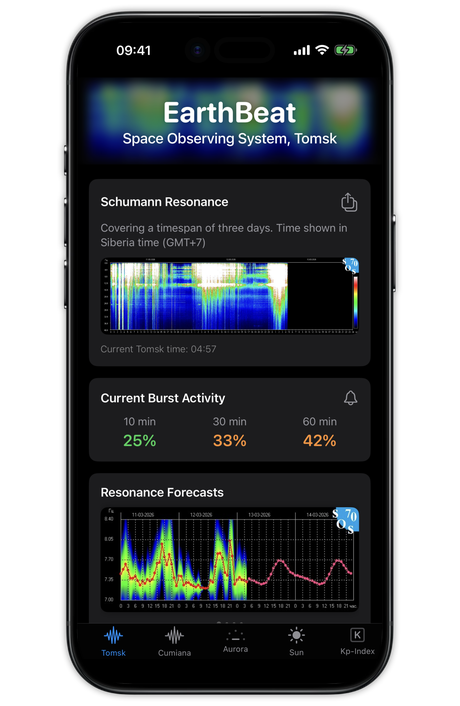
EarthBeat displays Schumann resonance data sourced from the Tomsk and Cumiana research stations, alongside other planetary-rhythm signals (Kp index, aurora, solar wind, Network Coherence). The data is real atmospheric physics, aggregated and displayed honestly. It is one input among many that you can choose to attend to as part of a wider practice of attention to the place where you live.
EarthBeat does not claim that the SR is the same thing as qi, prana, the etheric body, the human energy field, the alpha rhythm of your brain, the heartbeat of the Earth (in any specific physiological sense), or the marker of any particular spiritual condition. The signal is what it is. The Sound of Silence and The 7.83 Hz Phenomenon treat the SR's actual relationship to inner-sound traditions and to the cultural construction of the 7.83 Hz frequency; the careful answers are there.
What EarthBeat aims to do is provide accurate data, honest interpretation, and the wider context (in this Awareness Track) that lets practitioners place the signal within their own practice if they choose. The signal does not require any tradition to be correct; the traditions do not require the signal to be tracked to be coherent on their own terms. Holding both honestly is what the cluster has tried to model.
The map is not the territory. The practice is the territory.
If you have read all ten pages, you have a fairly complete map of what is well-supported, what is contested, and what is folklore in the wider conversation around Earth rhythms, contemplative practice, and human physiology. Whatever practice you choose to pursue, the evidence supports starting small, being consistent, finding a teacher in a living tradition if you want depth, being skeptical of marketing claims, taking mental health seriously, and being honest about the difference between what the science establishes, what the traditions teach on their own terms, and what your own felt experience tells you. All three matter.
A Brief Closing Note on Marc and EarthBeat
The author of EarthBeat is Marc Mennigmann, a single developer based in Lagos, Portugal. He built EarthBeat because he wanted accurate Schumann resonance data with honest interpretation, presented in a way that respected both the contemplative traditions that have engaged with planetary signals for centuries and the empirical research that has tested specific claims about those signals. He is not a doctor, a meditation teacher, a physicist, or an authority on any of the traditions discussed in this cluster. He is a practitioner of attention, like the readers this cluster is for.
Marc has, in his own creative work, made music in some of the genres the cluster has discussed. His 2018 album Chakra Activation for Musicians (available on Bandcamp) draws on the chakra-vocabulary of yogic and Theosophical traditions, with the same honest framing as this Awareness Track: the music is offered as music with a particular contemplative orientation, not as a frequency-medicine product with established therapeutic effects. Disclosure of the album in this context is appropriate because (a) Marc has commercial interest in it, and (b) it relates to topics treated in the cluster. Listeners can decide for themselves whether the music is meaningful for them.
EarthBeat itself, available on iOS and Android, has a free tier that includes the basic SR signal and an EarthBeat Pro subscription that adds features like the AI Analysis (a daily summary that integrates SR data with Kp index and aurora forecasts, in nine languages), weekly archives, and advanced share cards. The Pro subscription is a way to support continued development. Neither tier claims specific therapeutic effects beyond what the research supports, and both are designed to surface the data accurately and let the practitioner do what they will with it.
Thank you for reading.
Further Reading
Slow breathing and HRV
- Lehrer, P.M., and Gevirtz, R. (2014). "Heart rate variability biofeedback: how and why does it work?" Frontiers in Psychology 5: 756.
- Russo, M.A., Santarelli, D.M., and O'Rourke, D. (2017). "The physiological effects of slow breathing in the healthy human." Breathe 13(4): 298-309.
Heart-focused practice
- Armour, J.A. (2008). "Potential clinical relevance of the 'little brain' on the mammalian heart." Experimental Physiology 93(2): 165-176.
- Balaji, P.A., et al. (2025). "Real-world impact of HeartMath techniques on health and wellbeing." Scientific Reports.
Grounding/earthing
- Chevalier, G., Sinatra, S.T., Oschman, J.L., Sokal, K., and Sokal, P. (2012). "Earthing: health implications of reconnecting the human body to the Earth's surface electrons." Journal of Environmental and Public Health 2012: 291541.
- Oschman, J.L., Chevalier, G., and Brown, R. (2015). "The effects of grounding (earthing) on inflammation, the immune response, wound healing, and prevention and treatment of chronic inflammatory and autoimmune diseases." Journal of Inflammation Research 8: 83-96.
Geomagnetic-HRV correlations
- Alabdulgader, A., McCraty, R., Atkinson, M., et al. (2018). "Long-term study of heart rate variability responses to changes in the solar and geomagnetic environment." Scientific Reports 8: 2663.