Almost every traditional culture has some version of it. The Greeks called the Earth Gaia, the primordial mother. The Romans called her Tellus or Terra Mater. Indigenous Australian peoples speak of Country as a living relative. The Lakota say mitakuye oyasin, all my relations. Indian traditions personify the Earth as Bhumi or Prithvi. Andean traditions know her as Pachamama.
For most of the modern period, in mainstream Western science and philosophy, this view was treated as poetry at best and superstition at worst. The Earth was a planet, a substrate, the inert background against which life played out. In the second half of the 20th century, the picture began to shift. Not back to the old animism, but toward something the old animism had recognised: that the planet and its life are coupled in ways that make the dead-rock model inadequate.
This page traces several threads of that shift. The Gaia hypothesis of James Lovelock and Lynn Margulis, beginning in 1972. The deep ecology of Arne Naess, beginning in 1973. The "Work That Reconnects" of Joanna Macy. The botanist-poet voice of Robin Wall Kimmerer. And the much older indigenous cosmologies that several of these contemporary figures have explicitly drawn from. The threads do not collapse into a single view. They share a recognition that the Earth is, in some honest sense of the word, alive, and that this changes how we live with it.
The Gaia Hypothesis: Lovelock, Margulis, and a Self-Regulating Earth
In 1965, the chemist James Lovelock (1919-2022) was working as a consultant for NASA, helping to design instruments that would search for life on Mars. The question that occupied him was: how would you tell if a planet had life on it, just from looking at its atmosphere from a distance? Lovelock's insight was that a living planet should have an atmosphere far from chemical equilibrium. Earth's atmosphere is full of reactive gases like oxygen and methane that would react and disappear if life were not constantly replenishing them. Mars's atmosphere is at equilibrium. The chemistry alone gives the answer.
This led Lovelock to a larger question. If life maintains the atmosphere, in what sense does life shape the planet? He began to develop the idea that life on Earth, taken as a whole, is involved in regulating the planet's surface conditions, keeping temperature, salinity, and atmospheric composition within ranges suitable for life. He named the hypothesis after Gaia, the primordial Earth-deity of Greek mythology, on the suggestion of his Wiltshire neighbour, the novelist William Golding.
The first formal statement of the hypothesis appeared in a 1972 letter Lovelock wrote to Atmospheric Environment. In 1971 he had been put in touch with the American biologist Lynn Margulis (1938-2011), then at Boston University and already known for her revolutionary endosymbiosis theory of the eukaryotic cell. They began to correspond. Their first co-authored papers appeared in 1974 in Tellus and Origins of Life, and the collaboration continued in nearly 300 letters over the next 35 years (collected and published in 2022 as Writing Gaia, edited by Bruce Clarke and Sébastien Dutreuil).
Margulis brought to the partnership what Lovelock did not have: a deep grounding in microbial biology. The early Earth, in her view, was made habitable by microbes, which created the oxygenated atmosphere through cyanobacterial photosynthesis around two billion years ago and continue to cycle the elements that sustain life. Lovelock brought atmospheric chemistry, planetary perspective, and a knack for synthesis. Their partnership produced a hypothesis that proved durable enough to outlast its early critics.
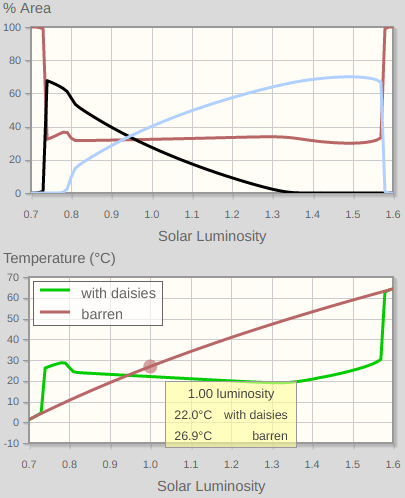
The early critics were vigorous. W. Ford Doolittle (1981) and Richard Dawkins (in The Extended Phenotype, 1982) argued that the Gaia hypothesis was unscientific because it implied a kind of planetary altruism inconsistent with natural selection: organisms cannot evolve traits that benefit the planet without benefiting themselves. Lovelock responded with a 1983 model called Daisyworld, a simple mathematical simulation showing how planetary temperature regulation could emerge from the differential growth of black and white daisies competing for sunlight, with no foresight or group selection required. Daisyworld was widely cited and shifted the debate.
By the 1980s and 1990s, parts of the Gaia hypothesis had been absorbed into the mainstream of Earth System Science. The 1985 symposium Is the Earth a Living Organism? at the University of Massachusetts Amherst, sponsored by the National Audubon Society, signalled the first wide scientific reception. The 1988 American Geophysical Union meeting in San Diego, organised by climatologist Stephen Schneider, brought Gaia into peer-reviewed climate science. The geomorphologist James Kirchner offered the most influential critique, distinguishing weak and strong forms of Gaia: weak forms (life affects the environment, environment affects life) are trivially true; strong forms (Earth as a single self-regulating super-organism) are difficult to test. Most scientists working in Earth System Science today accept some version of Gaia as a useful framework while remaining cautious about its strongest formulations.
What Gaia did, more than anything, was reframe the question. Earth is not the inert background against which life plays out. Life and the planet co-evolve, and the boundary between biology and geochemistry is not where the textbooks had drawn it. Margulis went further than Lovelock in her later writings, defining Gaia simply as "the series of interacting ecosystems that compose a single huge ecosystem at the Earth's surface". For Lovelock in his final decades, Gaia was a research programme; for Margulis, it was an instance of the larger principle of symbiosis that ran through her whole biology.
Lovelock died in July 2022, on his 103rd birthday. Margulis died in November 2011. Their hypothesis is now part of the working vocabulary of Earth System Science and the conceptual foundation of a great deal of contemporary ecological thought.
Deep Ecology: Arne Naess and the "Shallow and the Deep"
In 1972, the same year Lovelock published his first letter on Gaia, the Norwegian philosopher Arne Naess (1912-2009) gave a lecture in Bucharest that he would summarise the following year in a brief, dense article in the journal Inquiry. The article was called The Shallow and the Deep, Long-Range Ecology Movement: A Summary. It was six pages long. It introduced a distinction that has organised environmental philosophy ever since.
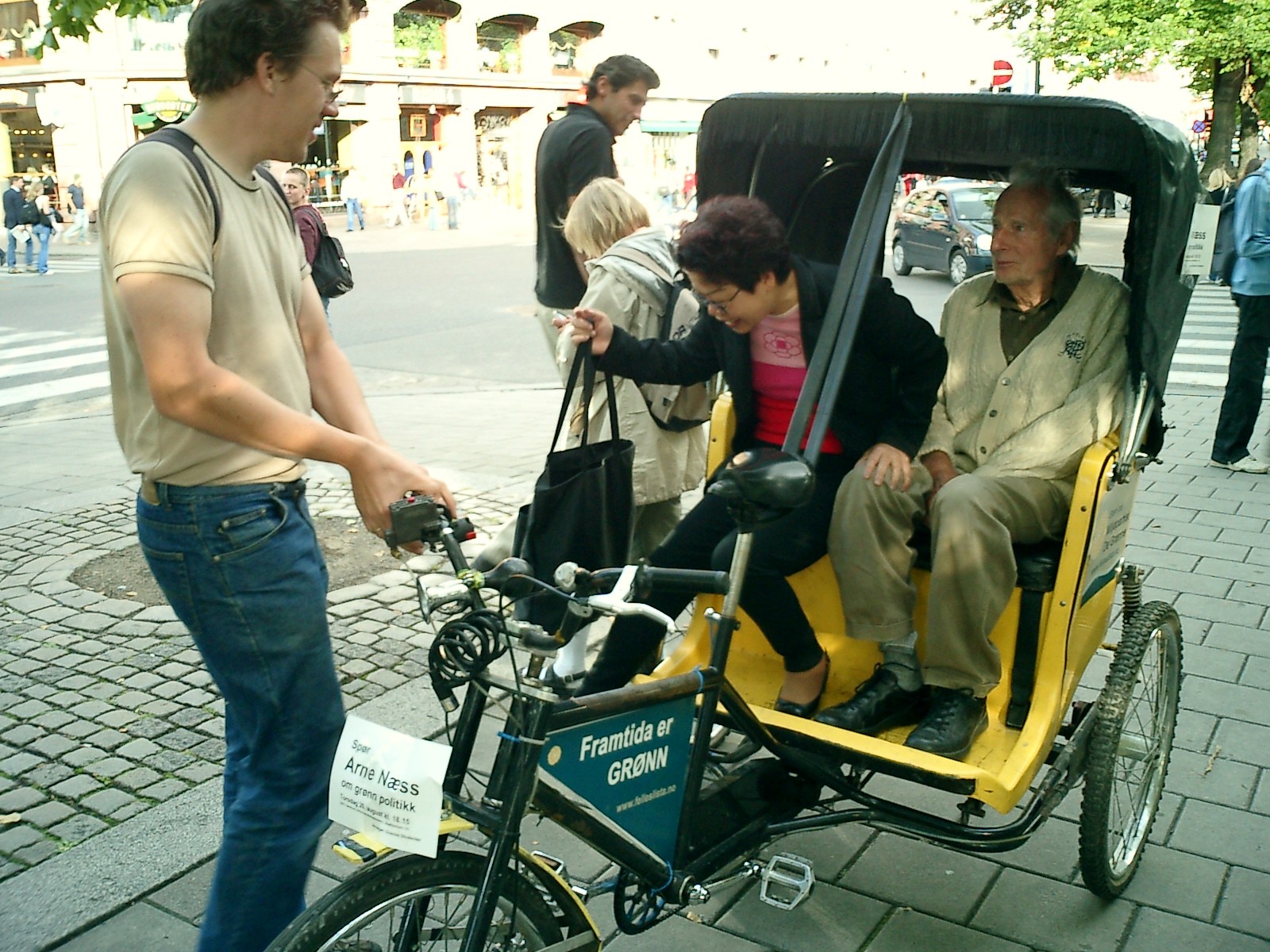
Naess was not a marginal figure. He was Norway's youngest professor (appointed at 27, in 1939, to the chair of philosophy at the University of Oslo), a leading philosopher of science, founder of the journal Inquiry, and a member of the Norwegian wartime resistance against the Nazi occupation. In 1969 he resigned his university chair to focus on environmental philosophy, and in 1972 articulated what he called "deep" ecology in distinction from "shallow" ecology.
Shallow ecology, in Naess's analysis, is the dominant Western environmentalist position: nature is valuable insofar as it serves human interests. Shallow ecology fights pollution and resource depletion, but does so as an extension of human-centred thinking. Its core motivation is the health and prosperity of people, particularly people in developed countries. It is anthropocentric in its foundation.
Deep ecology, by contrast, takes the position that all living beings have intrinsic value, regardless of their utility to humans. Naess called this biospherical egalitarianism in principle, with the qualifier "in principle" acknowledging that practical living involves trade-offs, but the philosophical starting point is that no single species has more right to flourish than any other. Deep ecology asks deeper questions: why should the human be the measure of value? What if our sense of self could expand to include the larger ecological community of which we are part?
This last move is what Naess called self-realisation. The narrow self of the ego, separate from nature, gives way to what he called the ecological Self (capitalised), in which one's identification expands to include other living beings, ecosystems, and ultimately the biosphere. The ecological self does not protect nature out of duty; it protects what is part of itself. Naess developed this further in his personal philosophy, which he called Ecosophy T (T for Tvergastein, his mountain hut in the Norwegian highlands where much of his thinking was done). He emphasised that Ecosophy T was his own, and that other people working in the deep ecology movement should develop their own ecosophies.
Naess co-authored, with the American philosopher George Sessions, a set of eight principles that came to be called the Deep Ecology Platform, intended not as a rigid manifesto but as a starting point for articulating one's own deep ecological position. The platform asserts the intrinsic value of all life, the right of all species to flourish, the need for a substantial decrease in human impact on the non-human world, and the obligation of those who subscribe to these principles to act on them.
Naess himself lived these commitments. He chained himself to the rocks at Mardalsfossen in 1970, in protest against a hydroelectric dam that would flood the waterfall. He combined his philosophy with Gandhian non-violence, climbing in the Hindu Kush, and a half-century of teaching. He died in 2009. His major work in English is Ecology, Community and Lifestyle: Outline of an Ecosophy (Cambridge University Press, 1989), translated and adapted from his Norwegian Økologi, samfunn og livsstil (1976).
What deep ecology contributed, beyond any specific policy proposal, is a vocabulary for asking why we treat the Earth the way we do. It made it easier to name the philosophical assumptions of environmental destruction without first having to argue about every individual policy. It also raised hard questions deep ecology did not always answer well: about population, about indigenous land rights, about what counts as "intrinsic" value. The movement has been criticised, particularly by Murray Bookchin's social ecology, for sometimes underplaying the specifically political and economic causes of ecological harm. The criticisms are part of an ongoing conversation that the framework was good enough to start.
Joanna Macy and the Work That Reconnects
Joanna Macy (1929-2025) brought together threads that the previous figures had left somewhat separate. A scholar of Buddhism with a doctorate in religious studies (Syracuse University, 1978, supervised by Huston Smith), a student of general systems theory under Ervin Laszlo, and someone who had spent years working with Tibetan refugees in northern India in the 1960s, Macy began in the late 1970s to develop what she initially called "Despair and Empowerment Work". The premise was that environmental destruction and the threat of nuclear annihilation were producing in many people a grief and dread they could not metabolise, and that this paralysis was itself a key obstacle to action.
Macy's method was experiential. People came together in workshops to acknowledge what they felt about the state of the world, in structured exercises that drew on Buddhist meditation, Gestalt psychology, and group ritual. After encountering the deep ecology of Naess and the work of the Australian rainforest activist John Seed, Macy renamed her work the Work That Reconnects and structured it as a four-part spiral: gratitude, honouring our pain for the world, seeing with new eyes, and going forth.
In 1988 Macy co-authored, with John Seed, Pat Fleming, and Arne Naess, Thinking Like a Mountain: Towards a Council of All Beings, which introduced into deep ecology a particular ritual practice: the Council of All Beings. In a Council, participants step out of their human identity and speak from the perspective of another being: a tree, a river, a mountain, a species of bird. The exercise is not theatre. It is a deliberate suspension of the human-centred standpoint, intended to allow what might be called the imagination of more-than-human perspective. Macy described it as an antidote to "the pervasive psychic numbing this culture incurs".
Her 1991 book World as Lover, World as Self set out the philosophical framework: the world is not an object outside us, an obstacle, or a backdrop. It is what we are in relationship with at the deepest level. Mutual Causality in Buddhism and General Systems Theory (1991), based on her doctoral thesis, argued that the Buddhist principle of dependent co-arising (pratityasamutpada) and contemporary systems theory describe overlapping insights about interconnection.
In 2012 she co-wrote with the British physician Chris Johnstone Active Hope: How to Face the Mess We're in Without Going Crazy, distinguishing active hope (a practice and stance) from passive optimism (an expectation that things will turn out well). She translated four volumes of Rainer Maria Rilke's poetry with Anita Barrows. She taught at the California Institute of Integral Studies, the Starr King School for the Ministry, and Naropa University, where the Joanna Macy Center now continues her work. She died in July 2025.
What Macy contributed was a practical methodology for the inner work of ecological engagement. Naess had given a philosophy. Lovelock and Margulis had given a science. Macy gave a practice for working with the emotional weight of what the philosophy and the science were both pointing to. Her work has been influential in contemplative-activist circles for four decades.
Robin Wall Kimmerer: Indigenous Knowledge as Equal Footing
Robin Wall Kimmerer (born 1953) is a Distinguished Teaching Professor of Environmental Biology at the State University of New York College of Environmental Science and Forestry, where she founded and directs the Center for Native Peoples and the Environment. She is also an enrolled member of the Citizen Potawatomi Nation. She is, in her own description, both a Western-trained botanist and a Potawatomi woman who learned from elders that plants and animals are humanity's oldest teachers. Her 2013 book Braiding Sweetgrass: Indigenous Wisdom, Scientific Knowledge and the Teachings of Plants argues that environmental healing requires both lenses, neither subordinated to the other.
The book opens with the Skywoman story of the Haudenosaunee creation, in which the world begins with a falling woman caught by birds and placed on the back of a turtle, called Turtle Island, the name many Indigenous peoples use for North America. Kimmerer contrasts this with the biblical Eden story, where humans are placed in a garden made for them. The two stories produce different relationships with the Earth: in one, the human is a gift-receiver in a community of gifts; in the other, the human is the lord of a property.
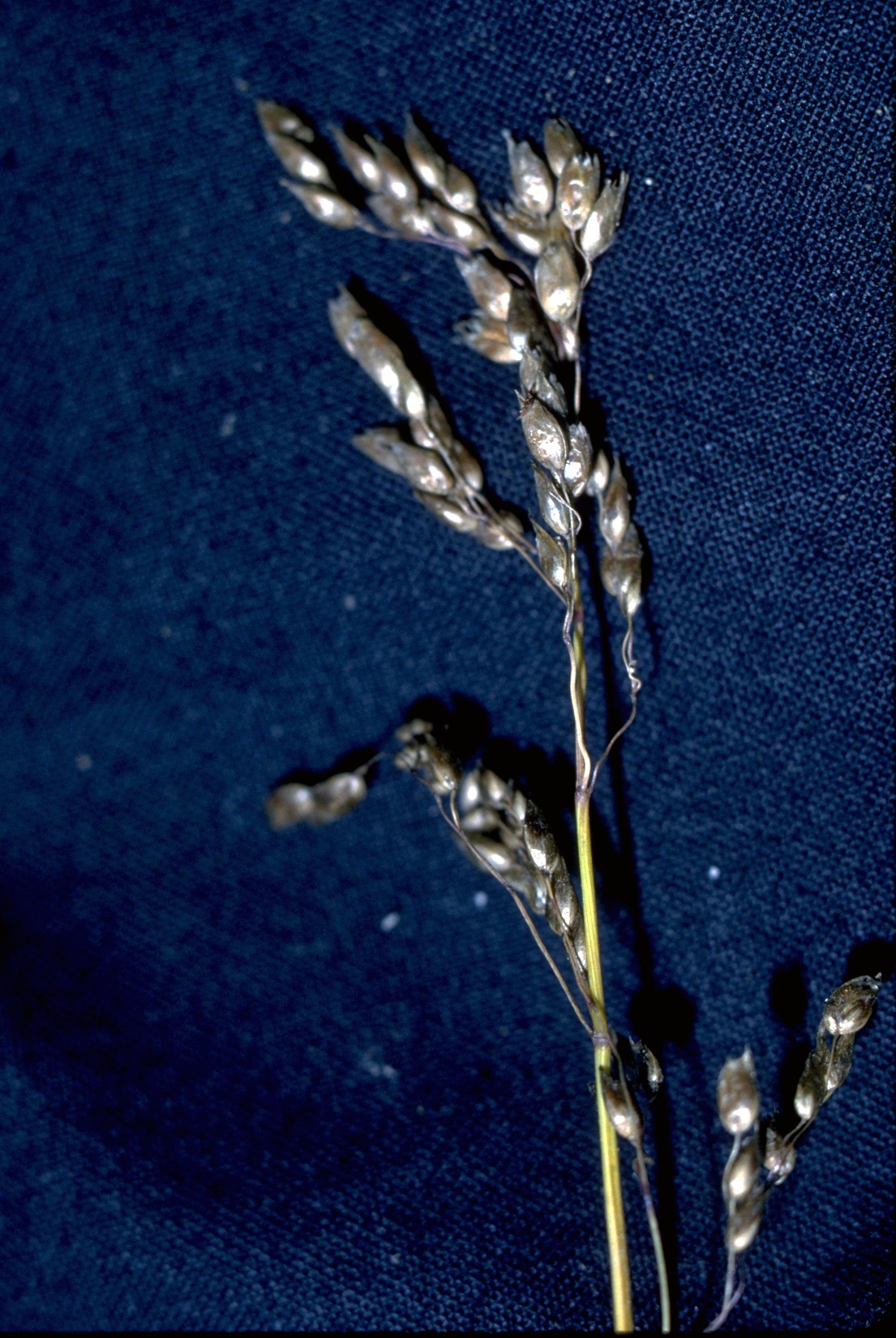
The central concept in Braiding Sweetgrass is reciprocity. In the Potawatomi tradition Kimmerer learned, plants are not resources but persons. They give gifts (food, medicine, materials), and the human response is to give in return: by tending, by gratitude, by harvesting in ways that allow the plant to continue and flourish, by ceremony. Kimmerer makes this concrete with sweetgrass, wiingaashk, a sacred plant of the Potawatomi which research has shown thrives best when harvested respectfully and declines when ignored or over-harvested. The plant prospers in relationship.
Kimmerer's earlier work, Gathering Moss: A Natural and Cultural History of Mosses (2003), won the John Burroughs Medal for nature writing. Braiding Sweetgrass has sold over 2 million copies and stayed on the New York Times bestseller list for years. Her 2024 book The Serviceberry: Abundance and Reciprocity in the Natural World extends the gift-economy framework. She received the MacArthur Fellowship in 2022.
What Kimmerer offered, as both an Indigenous person and a credentialed scientist, was a way to talk about the living Earth in language that was not borrowed metaphor or romantic projection. She is reporting on what specific traditions have actually said, what contemporary Indigenous communities continue to know, and what these knowings can contribute to ecological science. She is careful about what is hers to share and what is not. Some Indigenous knowledge belongs to specific communities and is not meant for outside readers. Kimmerer asks for permission, names her sources, and is explicit about the boundary.
Indigenous Cosmologies of the Living Earth
Beyond Kimmerer's specific work, a much larger pattern is worth naming. Indigenous traditions worldwide have, as a rule, treated the Earth as a living, related being rather than as inert background. This is not a single view, and it is important not to flatten the differences between cultures into a generic "indigenous wisdom". But the cross-cultural pattern is real, and it has been documented in scholarly anthropology and religious studies for over a century.
In Aboriginal Australia, the concept of the Dreaming (the term was introduced by anthropologists Walter Baldwin Spencer and Frank Gillen in the 1890s, refined by W.E.H. Stanner in his 1953 essay The Dreaming, and is itself a translation that scholars now treat with some caution) refers to a creation reality that, in Stanner's phrase, is "everywhen". Country is not land in the European sense. Country is alive, ancestrally inhabited, and bound to specific human communities through the songlines (also called Dreaming tracks): paths of song, story, and ritual that cross the continent and encode practical and sacred knowledge. The popularising book in English was Bruce Chatwin's The Songlines (1987), a literary travelogue rather than scholarship, but the underlying cultural reality predates Chatwin by tens of thousands of years. Margo Neale and Lynne Kelly's Songlines: The Power and Promise (2020) is a more recent scholarly treatment co-authored with Aboriginal custodians.
In the Andean world, Pachamama (Quechua and Aymara, often translated "Earth Mother" though the word pacha covers both space and time) is not a metaphor but a relational being to whom offerings (despachos) are made, with whom one is in obligation, and from whom one must ask permission. Bolivia's 2009 constitution and the Ley de Derechos de la Madre Tierra (2010) attempt to give legal expression to this: rights for Pachamama as a juridical being.
In North American Indigenous traditions, related concepts vary by people but share the core: the Lakota mitakuye oyasin (all my relations) extends kinship to plants, animals, weather, and rocks; the Haudenosaunee Thanksgiving Address (the Ohén:ton Karihwatéhkwen, the words that come before all others) is a long prayer of acknowledgement to all the parts of the world that sustain human life, recited at the opening of every gathering. The Diné (Navajo) concept of hózhó names a state of beauty, harmony, and rightness that is a relationship with the world, not a property of it.
In the Hindu tradition, the Earth is Bhumi or Prithvi, addressed as a goddess, mother, and bearer. The Atharva Veda's Bhumi Sukta (Hymn to the Earth) is one of the oldest extant texts of this tradition: Mata bhumih putro aham prithivyah, "the Earth is my mother, I am her child". West African traditions have varied figures: the Yoruba goddess Onile, the Akan Asase Ya. East Asian traditions have Hou Tu and the Daoist concept of qi in the body of the Earth.
These are different frameworks. They should not be collapsed. What they share is a relational stance: the Earth is not a thing to be managed but a being to be in relationship with. The political and ecological consequences of this stance are not academic; many of the world's most resilient remaining ecosystems are in lands held by Indigenous communities operating from precisely this set of assumptions, and a 2019 IPBES report estimated that around 80% of the planet's remaining biodiversity is on lands managed by Indigenous peoples, who make up about 5% of the human population.
Where Science Pushes the Picture
The Gaia hypothesis was, in its earlier formulations, controversial precisely because it seemed to import the relational stance of older traditions into a discipline that had spent centuries trying to remove it. What is striking about the contemporary science is that, even read very cautiously, it pushes in a similar direction.
Biogeochemistry has confirmed extensive feedback loops between life and the planet's surface conditions. Atmospheric oxygen, for instance, is maintained at around 21% by photosynthesis; without it the level would drop dramatically. Ocean salinity, the carbon-silicate cycle, the regulation of temperature within ranges life can tolerate. These are not properties of a dead planet. Microbial ecology has shown the depth of co-evolution between life and the lithosphere. Studies of the human microbiome have shown that what we are bodily is itself a community of organisms, not a single sealed individual.
None of this confirms that the Earth is a single conscious being. It does undermine the older picture of Earth as inert substrate against which life happens. The picture that emerges is Margulis's: a vast, layered network of interacting ecosystems, with humans embedded as one species among many, and with regulatory feedbacks operating at scales we are only beginning to characterise. This is, again, not the same as the indigenous frameworks. But it is no longer obviously inconsistent with them.
What science has not done, and probably cannot do, is settle the question of whether the relational stance of the older traditions is true in some deeper sense. Whether Pachamama hears your offering, whether Country grieves for the ancestors, whether the Earth is in some honest sense alive. These are questions that the instruments are not designed to answer. The science can rule out some easy targets (the Earth is not a single biological organism in the sense that you and I are organisms) and confirm that the system is far more interconnected than the old textbook picture allowed. Beyond that, the older traditions and the contemporary science look at the same Earth and read different things.
What the Different Threads Share
Stepping back across Lovelock and Margulis, Naess, Macy, Kimmerer, and the Indigenous cosmologies these have engaged with, a pattern emerges.
All of them treat the boundary between the human and the more-than-human as more permeable than the dominant Western modern view has assumed. They differ on the metaphysics. Lovelock would not have called Gaia a goddess. Naess was careful to distinguish his philosophy from mysticism. Macy worked from Buddhist non-self. Kimmerer speaks from Potawatomi tradition. Pachamama and Bhumi are different specific beings with their own theologies. The differences matter and should not be flattened.
But the shared stance is real. The Earth is not the inert backdrop. The human is not the sealed individual standing apart from nature. There is a relationship, and it works both ways. What we do to the Earth, we do to ourselves. What we receive from the Earth, we owe back in some form.
The vocabulary is different in each tradition. The orientation is recognisable across them.
For practical purposes (how a person lives, what they care about, what they consider a duty), this stance has the same kinds of consequences whether it is articulated in Lovelock's planetary chemistry, Naess's ecosophy, Macy's Council of All Beings, Kimmerer's reciprocity, or a Lakota mitakuye oyasin. The path of action narrows. It becomes harder to justify the things that the prevailing economic system asks to be justified.
What EarthBeat Shows
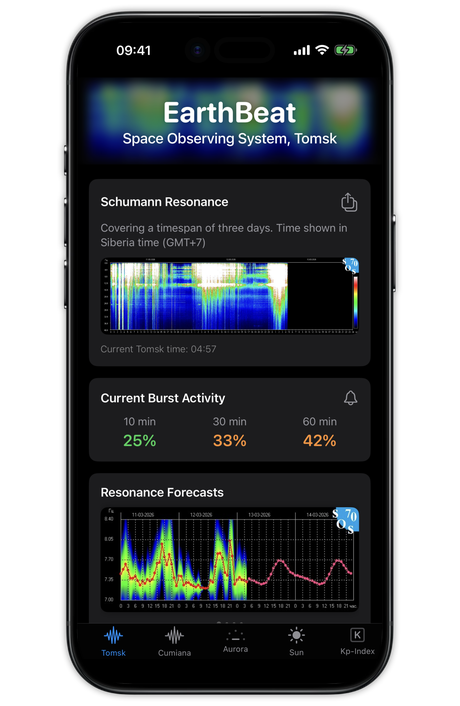
EarthBeat surfaces one specific signal: the Schumann resonance, the electromagnetic background of the Earth-ionosphere cavity, driven by the planet's continuous lightning activity and recorded by atmospheric research stations. It is one of the few signals through which the planet's wholeness is, in a literal physical sense, audible.
The Schumann resonance is not Gaia. It is not Pachamama. It is not Country. It is one of the regulatory rhythms of the planetary system, alongside many others. But it is a signal whose existence depends on the planet being roughly the size and composition it is, with an atmosphere of roughly the chemistry it has, lit by lightning storms that depend on a hydrological cycle that depends on life. In that sense, looking at the Schumann resonance is one way of looking at a living planet doing what a living planet does.
For the practitioner, this can be held in either of two registers, or both. The scientific register: the SR is a real, measurable, well-understood physical signal that reflects global atmospheric and electromagnetic conditions. The contemplative register: this is one of the rhythms by which a living Earth lets its tenants know it is here. Both registers are honest. Neither contradicts the other. The signal is the same; the meaning you bring to it is yours.
Further Reading
Gaia hypothesis
- James Lovelock, Gaia: A New Look at Life on Earth (Oxford University Press, 1979).
- James Lovelock, The Ages of Gaia: A Biography of Our Living Earth (Norton, 1988).
- Lynn Margulis, Symbiotic Planet: A New Look at Evolution (Basic Books, 1998).
- Bruce Clarke and Sébastien Dutreuil (eds), Writing Gaia: The Scientific Correspondence of James Lovelock and Lynn Margulis (Cambridge University Press, 2022).
- Stephen H. Schneider, James R. Miller, Eileen Crist, and Penelope J. Boston (eds), Scientists Debate Gaia: The Next Century (MIT Press, 2008).
Deep ecology
- Arne Naess, "The Shallow and the Deep, Long-Range Ecology Movement: A Summary", Inquiry 16 (1973): 95-100.
- Arne Naess, Ecology, Community and Lifestyle: Outline of an Ecosophy, translated by David Rothenberg (Cambridge University Press, 1989).
- Bill Devall and George Sessions, Deep Ecology: Living as if Nature Mattered (Gibbs Smith, 1985).
- David Rothenberg, Is It Painful to Think? Conversations with Arne Naess (University of Minnesota Press, 1993).
The Work That Reconnects
- Joanna Macy, World as Lover, World as Self (Parallax Press, 1991).
- Joanna Macy, Mutual Causality in Buddhism and General Systems Theory (SUNY Press, 1991).
- John Seed, Joanna Macy, Pat Fleming, and Arne Naess, Thinking Like a Mountain: Towards a Council of All Beings (New Society Publishers, 1988).
- Joanna Macy and Chris Johnstone, Active Hope: How to Face the Mess We're in Without Going Crazy (New World Library, 2012; revised 2022).
- Joanna Macy and Molly Young Brown, Coming Back to Life: The Updated Guide to the Work That Reconnects (New Society Publishers, 2014).
Indigenous knowledge and Earth-as-relation
- Robin Wall Kimmerer, Braiding Sweetgrass: Indigenous Wisdom, Scientific Knowledge and the Teachings of Plants (Milkweed Editions, 2013).
- Robin Wall Kimmerer, Gathering Moss: A Natural and Cultural History of Mosses (Oregon State University Press, 2003).
- Robin Wall Kimmerer, The Serviceberry: Abundance and Reciprocity in the Natural World (Scribner, 2024).
- W.E.H. Stanner, The Dreaming and Other Essays (Black Inc., 2009 [1953]).
- Margo Neale and Lynne Kelly, Songlines: The Power and Promise (Thames & Hudson Australia, 2020).
- Tyson Yunkaporta, Sand Talk: How Indigenous Thinking Can Save the World (Text Publishing, 2019).
Background and synthesis
- David Abram, The Spell of the Sensuous (Pantheon, 1996).
- Vandana Shiva, Earth Democracy: Justice, Sustainability, and Peace (South End Press, 2005).
- IPBES (2019), Global Assessment Report on Biodiversity and Ecosystem Services. Intergovernmental Science-Policy Platform on Biodiversity and Ecosystem Services.