The Hindu tradition speaks of akasha, an all-pervading subtle medium that retains the imprints of events. Buddhist teachings of karma and interdependent co-arising describe how acts and intentions reverberate across persons and lifetimes. Sufis describe a barzakh, an intermediate world between matter and spirit. Indigenous traditions often treat ancestors, places, and dreams as carriers of knowledge that no individual could possess on their own.
In the modern West, this old intuition began to find new vocabularies in the 19th and early 20th centuries. The vocabulary of psychology, in the work of Carl Gustav Jung. The vocabulary of evolutionary biology and theology, in the work of Pierre Teilhard de Chardin and Vladimir Vernadsky. The vocabulary of biology and field theory, in the controversial work of Rupert Sheldrake. The vocabulary of statistical anomaly detection, in the work of the Global Consciousness Project at Princeton. None of these are the same theory. They are different attempts to ask the same kind of question: are minds, or what minds give rise to, more interconnected than the individual-skull model of consciousness suggests?
This page describes those attempts and what their reception has been. It does not claim they are right. It does not claim they are equivalent. It tries to give an accurate account of what each thinker actually proposed, what evidence has been offered for and against, and where the honest reader stands at the end.
Carl Jung and the Collective Unconscious
Carl Gustav Jung (1875-1961) was a Swiss psychiatrist who served, for a time, as Sigmund Freud's chosen heir-apparent in the early psychoanalytic movement and broke with him in 1913. The break was painful and consequential. Where Freud had located the unconscious primarily in repressed personal material (childhood, sexuality, family dynamics), Jung came to see this personal unconscious as only a layer over something deeper.
Below the personal unconscious, Jung argued, lies a collective unconscious: a stratum of the psyche common to all human beings, populated by what he called archetypes. The archetypes are not specific images or memories. They are inherited dispositional patterns, comparable to instinctive behavioural patterns in animals, that shape the kinds of images and stories human consciousness produces. The Mother, the Hero, the Wise Old Man, the Shadow, the Trickster, the Self: these are the names Jung gave to recurring patterns that show up, with cultural variation but recognisable structure, in the dreams of his patients and in the mythology of cultures across the world.
The argument was empirical in spirit. Jung claimed that he had encountered, in his clinical work, dream images and fantasy material from patients who had no exposure to the mythological or religious traditions in which closely parallel images appeared. The schoolboy who had never read alchemical texts would dream alchemical symbols. The patient with no knowledge of Tibetan Buddhism would draw mandalas with the same fourfold structure documented in monastic art. From this, Jung inferred a substrate of inherited symbolic patterning that he called the collective unconscious.
Jung's central works on the topic include The Archetypes and the Collective Unconscious (Volume 9, Part 1 of the Collected Works, Princeton University Press, Bollingen Series), Symbols of Transformation (1912, revised 1952), Psychology and Alchemy (1944), and Aion (1951). His autobiography, Memories, Dreams, Reflections (1962, with Aniela Jaffé), gives the personal background. The Red Book (Liber Novus), a private journal of fantasy material illustrated by Jung between 1913 and 1930 and only published in 2009, contains the imagery from which his theoretical work emerged.
The reception of the collective unconscious has been mixed. As a clinical and interpretive framework it has been highly influential in depth psychology, in literary and cultural studies, and in popular thought. Joseph Campbell's The Hero with a Thousand Faces (1949) drew heavily on Jungian archetypes to identify a recurring narrative pattern across world mythology. James Hillman's archetypal psychology extended the framework. The contemporary therapeutic movement that uses the term "shadow work" descends from Jung's concept of the shadow archetype.
As an empirical claim about an inherited substrate of the psyche, the collective unconscious has been controversial. Critics have argued that Jung's evidence, the parallel imagery in his patients' dreams, can be explained by other means: cultural diffusion (most patients have at least indirect exposure to widespread mythological motifs), the structure of the human body and brain (which produces a finite repertoire of imagery), and the interpretive flexibility of dream symbols (which allows almost any image to be read as an archetype if one is looking). Mainstream psychology and neuroscience have not absorbed the collective unconscious in its strong form. The weaker claim, that human imagination has structural similarities across cultures because of shared cognitive and biological foundations, is uncontroversial but does less work.
What Jung contributed, beyond any specific empirical question, is a vocabulary for talking seriously about the impersonal layers of psychic life. Whether or not the collective unconscious exists as Jung described it, the experiences he was trying to name (dreams that feel ancient, encounters with figures that seem to know more than the dreamer, recurring patterns in the imagination of disparate cultures) are real and worth thinking about.
Teilhard de Chardin and the Noosphere
Pierre Teilhard de Chardin (1881-1955) was a Jesuit priest, palaeontologist, and one of the most original Catholic thinkers of the 20th century. He was also, for most of his life, forbidden by his Order from publishing his theological-philosophical work; the major books, The Phenomenon of Man (originally Le Phénomène humain, written 1938-1940, published 1955) and The Divine Milieu (1957), appeared only after his death.
Teilhard's central concept is the noosphere (sometimes spelled noösphere, from the Greek noos, mind). The noosphere is, in Teilhard's account, a layer of thought enveloping the Earth, the third in a sequence: geosphere (matter), biosphere (life), noosphere (mind). Just as life transformed the chemistry of the planet over billions of years, the emergence of human reflective thought, what Teilhard called hominisation, has begun to transform the biosphere into something new.
The word noosphere was first written down by Teilhard in an unpublished essay dated 6 May 1925, but the concept emerged from a three-way conversation in Paris in 1922-1925 between Teilhard, the French mathematician and philosopher Édouard Le Roy, and the Russian biogeochemist Vladimir Vernadsky (1863-1945), who was visiting the Sorbonne to lecture on his concept of the biosphere. Le Roy was the first to publish the term in print, in his 1928 book Les origines humaines et l'évolution de l'intelligence. Teilhard developed the concept across his subsequent essays, most fully in La formation de la noosphère (written 1947, published 1959).
For Teilhard, the noosphere has a directional, evolutionary structure. The increasing density of human connection (cities, communications, science, eventually what we now call the internet) is not random. It is the unfolding of a process he called the Law of Complexity-Consciousness: as material organisation increases in complexity, consciousness deepens. The noosphere converges, over time, on what Teilhard called the Omega Point: a final state of complete reflective unity. Teilhard identified the Omega Point with what he understood as the cosmic Christ, but the structural argument can be read independently of his Christology.
Vernadsky's version of the noosphere differed from Teilhard's in important ways. Vernadsky was a materialist and a Soviet-era scientist with no theological commitments. He treated the noosphere as a geological phenomenon: the stage of the biosphere in which human technological and cognitive activity becomes a planet-shaping force, comparable in scale to earlier biological transformations like the oxygenation of the atmosphere. His writings on the topic, particularly A Few Words about the Noosphere (1944), are foundational to what is now Earth System Science. Vernadsky's biosphere concept, developed in The Biosphere (1926), influenced James Lovelock and shaped 20th-century geochemistry. He died in 1945, before the term Anthropocene was coined, but his work prefigures the Anthropocene literature directly.
The noosphere, then, has two registers: Teilhard's, which is teleological and ultimately theological, and Vernadsky's, which is geological and secular. Both proposed that the emergence of human cognition is changing the planet at the scale of life itself. Both pictures have been criticised for vagueness, but the underlying observation, that human thought has become a planetary force, is now uncontroversial. The contested question is what kind of force, and toward what.
The noosphere has been the explicit conceptual frame for the Global Consciousness Project (discussed below) and for various contemporary efforts to think about a "global brain" or "planetary mind" arising through digital communications. The technical and academic literature on the noosphere has been growing again since the 2000s, alongside the broader conversation about the Anthropocene.
Vladimir Vernadsky's Biosphere
Worth treating separately, because his contribution is often subsumed under Teilhard's: Vernadsky was one of the great Russian scientists of the early 20th century, founder of biogeochemistry, and the originator of the modern scientific concept of the biosphere. His 1926 book Biosfera (later translated as The Biosphere, with a 1998 English edition by Mark McMenamin) argued that life on Earth is a single, planetary, geological force, not a passive layer atop the rocks.
Vernadsky's specific claim, that living matter (zhivoe veshchestvo) cycles atoms through itself at rates that geology cannot ignore, was decades ahead of its time in the West. His work was largely unread in English until late in the 20th century, but it directly shaped the work of later Earth System scientists. James Lovelock, when he developed the Gaia hypothesis in the 1970s, acknowledged Vernadsky as a forerunner. The connection between the Russian biosphere tradition and the Western Gaia tradition runs through both Lovelock and the later writings of Lynn Margulis.
For the noosphere question, Vernadsky's contribution is that it grounded the concept in materialist science. Whatever one makes of Teilhard's Omega Point or the wilder versions of "global brain" theory, Vernadsky's claim that human cognitive activity has become a geological force comparable to plate tectonics or to the oxygenation of the atmosphere is a defensible scientific statement. The Anthropocene literature can be read as a vindication of that claim.
For more on Vernadsky's place in the Earth System story, see EarthBeat's Awareness Track page on Gaia, Deep Ecology, and the Living Earth.
Rupert Sheldrake and Morphic Resonance
The most contested figure on this page is Rupert Sheldrake (born 1942). Sheldrake is a Cambridge-trained biochemist and plant physiologist with substantial early scientific credentials: a former Fellow of Clare College, Cambridge, a former Director of Studies in biochemistry and cell biology there, a Frank Knox Fellow at Harvard, and the discoverer of significant findings on plant auxin transport that remain part of standard plant biology. In 1981 he published A New Science of Life: The Hypothesis of Formative Causation, in which he proposed the hypothesis of morphic resonance.
Morphic resonance, as Sheldrake formulates it, is a hypothesis that self-organising systems (molecules, crystals, cells, organisms, social groups) inherit a kind of memory from previous similar systems. The mechanism, in his account, is not material in the conventional sense. The forms and patterns characteristic of a species or kind, he argues, are guided by morphic fields, and these fields carry the influence of past instances forward in time. The more often a pattern has been instantiated, the easier it becomes for new instances to take that form. Laws of nature, in this picture, become more like habits of nature.
The hypothesis has specific testable predictions. New compounds should crystallise more easily over time as the form becomes more "habitual" through morphic resonance. Animals learning a new task in one location should be followed by animals elsewhere learning the same task more readily, even without any conventional means of transmission. Human skills and habits, similarly, should diffuse through this non-physical channel.
The reception of A New Science of Life in 1981 set the tone for what followed. The journal Nature, then edited by John Maddox, ran an editorial in September 1981 titled A book for burning?. Maddox called the hypothesis "magic instead of science" and "heresy". The editorial became famous, and arguably increased the public profile of the book. Sheldrake has continued to develop the hypothesis across subsequent works including The Presence of the Past: Morphic Resonance and the Habits of Nature (1988, second edition 2011), The Rebirth of Nature (1991), Dogs That Know When Their Owners Are Coming Home (1999), The Sense of Being Stared At (2003), and The Science Delusion (UK, 2012; US title Science Set Free).
The honest summary of where this stands: morphic resonance is not accepted by mainstream biology. The principal scientific objections, beyond Maddox's polemic, fall into three categories. First, the proposed mechanism does not specify how morphic fields would carry information across space and time. Second, the supportive experimental evidence Sheldrake has offered (rat-learning experiments, crystallisation studies, telepathy and "sense of being stared at" experiments) has been criticised for methodological problems including possible experimenter effects and selective reporting. Third, the hypothesis as stated is difficult to falsify because almost any negative result can be accommodated by adjusting the strength or direction of the proposed effect. A representative critique is Steven Rose's analysis of one of the chick-learning experiments (Rivista di Biologia 1992), in which Rose argued that the data did not support Sheldrake's interpretation. Sheldrake responded vigorously, which is part of his standing pattern.
A more recent and balanced assessment came from neuroscientist Alex Gomez-Marin in a 2021 EXPLORE paper, Facing biology's open questions: Rupert Sheldrake's "heretical" hypothesis turns 40, which argued that the hypothesis is not as unfalsifiable as commonly stated and that the experimental implications remain largely untested because mainstream researchers have been unwilling to engage. The paper does not endorse morphic resonance but argues for taking it seriously enough to test properly.
What is honest to say. Sheldrake's hypothesis has not been validated. It has also not been definitively refuted; what mainstream biology has done is largely ignore it, which is a different state from rejection. The hypothesis is taken seriously by a minority of working scientists (the late physicist David Bohm corresponded with Sheldrake; the theoretical physicist Lee Smolin has formulated a "principle of precedence" with structural similarities). It is dismissed by most. For the contemplative-traditions reader, the relevant point is not whether morphic resonance is the right physical theory but that an elaborate, testable formulation of "memory in nature" was put forward by a credentialed scientist and has remained in conversation for forty years. Whether the conversation eventually produces evidence for the hypothesis or refines it into something more limited, or whether it dies out, is still being decided.
The Global Consciousness Project
The most data-driven entry in this conversation is the Global Consciousness Project (GCP), established at Princeton University in 1998 by Roger Nelson, then a research coordinator at the Princeton Engineering Anomalies Research (PEAR) lab. The GCP runs a network of around 70 hardware random number generators (electronic devices that produce random bits from quantum noise) distributed at sites around the world. The hypothesis the project tests is that during periods of focused global attention or strong shared emotion (major news events, large-scale meditations or rituals, terrorist attacks, royal weddings, sporting finals), the random number generators show small but statistically significant departures from chance.
Over more than two decades the project has accumulated several hundred such "events" with pre-registered analysis windows. The cumulative statistical departure from chance, summed across all events, has been reported in peer-reviewed publications including Foundations of Physics Letters and Explore. Nelson and colleagues have argued that the cumulative result is highly significant; critics have argued that the methodology is open to selection effects in event choice, that the effect sizes for individual events are tiny, and that random number generators are sensitive to environmental variables (temperature, electromagnetic interference) that are difficult to control across a global network.
For the awareness reader, the framing matters. The GCP does not claim to demonstrate that human collective consciousness produces a measurable physical field. It claims that the data are inconsistent with a pure-chance null hypothesis, and that this inconsistency clusters around moments of widespread shared focus. The interpretation of that inconsistency remains contested.
EarthBeat's Science Track page on Global Consciousness treats this material in detail, with full peer-reviewed citations and the principal critiques. The Awareness Track perspective is different: regardless of how the GCP debate is finally resolved, the project is one of the few sustained empirical attempts to investigate the older intuition that what people share in attention and feeling has consequences beyond their individual heads. Whether the consequences are a real effect on quantum noise generators, an artefact of selection bias, or something in between, is the question the data is being asked.
What Connects These Threads
Stepping back across Jung, Teilhard, Vernadsky, Sheldrake, and the GCP, a set of recurring questions emerges.
Are minds connected in ways that conventional individualism does not capture? Jung said yes, through the inherited substrate of archetypes. Teilhard said yes, through the convergent evolution of consciousness toward higher complexity. Vernadsky said yes in a more limited geological sense: collective human cognition has become a planetary force. Sheldrake said yes, through morphic fields and a memory inherent in nature. The GCP asks whether moments of global attention leave detectable traces in random data.
These are not the same answer. Jung's archetypes are a proposed structural feature of the human psyche. Teilhard's noosphere is an evolutionary direction. Vernadsky's noosphere is a geophysical phenomenon. Sheldrake's morphic resonance is a proposed physical mechanism. The GCP's claim is a statistical anomaly in pre-registered datasets. They cannot all be true in the same sense, and some of them might be wrong.
The picture of the individual mind as a sealed unit, separated from other minds by something more than distance, may be wrong. What the right picture is remains an open question.
But the underlying intuition is recognisable across all of them, and across the older traditions to which the page opened. The intuition is that the picture of the individual mind as a sealed unit, separated from other minds by something more than distance, may be wrong. What the right picture is remains an open question. The 20th century put four serious vocabularies on the table for asking it, and one ongoing experiment for testing one specific version of the question. None has produced the kind of definitive resolution that would either confirm or rule out the older intuition.
For the contemplative practitioner, this is an interesting place to sit. The traditions that maintain a relational view of mind do not require validation from contemporary science to remain coherent on their own terms. The contemporary science, when it engages with these questions, has not produced the easy refutation that some critics expect. The conversation continues. The honest stance is to take the older traditions seriously without overclaiming what science has shown, and to take the contemporary research seriously without overclaiming what it has yet to demonstrate.
What EarthBeat Shows
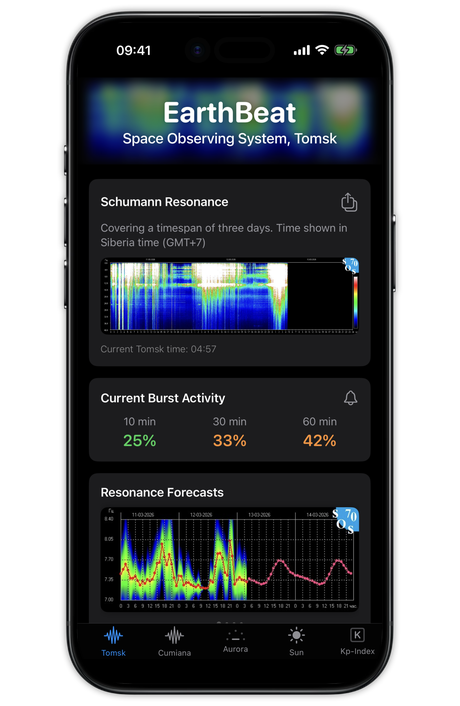
EarthBeat does not measure consciousness. It does not measure anything directly: it has no instruments of its own. What it does is collect data from research stations and observatories around the world, analyse it, and make it more accessible. The signal at the centre of that data is the Schumann resonance, an electromagnetic signal driven by global lightning activity in the Earth-ionosphere cavity. The signal is real, well-characterised in atmospheric science, and one of the few continuously measurable physical signatures of the planet considered as a whole.
There has been speculation, including in some HeartMath-affiliated literature, about possible coupling between human heart-rhythm coherence and the SR signal at large scales. EarthBeat's Science Track page on geomagnetic activity and the autonomic nervous system summarises the peer-reviewed evidence on this question. The summary is that small statistical effects of geomagnetic conditions on HRV have been reported, while claims of large-scale coupling between collective human emotion and global electromagnetic signals remain speculative.
For the practitioner, the SR is a window onto a real physical signal. Holding it alongside any of the frameworks discussed on this page (Jung's collective unconscious, Teilhard's noosphere, Vernadsky's biosphere, the GCP's statistical claims) is a personal interpretive choice. The signal does not require any of these frameworks to be correct. It also does not contradict them. What you bring to the data is yours.
Further Reading
Jung and the collective unconscious
- C.G. Jung, The Archetypes and the Collective Unconscious, Collected Works Volume 9 Part 1 (Princeton University Press, Bollingen Series). Translated by R.F.C. Hull.
- C.G. Jung, Symbols of Transformation, Collected Works Volume 5 (1956 [1912]).
- C.G. Jung, Memories, Dreams, Reflections, recorded by Aniela Jaffé (Pantheon, 1962).
- C.G. Jung, The Red Book / Liber Novus, edited by Sonu Shamdasani (Norton, 2009).
- Joseph Campbell, The Hero with a Thousand Faces (Pantheon, 1949).
- James Hillman, Re-Visioning Psychology (Harper, 1975).
- Anthony Stevens, Archetype Revisited: An Updated Natural History of the Self (Toronto, 2003).
The noosphere
- Pierre Teilhard de Chardin, The Phenomenon of Man (Harper & Row, 1959; original French Le Phénomène humain, 1955). Foreword by Julian Huxley.
- Pierre Teilhard de Chardin, The Future of Man (Harper & Row, 1964). Contains La formation de la noosphère (1947).
- Vladimir Vernadsky, The Biosphere, complete annotated English edition by Mark A.S. McMenamin (Copernicus / Springer, 1998 [1926]).
- Vladimir Vernadsky, "The Biosphere and the Noösphere", American Scientist 33: 1-12 (1945).
- Bruce Clarke (ed.), Earth, Life, and System: Evolution and Ecology on a Gaian Planet (Fordham, 2015).
Sheldrake and morphic resonance
- Rupert Sheldrake, A New Science of Life: The Hypothesis of Formative Causation (Blond & Briggs, 1981; revised editions 1985, 2009 as Morphic Resonance).
- Rupert Sheldrake, The Presence of the Past: Morphic Resonance and the Habits of Nature (Times Books, 1988; second edition Park Street, 2011).
- Rupert Sheldrake, Science Set Free: 10 Paths to New Discovery (Deepak Chopra Books, 2012; UK title The Science Delusion).
- John Maddox, "A book for burning?", Nature 293(5830): 245-246 (24 September 1981).
- Steven Rose, "So-called 'formative causation': A hypothesis disconfirmed", Rivista di Biologia 85: 445-453 (1992).
- Alex Gomez-Marin, "Facing biology's open questions: Rupert Sheldrake's 'heretical' hypothesis turns 40", EXPLORE 17(4): 313-318 (2021).
Global Consciousness Project
- Roger D. Nelson and Peter A. Bancel (2011), "Effects of Mass Consciousness: Changes in Random Data during Global Events", Explore 7(6): 373-383.
- Peter A. Bancel and Roger D. Nelson (2008), "The GCP Event Experiment: Design, Analytical Methods, Results", Journal of Scientific Exploration 22(4).
- Project archive and full data: noosphere.princeton.edu