The lineage runs roughly: Madame Blavatsky and Theosophy (1875 onward), Rudolf Steiner and anthroposophy (1912 onward), the mid-20th-century human-potential movement, Kirlian photography (popularised 1958-1970), Barbara Brennan's Hands of Light (1987), Valerie Hunt's Infinite Mind (1996), and Rupert Sheldrake's morphic resonance (1981 onward). Several of the figures had genuine credentials in mainstream science before moving into esoteric territory. Several of the institutions (Waldorf schools, biodynamic agriculture, Brennan Healing Science) have grown into substantial modern enterprises with millions of practitioners and patients. The questions of what these traditions actually claim, what evidence supports those claims, and what the relationship is between credentialed science and the esoteric lineage are worth treating with care.
This page is structured chronologically, names principal figures and their primary claims, and applies the same accuracy-and-folklore framing used in earlier pages. Where peer-reviewed evidence supports a claim, the page says so. Where the claim is unsupported or contested, the page says so. Where the figure has done genuine credentialed work in mainstream science alongside their esoteric work, the page distinguishes the two.
Madame Blavatsky and the Theosophical Synthesis (1875)
Helena Petrovna Blavatsky (1831-1891) was a Russian-American writer and mystic who co-founded the Theosophical Society in New York City on 17 November 1875, with Henry Steel Olcott and William Quan Judge. Her two principal works are Isis Unveiled (1877) and The Secret Doctrine (two volumes, 1888 and 1889). The latter, subtitled The Synthesis of Science, Religion and Philosophy, became the foundational text of modern Theosophy and one of the most influential esoteric works of the 19th century.
Blavatsky's project was the construction of a unified spiritual cosmology drawing on Hindu, Buddhist, Hermetic, Neoplatonic, and her own claimed sources (the Book of Dzyan, the Mahatma Letters from Tibetan Masters of the Ancient Wisdom). The system that emerged from The Secret Doctrine and the later writings of Annie Besant and Charles W. Leadbeater proposes that the human being consists of seven principles or vehicles: the physical body (sthula sharira), the etheric body (linga sharira in current Theosophy), prana, the astral body (kama rupa in current Theosophy), the higher and lower mind (manas), the spiritual soul (buddhi), and the spirit (atman). The first three form the body, the next two the soul, the last three the spirit.
The septenary structure was Blavatsky's distinctive contribution. After her death in 1891, Annie Besant and C.W. Leadbeater systematised the model into a more elaborate scheme of seven planes of existence (physical, etheric, astral, mental, causal, buddhic, atmic), each with seven sub-planes, populated by various subtle bodies and entities. Leadbeater's clairvoyant claims (he reported seeing chakras, auras, and astral entities directly) gave the Theosophical subtle-body model a visual specificity that persists in much New Age and energy-healing literature today.
The historical assessment is mixed. Blavatsky is widely credited as the grandmother of the New Age. Her work directly influenced Wassily Kandinsky, Paul Klee, Piet Mondrian, Alexander Scriabin, T.S. Eliot, and Kahlil Gibran in the arts; Mahatma Gandhi (an associate member of her London Lodge in 1891), Annie Besant (later President of the Indian National Congress), and many other public figures politically; and the founders of subsequent esoteric movements including Rudolf Steiner, George Gurdjieff, and Alice Bailey. The cultural reach is large.
The empirical assessment is harder. Blavatsky was repeatedly accused of producing fraudulent paranormal phenomena, most notably in the 1885 Hodgson Report by the Society for Psychical Research, which concluded after extensive investigation in India that the Mahatma Letters she claimed to receive from Tibetan masters were forgeries written by herself. The SPR partially retracted some of its conclusions in 1986, but the broader scientific reception of The Secret Doctrine's specific claims (root races, Lemuria, Atlantis, the precise structure of subtle bodies, clairvoyantly observed atomic structures in Besant and Leadbeater's Occult Chemistry, 1908) has been overwhelmingly negative. The book has also been criticised for elements of racial hierarchy, with some scholars (Hannah Newman, Michael Marrus) noting that the root race doctrine fed into 20th-century occult-influenced fascist ideology, even as Theosophists themselves have repeatedly disavowed racial interpretations.
The honest summary on Blavatsky is that she was a hugely culturally important figure who synthesised Asian religious vocabulary, 19th-century spiritualism, and Western esotericism into a system that has had measurable influence on modernist art, alternative spirituality, and the vocabulary of contemporary subtle-body medicine. The system's specific empirical claims are not supported, the historical evidence for fraud in some of her paranormal demonstrations is substantial, and the racial elements of the cosmology require explicit acknowledgement. Reading her as a cultural-historical figure with serious literary and synthesising power is reasonable. Reading her as a reliable source on the structure of the cosmos or the human being is not.
Rudolf Steiner and Anthroposophy (1912)
Rudolf Steiner (1861-1925) was an Austrian philosopher, scientist, and esotericist who began his career as a respected scholar of Goethe's scientific writings (editing the standard edition for the Joseph Kürschner Deutsche National-Litteratur series) and earned a doctorate in epistemology from the University of Rostock in 1891. He was active in the Theosophical Society, serving as General Secretary of its German Section from 1902, before separating from the Society in 1913 to found anthroposophy (literally wisdom of the human being).
Steiner's distinctive contribution was the practical application of esoteric ideas across multiple cultural domains. Between 1919 and his death in 1925, he founded or inspired:
- Waldorf education: the first school opened in 1919 for the children of Waldorf-Astoria cigarette factory workers in Stuttgart; there are now over 1,000 Waldorf schools worldwide.
- Biodynamic agriculture: launched in a 1924 lecture series at Koberwitz to a group of farmers concerned about declining soil quality; now practised on every continent.
- Anthroposophical medicine: a complementary-medicine movement working alongside conventional medicine, with the pharmaceutical company Weleda (founded 1921) and clinics in 80 countries.
- Eurythmy: a movement art making speech and music visible through gesture, used both performatively and therapeutically.
- Goetheanum architecture: the cultural centre at Dornach, Switzerland, which became a landmark of 20th-century organic architecture. The first Goetheanum (carved wood, completed 1919) was destroyed by arson on New Year's Eve 1922; the second (concrete, designed by Steiner before his death and completed afterwards) still serves as the world headquarters of the Anthroposophical Society.
Steiner's metaphysics adopted the Theosophical septenary structure but with his own emphasis on the etheric body (formative life forces shaping living organisms) and the astral body (consciousness and feeling). He claimed direct clairvoyant access to spiritual realities, arguing in works like How to Know Higher Worlds (1909) and Knowledge of the Higher Worlds and Its Attainment (also 1909) that systematic meditative training could develop supersensible perception in others.
The reception is divided in a way worth being honest about. Steiner's practical institutions (Waldorf schools, biodynamic farms, Weleda products) are large, durable, and have measurable cultural influence. Some have positive empirical track records in their domains: biodynamic agriculture is recognised by the EU and similar regulators as a valid form of organic farming, and Waldorf education has produced generations of graduates whom many regard as well-rounded.
The metaphysical foundations of these institutions are widely characterised in mainstream scholarship as pseudoscientific. The Wikipedia article on anthroposophy, drawing on a substantial academic literature, notes that authors and scientists including Michael Shermer, Edzard Ernst, Simon Singh, and David Gorski have criticised anthroposophic medicine as ineffective and biodynamic agriculture as unsupported by mainstream agronomy. The 2002 University of Kiel agricultural researcher Peter Treue characterised biodynamic preparations as more akin to alchemy or magic than science, while granting that biodynamic farms can produce comparable results to other organic methods through their farming practices independent of the metaphysical claims.
Steiner's racial views are also worth naming directly. Some passages in his lectures contain hierarchical statements about races and ethnic groups that contemporary anthroposophical institutions have explicitly disavowed; the Anthroposophical Society's official position rejects nationalist and racist readings, and the historical record includes both Nazi sympathisers (Rudolf Hess as a patron of Waldorf schools and biodynamics) and resistance figures (Traute Lafrenz, a member of the White Rose) among Steiner's followers. The honest frame is that Steiner's writings contain material that fed in different directions historically, and contemporary anthroposophical institutions have done meaningful work to disavow the directions they regard as incompatible with the spirit of Steiner's wider project.
The summary on Steiner is similar to the summary on Blavatsky but with more cultural durability. The institutions are real and many are valuable on their own terms; the metaphysical claims (etheric and astral bodies, clairvoyant perception of supersensible realities, biodynamic preparations as channels for cosmic forces) are not supported by mainstream science. Reading Steiner as a major figure in 20th-century alternative culture, with practical institutions worth engaging on their own merits, is reasonable. Reading the metaphysics as established fact is not.
Kirlian Photography and the Photographic Aura (1939, popularised 1970)
A specific technical development deserves separate treatment because it provided the most influential putative evidence for subtle-body claims in the second half of the 20th century.
In 1939, Soviet electrical engineer Semyon Kirlian (1898-1978) and his wife Valentina, working in Krasnodar, observed that placing an object on a photographic plate and energising the apparatus with a high-frequency, high-voltage source produced an image showing a glowing corona around the object. The technique came to be called Kirlian photography. The Kirlians published their first paper in 1958, and the technique became widely known in the West through the 1970 book Psychic Discoveries Behind the Iron Curtain by Sheila Ostrander and Lynn Schroeder.
For a period in the 1970s and 1980s, Kirlian photography was widely interpreted as photographic evidence of the aura or life energy of living things. The most famous claim was the phantom leaf effect: a leaf with a portion physically removed appeared, in some Kirlian photographs, to show coronal discharge in the area where the missing portion had been, interpreted as the leaf's etheric body persisting after physical removal. Soviet researchers including Thelma Moss and Kendal Johnson at the UCLA Center for the Health Sciences ran related experiments in the 1970s.
The contemporary scientific assessment is settled. Kirlian photography captures a real physical phenomenon: corona plasma discharge produced when a high-voltage electric field ionises the air around an object. The brightness and pattern of the corona depend on physical factors including the moisture content of the object, the conductivity of the surface, the local humidity, the pressure of contact with the photographic plate, and the voltage and frequency of the electrical source. The phantom leaf effect, when it appears, is generally an artefact of moisture residue on the photographic plate where the removed portion of the leaf had pressed; properly controlled experiments have been unable to reproduce the effect reliably. The 1973 paper by David G. Boyers and William A. Tiller in the Journal of Applied Physics (44(7): 3102-3112), one of the more careful technical treatments, characterises Kirlian images as gas-discharge phenomena of physical interest but without evidence of the biological or paranormal interpretations placed on them.
Kirlian photography is now sold in various commercial forms (Gas Discharge Visualization, Electrophotonic Imaging) for aura readings in alternative-health contexts. The images produced are real photographs of real physical phenomena. The interpretation of those phenomena as visualisations of the human energy field, the chakras, or the soul is not supported by the physics of the process.
The Mid-Century Human-Potential Movement and the Energy-Healing Field
Between roughly 1960 and 1990, a loose movement formed combining psychotherapy, alternative medicine, Eastern contemplative traditions, and Western esotericism. The Esalen Institute (founded 1962 in Big Sur, California, by Michael Murphy and Dick Price) became a central institutional venue. Figures associated with this movement included Abraham Maslow, Carl Rogers, Fritz Perls, Stanislav Grof, Wilhelm Reich (whose orgone energy concept influenced the lineage despite being rejected by mainstream science), Alexander Lowen and John Pierrakos (developing bioenergetics and core energetics from Reich's work), and many others.
Two particular figures from this milieu produced books and institutions that have become foundational for contemporary energy healing and deserve specific treatment.
Barbara Brennan and Hands of Light (1987)
Barbara Ann Brennan (1939-2022) had a Bachelor of Science in Physics (University of Wisconsin-Madison, 1962) and a Master's degree in Atmospheric Physics (also Wisconsin, 1964). She worked as a research scientist at NASA's Goddard Space Flight Center for several years following her Master's. From 1970 onward she trained at the Institute for Core Energetics in New York City under John Pierrakos and at the Phoenicia Pathwork Center under Eva and John Pierrakos, becoming a Pathwork Helper and Core Energetics therapist.
Her 1987 book Hands of Light: A Guide to Healing Through the Human Energy Field (Bantam) became the foundational text of contemporary energy healing in the English-speaking world. Over a million copies are reportedly in print across 22 to 26 languages. The book elaborates a seven-layer model of the Human Energy Field (HEF), or aura, mapped onto the seven chakras of the Hindu tradition, with detailed colour drawings of energy patterns associated with various physical and emotional conditions. The Barbara Brennan School of Healing, founded in 1982 and licensed by the Florida Commission for Independent Education, trains practitioners in Brennan Healing Science.
The honest assessment requires distinguishing several layers.
Brennan's NASA credentials are real. Her degrees from Wisconsin are real. She did work at Goddard. The two doctorates she later acquired (PhD from Greenwich University Australia, DTh from Holos University, both in 2001) were from unaccredited institutions and do not carry the same standing as her Wisconsin degrees; this is a fact worth being clear about, because her marketing has sometimes elided the distinction.
The seven-layer aura model and the specific colour-emotion correspondences described in Hands of Light are not derived from peer-reviewed scientific research. They are presented in the book as the result of Brennan's clairvoyant high sense perception, integrated with her training in core energetics and Pathwork. The book's references to physics (quantum field theory, holography) are evocative rather than technical; the model of the human energy field as an electromagnetic phenomenon detectable by instrumentation is not supported by the published physics or biology literature.
What the book does well, on its own terms, is offer a structured language for somatic-emotional experience that many practitioners and clients find useful. Whether the felt benefit comes from the specific aura-clearing techniques described, from the placebo effect, from the contact and attention of a trained practitioner, or from the somatic awareness work that Brennan integrates from Pierrakos's bioenergetics is not established. The benefits practitioners and clients report are real to them; the mechanism of those benefits is contested. This is a familiar pattern across complementary medicine.
Valerie Hunt and Infinite Mind (1996)
Valerie V. Hunt (1916-2014) was Professor Emerita of the Department of Physiological Sciences at UCLA. She held a doctorate in physiological psychology from Texas Woman's University and had a long mainstream career in motor function research, kinesiology, and physical therapy education. Her academic credentials are real and substantial; she is a different category of figure from Brennan in terms of mainstream-science standing.
In the 1970s and 1980s, while at UCLA, Hunt began collaborating with the bodyworker Emilie Conrad and others on studies that placed surface electromyography (EMG) sensors on the skin over the traditional chakra locations of subjects undergoing Rolfing structural integration sessions. She reported recording electrical signals at frequencies between 100 Hz and 1600 Hz, well above the normal ranges for muscle (up to ~225 Hz), heart (up to ~250 Hz), and brain (typically below 100 Hz) activity. She interpreted these high-frequency signals as corresponding to the auric field, with different colour-correlations reported by aura readers observing the subjects simultaneously. The work was conducted in part in the Mu Room in the UCLA physics department, an electromagnetically shielded chamber that allowed manipulation of the local EM environment. The 1996 book Infinite Mind: Science of the Human Vibrations of Consciousness (Malibu Publishing) summarised twenty-five years of this research.
The empirical assessment is more nuanced than for Brennan. Hunt's published work in mainstream peer-reviewed journals is in physiology and physical therapy and is unproblematic. Infinite Mind, published by a small independent press without standard peer review, makes claims that have not been replicated in independent laboratories using standard scientific protocols. The high-frequency EMG signals she reported above 1000 Hz are at the edge of what surface electrodes can measure cleanly; many electrophysiologists would interpret signals in that range as electrical noise from various sources rather than as biological signals from the chakras. The lack of independent replication and the absence of detailed methodology in the published descriptions makes the work difficult to evaluate, which is itself a methodological problem.
Hunt's Mu Room observations, in which subjects allegedly experienced disorientation and emotional distress when the local electromagnetic environment was altered, are also unreplicated outside her own work. They overlap conceptually with the more carefully documented Wever bunker experiments at the Max Planck Institute (treated in The 7.83 Hz Phenomenon), but the magnitude of effects Hunt reports is much larger than what Wever published, and the methodology is less transparent.
The honest summary on Hunt is that she had genuine credentials in physiology, and her core claim (that the body produces measurable electromagnetic activity above the conventional frequency ranges) is not implausible in principle. The specific claims of Infinite Mind about chakra-correlated frequencies and aura colours have not been independently replicated, and the difference between her credentialed mainstream work and her esoteric work is a meaningful one to keep visible.
Rupert Sheldrake and Morphic Resonance (1981)
Rupert Sheldrake (born 1942) is the contemporary case where the question of credentialed scientist plus contested claim is most carefully studied, because his career trajectory is unusually well documented and his hypothesis is unusually well-specified for a contested idea.
Sheldrake earned a PhD in biochemistry at Cambridge University in 1967, became a Fellow of Clare College Cambridge, and made significant contributions to plant biology, particularly on the production of the plant hormone auxin and its polar transport system. He resigned his Cambridge fellowship in 1974 and worked as Principal Plant Physiologist at the International Crops Research Institute for the Semi-Arid Tropics (ICRISAT) in Hyderabad, India, until 1985.
His 1981 book A New Science of Life: The Hypothesis of Formative Causation proposed what he called morphic resonance: the idea that nature has a kind of inherent memory, with each member of a self-organising system (a molecule, a crystal, a cell, a plant, an animal, a society) drawing on the patterns of similar previous systems and contributing to the patterns available to subsequent ones. The hypothesis predicts, among other things, that newly synthesised crystals should become easier to grow over time, that animals should learn tasks faster after others of their species have learned them, and that telepathy-type effects between organisms should be detectable.
The reception was unusually intense. In September 1981, Nature editor John Maddox published an editorial titled A book for burning? in Nature 293(5830): 245-246. Maddox called A New Science of Life the best candidate for burning there has been for many years and characterised morphic resonance as pseudo-science. In a 1994 BBC programme, Maddox said Sheldrake is putting forward magic instead of science, and that can be condemned in exactly the language that the Pope used to condemn Galileo, and for the same reasons. It is heresy.
The companion essay Collective Consciousness in this cluster treats Sheldrake's reception in detail. The philosopher Steven Rose's 1992 attempted replication of one of Sheldrake's predictions returned mixed results. Alfonso Gomez-Marin's 2021 piece in EXPLORE offered a more balanced assessment forty years on. The current scientific consensus is best characterised as morphic resonance has not been validated and has not been definitively refuted; the evidence remains insufficient for either conclusion. The status is not the same as Brennan's or Hunt's energy-healing claims; it is more comparable to the status of cold fusion or the parapsychology research literature, where credentialed researchers continue to investigate and most of the mainstream remains skeptical.
What is worth being honest about is that Sheldrake represents a different category from the rest of the figures on this page. He is a working scientist with mainstream credentials and a specific testable hypothesis, whose work remains in the contested-but-not-clearly-refuted category. The fact that he is often grouped with Theosophy and energy healing in popular discussions reflects the cultural sociology of how contested science gets categorised, more than it reflects the actual epistemological status of his hypothesis.
What the Lineage Shares
Several patterns are worth naming explicitly.
The vocabulary of subtle bodies that circulates in contemporary energy healing is largely derived from late-19th-century Theosophy. The seven-layer aura, the chakras as energy centres, the etheric body as formative life force, the astral body as feeling-body, the colour-emotion correspondences, are Theosophical synthesis from Hindu and Western esoteric sources, systematised by Besant and Leadbeater in the early 20th century. Where Asian traditions are invoked (qi, prana, lung), the Theosophical lens is usually doing more work than the original tradition. This is not necessarily a problem; it is a fact about provenance worth knowing.
The pattern of credentialed scientists moving into esoteric territory recurs. Steiner had a Goethe scholarship and an epistemology doctorate; Brennan had a NASA atmospheric physics background; Hunt had a UCLA physiology professorship; Sheldrake had a Cambridge biochemistry doctorate. Credentialed background does not automatically make subsequent claims correct, but it does make them harder to dismiss out of hand and harder to evaluate without engaging the specific claims.
The claims have generally not survived rigorous testing where rigorous testing has been attempted. Blavatsky's paranormal demonstrations were investigated and judged fraudulent. Steiner's clairvoyant claims have not been independently confirmed. Kirlian photography has been explained in terms of conventional physics. The seven-layer aura model is not detectable by instrumentation. Hunt's specific high-frequency findings have not been replicated. Morphic resonance has produced mixed and inconclusive results in attempted replications. This is a real pattern.
The institutions and practices the lineage produced have outlasted the falsification of their metaphysical claims.
Waldorf schools, biodynamic farms, the Brennan Healing School, anthroposophical medicine clinics in 80 countries, energy-healing certifications worldwide, are large operating concerns. They have institutional logic of their own that is not strictly dependent on the empirical truth of the underlying claims; they meet real human needs around education, food, healthcare, and somatic-emotional support. This is its own interesting phenomenon, treated more carefully in the sociology of religion and complementary medicine literature than in popular debunking.
The separation between mystic and scientist has become harder to maintain cleanly. Some of the figures on this page held credentialed scientific positions and produced credentialed scientific work alongside their esoteric claims. The work was often siloed (Hunt's UCLA physiology vs. Infinite Mind; Sheldrake's ICRISAT plant physiology vs. morphic resonance), but it shows that the categories are not water-tight. This is true in both directions: some mainstream scientists have personal mystical practice they keep separate from their day jobs, and some esoteric practitioners have specific technical claims that are testable in principle.
What This Means for Practitioners
For someone considering energy healing, anthroposophic medicine, Brennan Healing Science, biodynamic produce, or related modalities, several honest observations are worth keeping in mind.
The institutions are real, the practitioners are often skilled in attending to people, and many recipients report meaningful benefits. These benefits are real to those experiencing them. Whether the benefits come from the specific modality's stated mechanism (manipulating the human energy field, balancing chakras, applying biodynamic preparations to soil) or from non-specific factors (skilled attention, placebo effects, somatic awareness, ritual structure, community) is generally not established.
The metaphysical claims of the modalities are not, in most cases, supported by mainstream science. This does not necessarily mean the modalities are useless. It does mean that the specific stated mechanisms cannot be relied on as if they were established facts.
For health conditions where mainstream medicine has effective treatments, those treatments should not be replaced by energy healing, anthroposophic medicine, or other esoteric modalities on the basis of metaphysical claims that have not been validated. For conditions where mainstream medicine has limited effective treatments (chronic pain, mood states, somatic distress), or as a complement to mainstream care, esoteric modalities may have value depending on the practitioner and the patient. The sensible position is complementary, not alternative.
For readers who find the older esoteric literature (Blavatsky, Steiner, Brennan, Hunt) personally meaningful, reading it as cultural and spiritual literature, with its own internal coherence and its own beauty, is a reasonable thing to do. Reading it as an established description of physical reality, validated by science, is not.
What EarthBeat Shows
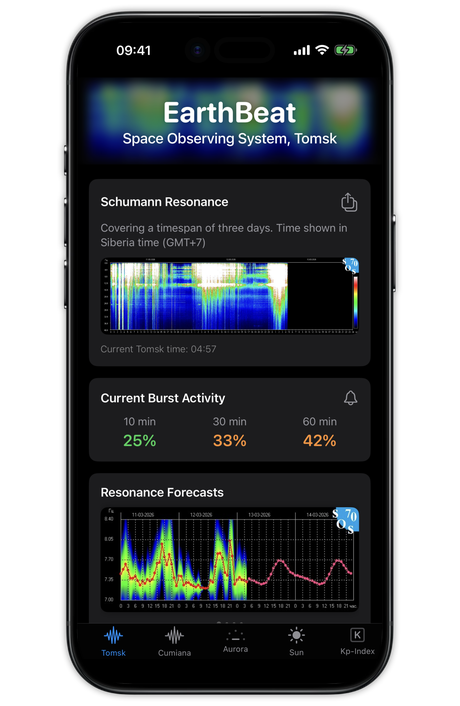
EarthBeat tracks the Schumann resonance, the electromagnetic background of the Earth-ionosphere cavity, by aggregating data from research stations around the world. The signal is real, well-characterised, and uncontroversial in atmospheric physics. EarthBeat does not claim that the SR is the same thing as the etheric body, the aura, prana, qi, chakra energy, or morphic field. None of those equations is supported by the published physics or biology literature.
What EarthBeat does is provide accurate atmospheric-physics data on a real planetary signal. Practitioners of any of the traditions discussed on this page may incorporate that data into their practice in any way they find meaningful. Whether such incorporation has empirical effects beyond what the practice would have without it is a separate question that EarthBeat does not attempt to answer.
The honest framing is that the Western esoteric lineage of subtle-body medicine and the atmospheric physics of the Schumann resonance are studying different things, despite both using the vocabulary of fields and energy. EarthBeat sits in the atmospheric physics column. The traditions sit in their own column, with their own internal logic, their own communities of practitioners, and their own patterns of accuracy and folklore. Holding both honestly is the goal.
Further Reading
Theosophy
- Helena P. Blavatsky, Isis Unveiled (1877) and The Secret Doctrine (1888-1889). Theosophical Publishing Company.
- Annie Besant and Charles W. Leadbeater, Thought-Forms (1901), Occult Chemistry (1908). Theosophical Publishing House.
- Julie Chajes, Recycled Lives: A History of Reincarnation in Blavatsky's Theosophy (Oxford University Press, 2019). Contemporary scholarly history.
- Mark Bevir, "The West Turns Eastward: Madame Blavatsky and the Transformation of the Occult Tradition." Journal of the American Academy of Religion 62(3): 747-767 (1994).
Anthroposophy
- Rudolf Steiner, How to Know Higher Worlds: A Modern Path of Initiation (1909). Various editions.
- Rudolf Steiner, The Philosophy of Freedom (also translated as Intuitive Thinking as a Spiritual Path, 1894). The principal pre-anthroposophy philosophical work.
- Geoffrey Ahern, Sun at Midnight: The Rudolf Steiner Movement and Gnosis in the West (James Clarke, 2009). Critical scholarly history.
- Olav Hammer, Claiming Knowledge: Strategies of Epistemology from Theosophy to the New Age (Brill, 2003). On esotericism's claims to scientific status.
Kirlian photography
- David G. Boyers and William A. Tiller, "Corona Discharge Photography." Journal of Applied Physics 44(7): 3102-3112 (1973).
- Sheila Ostrander and Lynn Schroeder, Psychic Discoveries Behind the Iron Curtain (1970).
Energy healing
- Barbara Ann Brennan, Hands of Light: A Guide to Healing Through the Human Energy Field (Bantam, 1987) and Light Emerging (Bantam, 1993).
- Valerie V. Hunt, Infinite Mind: Science of the Human Vibrations of Consciousness (Malibu Publishing, 1996).
- Wayne B. Jonas et al., "A Critical Overview of Homeopathy." Annals of Internal Medicine 138(5): 393-399 (2003). For context on complementary-medicine epistemology.
Morphic resonance
- Rupert Sheldrake, A New Science of Life (Blond & Briggs, 1981; revised editions 1985, 2009 as Morphic Resonance).
- John Maddox, "A book for burning?" Nature 293(5830): 245-246 (1981).
- Alfonso Gomez-Marin, "Facing biology's open questions: Rupert Sheldrake's 'heretical' hypothesis turns 40." EXPLORE 17(4) (2021).
General critical assessment
- Wouter J. Hanegraaff, New Age Religion and Western Culture: Esotericism in the Mirror of Secular Thought (Brill, 1996; SUNY 1998). The standard scholarly history of New Age esotericism.
- Antoine Faivre, Access to Western Esotericism (SUNY, 1994). For the academic field of Western Esotericism studies.