It is referred to as the heartbeat of the Earth, the planetary frequency, the resonance that keeps our brains in tune with the world. Before the 1950s, this number meant nothing to anyone. It did not exist in any scientific paper, religious text, philosophical work, or piece of common knowledge. There was no Pythagorean tradition of 7.83 Hz, no Vedic chant tuned to it, no Egyptian temple measurement that produces it. The frequency entered human awareness through a specific 1952 calculation by a German physicist who was lecturing on ball capacitors. From there, it took roughly fifty years to migrate from a footnote in atmospheric physics to a cultural icon.
This page is the meta-history of that migration. It is not, primarily, about whether the Schumann resonance affects human biology (the Science Track page on the human body and the SR and the page on geomagnetic activity and the autonomic nervous system treat that question with the peer-reviewed evidence). It is about how a number from physics became a cultural symbol, who carried it across that boundary, what got accurate in the process and what did not, and why the question of whether 7.83 Hz "is rising" became the kind of question that fills wellness feeds. The story is interesting on its own terms.
1952: Schumann's Calculation
The story begins in a lecture hall at the Technische Hochschule München in 1952. Winfried Otto Schumann (1888-1974), a professor of electrophysics, was teaching his students about ball capacitors. During the lecture he posed a problem: what would the resonant frequency be in the cavity formed by two concentric conducting spheres, namely the Earth and the ionosphere? The students, working out the calculation, arrived at a value of approximately 10 Hz.
Schumann developed the calculation into a series of theoretical papers. The first appeared in 1952 in Zeitschrift für Naturforschung A under the title Über die strahlungslosen Eigenschwingungen einer leitenden Kugel, die von einer Luftschicht und einer Ionosphärenhülle umgeben ist ("On the non-radiating natural oscillations of a conducting sphere surrounded by an air layer and an ionosphere shell"). Between 1952 and 1957 he published roughly twenty papers on the topic. The historical synopsis is laid out in detail in a 2007 Radio Science paper by Heinrich Besser, Synopsis of the historical development of Schumann resonances, which remains the authoritative reference.
What Schumann predicted was that the cavity between Earth and ionosphere should sustain standing electromagnetic waves at a fundamental of around 7 to 10 Hz, with harmonics. He did not predict 7.83 Hz specifically; the precise value depends on the cavity's actual dimensions and electrical properties, which were not fully known in 1952. The fundamental was eventually measured at approximately 7.83 Hz with substantial daily, seasonal, and solar-driven variation around that value. The number 7.83 emerged from later measurement, not from Schumann's original derivation.
1952-1954: Schumann and König attempt measurement. Schumann, with his graduate student Herbert König, attempted to measure the predicted resonances in 1952-1954. Their equipment was not sensitive enough to extract the signal from background noise reliably. Schumann remained primarily a theorist; the practical measurement problem fell to others.
1960-1963: Confirmation by Balser and Wagner. Martin Balser and Charles Wagner at MIT made the first reliable measurements in 1960-1963, using sensitive antennas at the Geophysical Field Station in Aberdeen, Scotland. Their papers in Nature (1960) and the Journal of Geophysical Research (1962-1963) confirmed Schumann's prediction. Independently, Charles Polk and Frederick Fitchen at the University of Rhode Island in Kingston published measurements in the National Bureau of Standards Journal of Research in 1962. The phenomenon was now experimentally established.
What 7.83 Hz meant at this point: a peak in the electromagnetic background of the Earth-ionosphere cavity, produced by global lightning, of interest to radio engineers, atmospheric physicists, and a small community studying ELF (extremely low frequency) propagation. It had no cultural meaning whatsoever. It was a physics result.
The Biology Bridge: König, Ankermüller, and EEG Alpha
Two things connected 7.83 Hz to biology, and they both happened quickly.
The first was an observation made almost immediately on publication. The dominant rhythm of the human EEG in relaxed awakeness, the alpha rhythm, falls roughly between 8 and 13 Hz. The Schumann fundamental at 7.83 Hz sits just at the lower edge of this band. A German physician named Ankermüller, reading Schumann's Technische Physik paper, was struck by the closeness and contacted Schumann to suggest a possible biological significance. Schumann assigned the question to König, who developed it into one of his life's interests.
The second was König's persistent comparative work. Between the 1950s and his 1979 publication of Unsichtbare Umwelt (Invisible Environment), König catalogued the close match between Schumann modes and various biological rhythms. His 1979 figure, comparing natural electromagnetic processes to human EEG records, became one of the most-reproduced images in the literature. König also refined the measurement of the Schumann fundamental, settling on a value of approximately 7.83 Hz, which has been the cited figure ever since.
It is worth being honest about what this match is and is not. The Schumann fundamental at 7.83 Hz is at the bottom edge of the EEG alpha band. The alpha band itself spans roughly 8 to 13 Hz, depending on the individual and the measurement convention. Mammalian hippocampal theta rhythms (which Gray reported in 1982 with a 7.7 Hz minimum threshold for septal driving in rats) overlap the SR fundamental more closely, but theta is not the same as alpha. The fact that Earth's electromagnetic background and the human brain operate in similar frequency ranges is interesting and worth noticing, but it does not by itself demonstrate any specific causal coupling. The Schumann fundamental did not "make" alpha rhythms evolve at 8 to 13 Hz; it sits adjacent to them. The biological-resonance hypothesis (that life on Earth is shaped by the electromagnetic background of the planet) is a serious one, but it remains a hypothesis. The frequency overlap is the starting point of the hypothesis, not its proof.
For the cultural diffusion of 7.83 Hz, what mattered was that König's work made it possible to talk about the Schumann resonance and human brain rhythms in the same sentence. From this point forward, the number was no longer purely a physics result. It had biological resonance, in both the literal and figurative senses.
Wever's Bunker: What Actually Happened
The story most often told in 7.83 Hz wellness literature involves Rütger Wever and an underground bunker at Erling-Andechs, Germany. The story usually runs something like this: Wever placed students in an electromagnetically shielded bunker; they got sick within days; he secretly introduced a 7.83 Hz generator; they recovered; this proves that humans need 7.83 Hz to be healthy. The story is repeated across hundreds of websites with minor variations, and is one of the most cited pieces of "evidence" for SR-wellness claims.
The actual research is interesting and worth knowing accurately.
Rütger Wever (1923-2010) was a German chronobiologist working at the Max Planck Institute for Behavioural Physiology in Erling-Andechs, in collaboration with Jürgen Aschoff. Between 1964 and 1989 they conducted approximately 418 studies in 447 volunteers, using two underground experimental rooms. One room was electromagnetically shielded; the other was not. The shielded room blocked natural electric and magnetic fields, including the Schumann resonance, at much greater attenuation than ordinary buildings.
What Wever found, summarised in his 1970 paper The effects of electric fields on circadian rhythmicity in men (Life Sciences and Space Research 8: 177-187) and elaborated in subsequent publications: the mean circadian period of subjects living in the shielded room was statistically longer than in the unshielded room (p < 0.01). Real internal desynchronisation, where the sleep-wake rhythm and the body-temperature rhythm decouple, occurred only in the shielded room (p = 0.0001). Apparent desynchronisation with circa-bi-dian (roughly 48-hour) activity periods occurred only in the unshielded room (p = 0.01). Wever concluded that the natural electromagnetic fields shorten the circadian period and strengthen the coupling between the activity rhythm and other physiological rhythms.
Some experiments did include the introduction of an artificial low-frequency electromagnetic field (around 10 Hz, near but not exactly 7.83 Hz), and these experiments did show partial restoration of normal circadian behaviour. This is a real finding, published in peer-reviewed journals, and it is the empirical basis of the wellness claim.
What the wellness telling has typically added that is not in the published research:
- The students did not "get sick" in the dramatic sense often portrayed. They showed lengthened circadian periods and increased desynchronisation, statistically detectable but subjectively often not noticed.
- Wever's introduction of a 10 Hz field was not a secret experiment with dramatic before-and-after effects. It was part of a long programme of carefully controlled experiments.
- The frequency used was approximately 10 Hz, not specifically 7.83 Hz. The wellness literature has retroactively assigned the 7.83 Hz value.
- The mechanism, then and now, is not understood. Wever's findings showed an effect; they did not establish what the effect was caused by.
The honest summary: Wever's research showed that complete electromagnetic shielding from natural fields has small but statistically detectable effects on human circadian rhythms, and that introducing an artificial low-frequency field can partially restore normal patterns. This is a real and interesting finding. It does not, by itself, establish that 7.83 Hz specifically is the active frequency, or that humans get "sick" without it. The cultural retelling has tightened and dramatised the actual research considerably.
For the chronology of the 7.83 Hz story, what mattered is that Wever's work, conducted over decades and citing some of the largest controlled studies of human circadian rhythms ever performed, became the empirical anchor for the claim that humans need the Schumann frequency. The anchor is real but smaller and less dramatic than the cultural use of it.
1977: Bentov's Stalking the Wild Pendulum
The decisive moment in the migration of 7.83 Hz from physics to popular culture was the 1977 publication of Itzhak Bentov's Stalking the Wild Pendulum: On the Mechanics of Consciousness. Bentov (1923-1979) was an Israeli-American inventor, the developer of a steerable cardiac catheter that became standard in cardiology, and an autodidact with broad interests in consciousness research, meditation, and physics. He had no formal credentials in physics or biology.
Stalking the Wild Pendulum proposed that during meditation, the human body enters a state of mechanical resonance involving the heart's pumping action and the elastic properties of the aorta, producing a standing wave that reverberates through the skeleton and ultimately couples the meditator to the Earth-ionosphere cavity at the Schumann fundamental. The book described this in a chapter called The Body as a Tuning Fork. The mechanical model is mostly speculative and has not been validated in subsequent biomechanical research. The proposed coupling between the meditating body and the SR is similarly speculative. But the book is engaging, accessible, and confident in tone, and it gave the wellness world a vivid picture of why 7.83 Hz might matter for inner life.
Bentov's contribution to the cultural diffusion of 7.83 Hz cannot be overstated. Before Stalking the Wild Pendulum, the SR was a topic for atmospheric physicists. After it, the number had a place in spiritual literature. Bentov died in an airplane crash in 1979, and the book has remained continuously in print since. Many of the wellness claims about 7.83 Hz that circulate today can be traced, more or less directly, to a paragraph in Bentov.
It is worth distinguishing here. Bentov's enthusiasm for the SR is part of the older intuition that the human nervous system is in conversation with the electromagnetic environment of the planet. That intuition may turn out to have something to it; some of the peer-reviewed literature on geomagnetic activity and HRV suggests modest statistical effects (see the Science Track page on geomagnetic activity and the autonomic nervous system). But Bentov's specific mechanical-resonance-of-the-aorta hypothesis is not supported by the biomechanical literature, and his elaborate theoretical framework involves a great deal of speculation presented in the confident voice of someone explaining established facts. Stalking the Wild Pendulum is best read as a 1970s work of speculative consciousness writing in the same family as Fritjof Capra's The Tao of Physics (1975) and Gary Zukav's The Dancing Wu Li Masters (1979), not as an account of established science.
The Wider 1970s to 1990s Diffusion: Smith, Ludwig, Hainsworth
A handful of other figures helped carry 7.83 Hz across the boundary from physics to wellness.
Cyril W. Smith (1930-2024) was a British electrical engineer with a position at the University of Salford whose work on bioelectromagnetics and "electromagnetic hypersensitivity" placed the SR within a wider framework of biological responses to electromagnetic fields. His 1989 book Electromagnetic Man (with Simon Best) treated SR exposure as one element of a broader environmental-electromagnetic picture. Smith's work has been highly influential in the European bioelectromagnetics community and remains contested in mainstream science.
Wolfgang Ludwig (1927-2004) was a German physicist who continued and extended König's biological-resonance research, founding the Institut für Biophysik in Tübingen and developing therapeutic devices based on Schumann frequencies. His 1995 book Schumann Resonance and Its Effect on Human Behavior (translated from German) is widely cited in bioresonance literature. Ludwig's work has been influential in European complementary medicine but is not part of mainstream biomedical research.
Lewis B. Hainsworth was a British electrical engineer whose hypothesis (published in Medical Hypotheses in 1983) held that human brain-wave frequencies evolved to fit the electromagnetic envelope of the Earth-ionosphere cavity. The hypothesis is a more careful articulation of the biological-resonance idea: not that the Schumann frequencies cause specific biological effects, but that life on Earth has evolved within a particular electromagnetic environment and is therefore tuned to it. Hainsworth's hypothesis is testable in principle, has not been definitively confirmed, and remains in the speculative-but-interesting category.
Michael Persinger (1945-2018), at Laurentian University in Sudbury, Ontario, conducted a large body of research on the effects of weak electromagnetic fields on the brain, including studies of correlations between geomagnetic activity and neurological events. His work is part of the peer-reviewed literature on geomagnetic-biological coupling and is treated more fully on the Science Track page on the human body and the Schumann resonance. Persinger and his collaborator Kevin Saroka have published specifically on SR-EEG coherence.
These figures together produced a body of literature that, by the 1990s, made it possible to write about 7.83 Hz as a topic in human biology and to find citations for the claim. Whether the claims are correct is a separate question; the citations exist. This is the period in which the 7.83 Hz idea moved from a single popularising book (Bentov) into a broader literature that wellness writers could draw on.
The "NASA Schumann Generator" Story
One specific claim deserves direct treatment because it appears in nearly every wellness piece on 7.83 Hz: that NASA installs Schumann resonance generators in spacecraft to keep astronauts healthy in the absence of the Earth's natural field.
This claim is not supported by any documentation from NASA or by any working aerospace engineer with relevant expertise. It is denied by people who have worked on the relevant programmes. The claim appears to have originated in the late 1990s in wellness literature, propagated through repetition, and has no traceable primary source.
A NASA employee, posting on the audiophile forum Audio Asylum in 2015, wrote bluntly: "Trust me, NASA never used Schumann devices, supposedly on the Shuttle. I was fooled for about ten seconds by all the New Age and Health sites that talk about NASA having a Schumann generator. It's what we call an old wives' tale." The Cosmoquest astronomy forum has carried multiple debunkings of the same claim. Skeptical analyses have repeatedly searched for documentation and found none.
This does not mean NASA has no interest in the SR. NASA has substantial scientific interest in Schumann resonances; the agency's Goddard Space Flight Center and Ames Research Center have hosted SR research, and a 2023 white paper by Viktor Stolc and David J. Loftus of NASA Ames, The Impact of the Schumann Resonance on Biological Cells, was submitted to the NASA Biological and Physical Sciences division reviewing the biological-effects literature. The paper is honest about the state of evidence and is worth reading. NASA scientists working on this topic do so as scientists, examining published evidence; this is different from "NASA installs SR generators in spacecraft", which is folklore.
The honest summary: the SR is a real topic of scientific interest at NASA. The specific claim that NASA installs 7.83 Hz generators in spacecraft to protect astronaut health is not documented, denied by sources with relevant knowledge, and best understood as a piece of cultural folklore that has been repeated until it acquires the appearance of fact. When you see this claim on a wellness website, it is reasonable to discount.
The Internet Era: Trackers, Apps, and the "Is It Rising?" Question
Through the 2000s and 2010s, 7.83 Hz arrived in mass internet culture. Several developments mark the path.
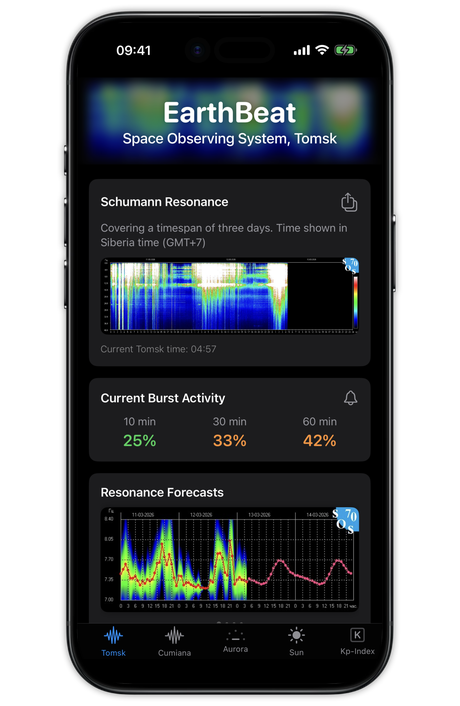
Real-time tracking sites. Websites began publishing live or near-live readings of the Schumann resonance from research stations, particularly the Tomsk station in Russia. The most widely cited has been the live spectrogram at the Space Observing System of Tomsk State University. The data is real research data; the cultural use of it has often been speculative.
The rising-frequency story. Beginning in the late 1990s and accelerating through the 2010s, a story circulated that the SR was "rising" from its baseline of 7.83 Hz, often citing values of 8 Hz, 11 Hz, 13 Hz, or higher, and connecting this to spiritual evolution, the 2012 phenomenon, the ascension narrative, or planetary consciousness shifts. The actual SR fundamental has not been rising; it varies daily and seasonally around its baseline due to ionospheric conditions, and it can spike briefly during certain events (notably geomagnetic storms or large solar flares). Spectrograms display higher harmonics (14.3, 20.8, 27.3, 33.8 Hz) which, when read by people unfamiliar with multi-mode spectrograms, can be misinterpreted as the fundamental "rising". The Science Track page on long-term SR trends treats this question with the data; the short answer is that the SR has not been rising in the way the wellness story claims.
Mobile apps. From around 2018 onward, a family of consumer apps appeared offering live SR data, alerts, history, and increasingly elaborate interpretations. EarthBeat is one such app. The apps differ widely in the quality of their data sourcing, the framing of what the SR is and is not, and the accuracy of their wellness claims. EarthBeat aims to provide accurate data with honest interpretation, and to surface the contemplative-traditions context (this Awareness Track) without overclaiming what the science shows.
Social-media diffusion. Instagram, TikTok, and YouTube wellness creators have made 7.83 Hz part of the standard vocabulary of contemporary spiritual culture. Generators, frequency-tuned music tracks, "7.83 Hz binaural beats", and devices for the home have proliferated. The frequency now has a cultural meaning roughly equivalent to "Earth's spiritual heartbeat" or "the planetary tuning note", regardless of what the underlying physics actually says.
By 2026, 7.83 Hz is a cultural icon. It is referenced in yoga studios, sound-healing sessions, app interfaces, and bestselling spiritual-wellness books. Its cultural meaning has substantially outrun the science that produced it. This is not, in itself, a bad thing; it is a normal pattern in how scientific results get culturally absorbed. But the gap is worth being honest about.
What Happened in the Migration: Honest Accounting
Stepping back across seventy years of cultural diffusion, several patterns are worth naming.
What survived accurately. The basic physics is right. There is a Schumann resonance at approximately 7.83 Hz, generated by global lightning in the Earth-ionosphere cavity, predicted by Schumann in 1952 and measured beginning in the early 1960s. The frequency is real, the phenomenon is real, the underlying science is uncontroversial. This part of the cultural inheritance is correct.
What got tightened or dramatised. Wever's bunker experiments, real research with statistically detectable effects, became dramatic stories of students getting sick and being cured. The wellness retelling has consistently amplified the magnitude of the effects beyond what the published research shows. The Bentov mechanical-resonance hypothesis, presented speculatively in 1977, has often been retold as established fact. König's frequency match between SR and EEG alpha (a real and interesting observation) has been retold as proof of biological coupling (a stronger claim that the data does not support).
What was never true. The "NASA Schumann generator" story is not documented. The "SR is rising" narrative does not match the data. Specific therapeutic claims for 7.83 Hz devices (that they cure conditions, fix sleep, balance hormones, and so on) are not generally supported by peer-reviewed evidence, though some HRV-effect studies show modest correlations.
What is genuinely interesting. That life on Earth evolved within a specific electromagnetic environment, and that biological rhythms might be influenced by that environment, is a serious hypothesis with some evidence and many open questions. Geomagnetic-HRV correlations have been replicated in peer-reviewed work. The frequency overlap between SR and EEG alpha is real, even if the causal interpretation is not established. The Hainsworth hypothesis is testable in principle. These are live scientific questions.
What is folklore. The dramatic Wever story, the NASA generator, the rising-frequency narrative, the specific therapeutic claims, and the elaborate metaphysical interpretations are folklore in the technical sense: stories that have spread and acquired cultural authority through repetition rather than through evidence.
What survived accurately. What got tightened or dramatised. What was never true. What is genuinely interesting. What is folklore. Five honest categories for any 7.83 Hz claim you encounter.
Why This Matters
For someone using EarthBeat or any other SR tracker, the practical question is: what should I make of the data?
The honest answer is that the data is real, the phenomenon is real, and the cultural lore around it is mixed. You can hold the SR signal in either of two registers, or both. The scientific register: this is the electromagnetic background of the planet you live on, fluctuating with global weather and solar conditions, of genuine interest in atmospheric physics. The contemplative register: this is one of the rhythms of the planet, audible in a literal physical sense, that you can choose to attend to as part of a wider relationship with the place where you live.
What you should not do, on the basis of the cultural lore alone, is reorganise your medical care, attribute mood changes to SR fluctuations, or believe that a 7.83 Hz generator will fix specific problems. The science does not support those uses. The science does support the more modest claim that human physiology and the Earth's electromagnetic environment are in some kind of conversation, and that paying attention to that conversation is a reasonable thing to do.
For the meta-history specifically, what is striking is how little time it took. From 1952, when 7.83 Hz did not exist as a cultural object, to 2026, when it is a globally circulating wellness icon, is seventy-four years. The path went through a lecture-hall calculation, a few decades of physics measurement, two decades of biological-resonance research, one hugely influential popular book (Bentov), several decades of fringe-to-mainstream wellness diffusion, and the internet age's amplification effects. The pattern is not unique to 7.83 Hz; many scientific results undergo similar journeys. But the specifics of this one are worth knowing if you are going to engage with the number at all.
What EarthBeat Shows
EarthBeat does not measure anything directly. It displays real-time and historical Schumann resonance data sourced from the Tomsk and Cuminiana research stations. The data is the data. The interpretation is yours.
What EarthBeat does not do: claim that 7.83 Hz cures disease, restores cellular vitality, balances hormones, or accomplishes any of the specific therapeutic outcomes that some 7.83 Hz devices and apps claim. These claims are not supported by the peer-reviewed evidence and EarthBeat does not make them.
What EarthBeat does do: provide accurate atmospheric-physics data, contextualise it within the science (in the Science Track) and the older contemplative traditions (in the Awareness Track), and give the user the information they need to form their own relationship with the signal.
Further Reading
Primary scientific history
- Schumann, W.O. (1952). "Über die strahlungslosen Eigenschwingungen einer leitenden Kugel, die von einer Luftschicht und einer Ionosphärenhülle umgeben ist." Zeitschrift für Naturforschung A 7: 149-154.
- Balser, M., and Wagner, C.A. (1960). "Observations of Earth-Ionosphere Cavity Resonances." Nature 188: 638-641.
- Polk, C., and Fitchen, F. (1962). "Schumann Resonances of the Earth-Ionosphere Cavity: ELF Reception at Kingston, R.I." Journal of Research of the National Bureau of Standards 66D(3): 313-318.
- Besser, B.P. (2007). "Synopsis of the historical development of Schumann resonances." Radio Science 42: RS2S02. The authoritative history.
The biology bridge
- König, H.L. (1979). Unsichtbare Umwelt: Der Mensch im Spielfeld elektromagnetischer Kräfte. Munich: Selbstverlag.
- Wever, R. (1970). "The effects of electric fields on circadian rhythmicity in men." Life Sciences and Space Research 8: 177-187.
- Wever, R. (1979). The Circadian System of Man: Results of Experiments under Temporal Isolation. New York: Springer-Verlag.
- Hainsworth, L.B. (1983). "The effect of geophysical phenomena on human health." Medical Hypotheses 11(4): 391-403.
The popular diffusion
- Bentov, Itzhak (1977). Stalking the Wild Pendulum: On the Mechanics of Consciousness. New York: E.P. Dutton.
- Smith, Cyril W., and Best, Simon (1989). Electromagnetic Man: Health and Hazard in the Electrical Environment. London: Dent.
- Ludwig, Wolfgang (1995). Schumann-Resonanz und ihre Bedeutung. Paracelsus.
Contemporary scientific assessment
- Stolc, V., and Loftus, D.J. (2023). The Impact of the Schumann Resonance on Biological Cells. NASA Biological and Physical Sciences white paper. science.nasa.gov
- Cherry, N. (2002). "Schumann Resonances, a plausible biophysical mechanism for the human health effects of Solar/Geomagnetic Activity." Natural Hazards 26(3): 279-331.
- Saroka, K.S., and Persinger, M.A. (2014). "Quantitative evidence for direct effects between earth-ionosphere Schumann resonances and human cerebral cortical activity." International Letters of Chemistry, Physics and Astronomy 39: 166-194.