Across the contemplative traditions of the world, the heart is something else. In the Islamic Sufi tradition it is qalb, the organ of spiritual perception, the throne of the divine, the mirror that reflects reality. In the Christian contemplative tradition it is the kardia, the place into which the mind descends in prayer, the locus where human and divine meet. In the Hindu yogic tradition it is hridaya, the cave of the heart, the seat of the Self and the source of consciousness itself. In the Hebrew Bible the heart (lev or levav) is the organ of understanding, of will, of what a person truly is. The Christian Gospels say out of the abundance of the heart the mouth speaks. The Chinese medical tradition calls the heart (xin) the emperor of the organs, the home of shen or spirit.
This is not the same organ the cardiologist sees. Or rather, it is the same physical organ, but the traditions treat it as something more. For thousands of years, people in very different places independently came to the view that the heart is the seat of a kind of knowing distinct from the intellect, and that this knowing can be cultivated by specific practices.
This page is an attempt to describe, carefully and with sources, what several traditions have said about the heart as an organ of perception, and what modern research on the heart has and has not established. The aim is not to claim that qalb and kardia and hridaya are all describing the same thing, nor that contemporary heart-rhythm research confirms ancient doctrines. The aim is to hold both pictures honestly alongside each other.
The Sufi Heart: Qalb
The word qalb in Arabic comes from a root meaning "to turn, to transform". The Sufi tradition has made much of this etymology. The human heart, in Sufi teaching, is in perpetual flux, never the same from moment to moment. A famous prayer attributed to the Prophet Muhammad plays on the same root: O Turner of hearts, establish my heart upon Thy religion. Another hadith says: the heart of the believer is between God's two fingers.
The Qur'an itself makes the heart the organ of genuine perception. In Sura 22:46: For indeed it is not the eyes that grow blind, but it is the hearts, which are within the chests, that grow blind. In Sura 13:28: Verily, in the remembrance of God do hearts find rest. The Islamic tradition built on these verses a detailed theology of the heart as the site where spiritual knowledge actually happens.
Ibn al-'Arabi, the 12th-13th century Andalusian Sufi known as al-Shaykh al-Akbar (the Greatest Master), gave the teaching its most complete expression. For Ibn 'Arabi, the heart has two eyes, reason ('aql) and imagination, and the dominance of either distorts perception. The heart is a mirror; when polished by spiritual practice, it reflects the divine realities that impinge on it. Ibn 'Arabi wrote the verses, still quoted widely:
My heart has become receptive to any form:
A meadow for gazelles, a cloister for monks,
A house for idols, and the pilgrim's Ka'ba,
The tablets of the Torah, the scrolls of the Qur'an.
My creed is love and wherever its caravan turns along the way,
That love is my belief, my faith.
Jalal al-Din Rumi (d. 1273) developed the same teaching in Persian poetry. For Rumi, the heart (qalb in Arabic; dil in Persian) is the primary faculty of spiritual perception. He and al-Ghazali before him compared the knowledge of reason to irrigation channels running along the surface of the earth, and the knowledge of the heart to a spring welling up from deep beneath the earth's surface. The two kinds of knowing are distinct, and the Sufi path is about transferring the centre of gravity from the first to the second.
The practice by which this is accomplished, in most Sufi orders, is dhikr (or zikr), the remembrance of God through repetition of a sacred phrase or name. The Qur'an verse verily in the remembrance of God do hearts find rest is understood as a practical instruction. The Naqshbandi order, one of the major Sufi lineages, teaches dhikr khafi, silent heart-remembrance, in which the repetition descends from the tongue into the chest and becomes a rhythm of the heart itself. This is a lineage in which the practitioner literally synchronises mental repetition with the heartbeat.
What the Sufi tradition says is clear and specific. The heart is not merely a metaphor for feeling. It is an organ with a specific function in spiritual knowing, cultivatable by specific practices, located in or near the physical chest, accessed through the stilling of discursive thought and the polishing of what Ibn 'Arabi called the mirror. The tradition does not confuse it with the pump, but it also does not fully separate them. The physical location matters.
The Christian Heart: Kardia and the Prayer of the Heart
A remarkably parallel tradition developed in Eastern Christianity. The Greek word kardia appears in the New Testament at key moments: out of the abundance of the heart the mouth speaks; blessed are the pure in heart, for they shall see God. The Christian contemplative tradition took this not as metaphor but as practical guidance. If the pure heart sees God, then cultivating purity of heart, literally, became the whole task.
The line of practice that emerged is called hesychasm, from the Greek hesychia, meaning stillness or silence. Its earliest roots lie with the Desert Fathers of the 4th century, particularly Evagrios of Pontos and Macarius the Great, and it developed into a continuous tradition across Byzantine monasticism. The Philokalia, an anthology of 36 spiritual texts compiled in Greek and first published in 1782 by Nikodemos of the Holy Mountain and Makarios of Corinth, collects the tradition's key writings from the 4th to the 15th century.
Hesychast practice centres on the Jesus Prayer: Lord Jesus Christ, Son of God, have mercy on me. The prayer is repeated slowly, often synchronised with the breath, with the attention gradually moved from the lips to the mind and from the mind down into the heart. The goal is not a particular emotional state but a descent of awareness: the nous (mind or attention) is to settle in the kardia. Theophan the Recluse, a 19th-century Russian bishop who wrote extensively on the practice, described this as going from the mind into the heart.
The practice became the centre of a major 14th-century theological controversy. Barlaam of Calabria, an Italian monk influenced by Aristotelian scholasticism, attacked the hesychasts for their physical methods (breath-synchronisation, attention on the chest) as superstitious materialism. Gregory Palamas (1296-1359), a monk of Mount Athos and later Archbishop of Thessalonica, defended the practice in writings collected as the Triads. Palamas argued that because the human being is a unity of body and soul, the body rightly participates in prayer; and that the uncreated light experienced by hesychasts in deep prayer (the same light, he held, that shone from Christ at the Transfiguration) is a genuine divine energy accessible through the practice. Palamas prevailed at the Councils of Constantinople in 1341, 1347, and 1351. His theology of divine energies (energeiai) as distinct from the divine essence remains foundational in Eastern Orthodox theology.
What Palamas and the hesychast tradition insist on is striking from a contemplative-comparative angle. The heart is not a symbol. It is the actual place where the prayer goes. The nous physically descends to the chest, the breath rhythms with the name of Jesus, and what is encountered there is not a mental construction but the real presence of God. This is a tradition that takes the embodied heart seriously as an organ of perception, maintained continuously for at least sixteen centuries.
The 20th century saw a revival of hesychast practice in Eastern Orthodoxy and a partial uptake in Western Christian contemplative circles. Thomas Merton, the Trappist monk whose writings helped introduce the Philokalia to English-speaking readers, drew attention to the depth of this tradition. The influence continues in centering prayer, lectio divina, and related practices in the contemporary Catholic and Anglican worlds.
The Yogic Heart: Hridaya
The Indian yogic and Vedantic traditions have their own, even older teaching. The Sanskrit word hridaya (often shortened to hrid) means heart, but in the Upanishads and later in Advaita Vedanta it refers not to the physical organ but to the spiritual heart, described as a cave (guha) in which the Self (atman) resides.
The Chandogya Upanishad (one of the oldest Upanishads, probably 8th-7th century BCE) teaches the Dahara Vidya, the "knowledge of the small space": In the city of Brahman, there is a small lotus-shaped palace; in it is a small space. That which is within that is to be searched out, that is to be understood. The text immediately expands: as vast as this space outside is, so vast is the space within the heart. Heaven and earth, fire and air, the sun and the moon, the lightning and the stars, all that is and all that is not, are within this space.
The teaching persists through the Upanishadic tradition. The Maha Narayana Upanishad describes the heart, located near the chest, as the seat of the universal form of paramatman. The Katha Upanishad uses the word guha for the cave of the heart in which the Self is hidden. The Bhagavad Gita (Chapter 18, verse 61) says that the Lord dwells in the heart of all beings.
In the 20th century, this teaching was given renewed clarity by Ramana Maharshi (1879-1950), the Advaita sage of Arunachala in Tamil Nadu. Ramana taught that the spiritual heart, hridaya, is located in the right side of the chest, about a finger-width to the right of the body's midline. He distinguished this carefully from the physical heart, which is on the left, and from the anahata chakra in the heart-chakra system of tantric yoga, which is in the centre of the chest. The spiritual hridaya in Ramana's teaching is the source of the "I"-consciousness and the seat of the Self. He described a channel, atma nadi, carrying consciousness from the heart to the brain, and taught atma vichara (Self-inquiry) as a practice: asking who am I? and tracing the "I"-thought back to its source in the heart.
Ramana's teaching has been highly influential in modern non-dual circles. The basic pattern it preserves, the heart as the seat of the deepest self, accessed through inquiry and meditation rather than discursive thought, is much older than Ramana himself. The Chandogya Upanishad had already said it, thousands of years before.
Other Traditions, Briefly
The pattern of the heart as the organ of perception and knowing, distinct from the intellect and accessed through different practices, shows up in other traditions that we cannot treat at length here.
In the Hebrew Bible, lev and levav (both meaning heart) appear over 850 times and serve as the primary organ of thought, will, emotion, and moral capacity. Create in me a clean heart, O God (Psalm 51). Keep thy heart with all diligence, for out of it are the issues of life (Proverbs 4:23). Later Jewish mystical traditions, particularly Kabbalah, developed a detailed understanding of the heart's role in meditative practice and in the descent of divine light.
Traditional Chinese medicine names the heart (xin) as the emperor among the organs and the dwelling place of shen, the spirit or consciousness. Daoist internal alchemy has extensive practices focused on the heart as a centre of transformation, and the heart-mind (also xin) is treated as a single faculty in classical Chinese philosophy.
Tibetan Buddhist tantric traditions locate the indestructible drop of consciousness in the heart centre at the moment of death, making it the anatomical locus of the subtle body's most important point.
This cross-cultural pattern is striking. Traditions that did not know about each other, in languages that did not share a root, independently arrived at something similar: the heart is not only a pump, and it can be trained as an organ of a particular kind of knowing.
What Modern Heart Research Shows
The question of whether any of this finds echo in modern physiology is its own complex story. It is honest to start with what is established.
The heart is electrically active in its own right. The heart has its own intrinsic pacemaker (the sinoatrial node) and generates the strongest electromagnetic field of any organ in the body, detectable several feet from the chest with sensitive magnetometers. This is standard cardiology.
The heart has its own nervous system. Research in neurocardiology, particularly the work of J. Andrew Armour from the 1990s onward, has characterised what is sometimes called the "heart brain" or "intrinsic cardiac nervous system": a network of roughly 40,000 neurons embedded in the heart itself, with sensory neurons, interneurons, and motor neurons, capable of a degree of local information processing independent of the brain. Armour's work is published in peer-reviewed cardiology and neuroscience journals.
More afferent than efferent signals. The vagus nerve, the main parasympathetic connection between heart and brain, carries more signals from heart to brain than from brain to heart, a finding established in standard physiology. The heart sends information to the brain continuously about blood pressure, rhythm, and chemical states, and this afferent information influences the brain's emotional and cognitive processing.
Heart rate variability as a measure of autonomic function. The beat-to-beat variation in heart rate (HRV) reflects the dynamic balance of sympathetic and parasympathetic activity. Low HRV is associated with stress, poor health outcomes, and reduced capacity to adapt to challenges; higher HRV is associated with resilience and wellbeing. HRV is an established clinical measure used in cardiology, psychiatry, and stress research.
This is the established picture. It does not, by itself, say anything about the heart as an organ of spiritual perception. What it does say is that the heart is more than a pump in a specific, measurable sense: it is a complex, electrically active, locally-intelligent organ in continuous two-way conversation with the brain, and its rhythm reflects the state of the autonomic nervous system.
HeartMath and the Coherence Model
The research programme most directly connecting the traditional contemplative picture with modern heart physiology is the work of the HeartMath Institute, founded in 1991 by Doc Childre in Boulder Creek, California. The Institute's research director since the mid-1990s has been Rollin McCraty, whose work has been published in journals including Integral Review, Frontiers in Psychology, Frontiers in Public Health, Applied Psychophysiology and Biofeedback, and Scientific Reports.
HeartMath's central concept is psychophysiological coherence (also called heart rhythm coherence or cardiac coherence). The researchers found that when people cultivate positive emotions (appreciation, care, compassion) while maintaining heart-focused attention and paced breathing, the HRV rhythm shifts into a characteristic ordered, sine-wave pattern centred around approximately 0.1 Hz (one cycle every ten seconds, close to the baroreflex resonance frequency). In this state, heart rhythm, breathing, and blood pressure oscillations tend to synchronise. A recent large-scale study analysing 1.8 million user sessions from the Inner Balance mobile app (Balaji et al., 2025, Scientific Reports) confirmed 0.1 Hz as the most common coherence frequency, with some users showing stable patterns in a slightly lower 0.04 to 0.10 Hz range.
What is reasonably established from HeartMath and related HRV biofeedback research:
- Coherence breathing (slow breathing around 5 to 6 breaths per minute) reliably increases HRV amplitude and shifts it into a sinusoidal pattern. This is well-documented and widely replicated by HeartMath and by independent researchers such as Paul Lehrer, Evgeny Vaschillo, and others.
- HRV biofeedback training has been shown, in a growing body of peer-reviewed studies, to reduce anxiety, improve emotional self-regulation, and help with conditions including PTSD, hypertension, and post-traumatic dysregulation.
- Heart rhythm patterns differ reliably between emotional states of stress and emotional states of positive affect; the "coherent" pattern correlates with subjectively positive experience.
What is less well-established and should be stated carefully:
- HeartMath's wider claims about heart-to-heart electromagnetic communication between people, and about global heart-field effects, are less supported by independent replication. The underlying physics of macroscopic electromagnetic coupling between people at conversational distances remains debated.
- The identification of HeartMath's measurable "coherence" state with the spiritual states described by contemplative traditions is a metaphorical extension, not a demonstrated equivalence. A stable 0.1 Hz HRV rhythm is a real physiological state; whether it is the same thing that Rumi or Ramana meant by the polished heart is a separate and more speculative question.
The honest summary: the HeartMath line of research has produced measurable, replicable findings about heart rhythms, breathing, emotion, and health, alongside broader claims that remain more speculative. The measurable findings are real. The larger claims deserve more caution than they are often given in the wellness literature.
What the Traditions Share, What Science Can and Cannot Say
Stepping back across the Sufi, Christian, yogic, and other teachings on the heart, a pattern emerges that is honest to name.
The traditions agree that the heart has a specific role in spiritual perception distinct from the role of the discursive mind. They agree that this role is cultivatable by practices involving attention, breath, and repetition, often synchronised with the beat or location of the physical heart. They agree that the cultivation takes time and is taught from person to person rather than learned from books alone.
The Sufi qalb is the mirror in which God contemplates Godself. The Christian kardia is the place where the soul meets divine energies. The yogic hridaya is the cave in which the non-dual Self resides. These are different pictures, drawn with different theological vocabularies, and they should not be collapsed into each other.
They disagree about the metaphysics. The experiences the traditions describe have recognisable family resemblances, which is what has allowed comparative scholarship (from William James's Varieties of Religious Experience in 1902 to Aldous Huxley's The Perennial Philosophy in 1945 to contemporary work in comparative mysticism) to treat them in a single field of study.
Modern physiological research can confirm some things and not others. The heart does have its own nervous system; it does communicate extensively with the brain; it does show distinct rhythm patterns in different emotional states; it can be trained to rhythms associated with wellbeing. Research cannot tell you whether the mirror of the heart reflects the divine, whether the nous descends to the chest and meets God, or whether the Self lives in the cave of the heart. These are claims of a different order, and the instruments we have are not designed to test them.
What the science says and what the traditions say are not in conflict, as long as both are read carefully. The science says the heart is more than a pump in specific measurable ways. The traditions say the heart is an organ of a particular kind of perception cultivatable by practice. You might feel or experience something in the practice that neither picture fully captures; that experience is yours to sit with, and the traditions will suggest it is worth sitting with for years.
Practising with the Heart
A few honest framings for contemporary practitioners.
Heart-focused breathing works. Slow breathing (around five to six breaths per minute) with attention resting in the chest reliably shifts the autonomic nervous system toward a calmer, more recoverable state. This is well-supported by HRV research and is also very close to what the Sufi, Christian, and yogic traditions prescribe. It is not a metaphysical claim; it is a physiological fact. HeartMath's Quick Coherence technique, the Jesus Prayer synchronised with breath, Naqshbandi silent dhikr, and Ramana's Self-inquiry all share this practical structure.
Posture and place matter. The contemplative traditions are unanimous on a point that modern wellness culture often forgets: the physical location of attention matters. Attention directed to the chest is different from attention directed to the forehead, and different again from attention in the belly. The practices are specific about this.
The pump and the organ of perception are the same organ. Ancient traditions and modern physiology both treat the heart as something more than a simple muscle. They approach the "more" from opposite directions, but they are not necessarily looking at different organs. Taking care of the physical heart (movement, sleep, stress management) supports the contemplative engagement with it, and vice versa.
The measurable is not the whole. HRV data, even very sophisticated data, is one window onto what the heart is doing. The contemplative traditions would say that the heart's most important work is not captured in any biofeedback reading. Both statements can be true.
What EarthBeat Shows
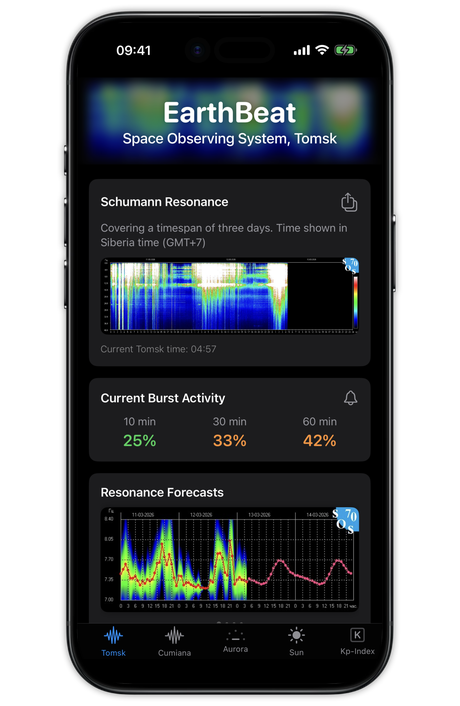
EarthBeat does not measure your heart. It does not measure anything directly: it gathers data on the electromagnetic background of the planet you are living on, principally the Schumann resonance at around 7.83 Hz, from atmospheric research stations. These are different signals.
But there is a thread worth noticing. EarthBeat's Science Track page on geomagnetic activity and the autonomic nervous system summarises peer-reviewed research on HRV and geomagnetic activity, much of it conducted in collaboration with the HeartMath Institute in the Global Coherence Initiative. The research suggests small, statistically detectable influences of geomagnetic conditions on HRV across populations, though the effect sizes are modest and the mechanisms are not fully understood. This is an area where the science, while not confirming the metaphysical claims of any contemplative tradition, also does not reduce the heart to a pump operating in isolation. The heart and the electromagnetic environment are in conversation, even if the conversation is quiet.
For the practitioner, this means that tracking Earth's rhythms alongside personal heart practice is, at a minimum, coherent with what physiological research is finding. Whether it means more than that is for the practitioner to find out through their own practice. EarthBeat's role is to give you accurate information about the external signal. Your heart is yours.
Further Reading
Sufi tradition
- Ibn al-'Arabi, Fusus al-Hikam (The Bezels of Wisdom, 13th century). Foundational text on the heart in Sufi metaphysics.
- Jalal al-Din Rumi, Masnavi-yi Ma'navi (13th century). Extensive teachings on the heart and the intellect.
- al-Ghazali, Ihya Ulum al-Din (The Revival of the Religious Sciences, 11th-12th century). Sufi psychology and the heart.
- Henry Corbin, Creative Imagination in the Sufism of Ibn 'Arabi (1958). Classic scholarly study.
- William Chittick, The Sufi Path of Knowledge: Ibn al-Arabi's Metaphysics of Imagination (SUNY, 1989).
Christian hesychast tradition
- The Philokalia, Volumes 1-5, translated by G.E.H. Palmer, Philip Sherrard, and Kallistos Ware (Faber, 1979-2023). The primary anthology.
- Gregory Palamas, Triads in Defence of the Holy Hesychasts (14th century).
- Theophan the Recluse, The Art of Prayer (19th century).
- Kallistos Ware, The Orthodox Way (SVS Press, 1995). Modern introduction.
Yogic and Vedantic tradition
- Chandogya Upanishad, especially chapter 8 (Dahara Vidya).
- Maha Narayana Upanishad.
- Katha Upanishad.
- Ramana Maharshi, Talks with Sri Ramana Maharshi, recorded by Munagala Venkataramiah (1935-1939).
- David Godman, Be As You Are: The Teachings of Sri Ramana Maharshi (Penguin, 1985).
Contemporary heart research
- J. Andrew Armour, Neurocardiology: Anatomical and Functional Principles (HeartMath Institute, 2003). Foundational work on the intrinsic cardiac nervous system.
- McCraty R, Atkinson M, Tomasino D, Bradley RT (2009). "The Coherent Heart: Heart-Brain Interactions, Psychophysiological Coherence, and the Emergence of System-wide Order." Integral Review 5(2): 10-115.
- McCraty R, Zayas MA (2014). "Cardiac Coherence, Self-Regulation, Autonomic Stability, and Psychosocial Well-Being." Frontiers in Psychology 5:1090.
- Balaji S, Plonka N, Atkinson M, et al. (2025). "Heart rate variability biofeedback in a global study of the most common coherence frequencies and the impact of emotional states." Scientific Reports 15:3241.
- Shaffer F, Ginsberg JP (2017). "An Overview of Heart Rate Variability Metrics and Norms." Frontiers in Public Health 5:258.
Comparative contemplative studies
- William James, The Varieties of Religious Experience (1902).
- Aldous Huxley, The Perennial Philosophy (1945).
- James Cutsinger (ed.), Paths to the Heart: Sufism and the Christian East (World Wisdom, 2002).