For most of the 20th century, Western scholars treated these terms as roughly equivalent, naming what they assumed was a single underlying phenomenon glimpsed by different cultures from different angles. This assumption is itself worth examining. The traditions are real and worth taking seriously, but they are not always saying the same thing, and the European-modernist habit of collapsing them into one master concept (with names like vital force or cosmic energy or prana-qi-mana) has its own cultural history that needs to be acknowledged.
This page does several things at once. It describes, with primary sources, what the major Asian and Pacific traditions actually teach about the energetic body and the energetic landscape. It treats more briefly the European ley line tradition, which is younger and stands on shakier scholarly ground. It gives an honest account of the early-20th-century anthropological move that assembled "world cultures know about a universal life-energy" as a single argument. And it notes one piece of contemporary research, in archaeoacoustics, where the assumption that ancient peoples paid attention to the sonic properties of places has held up well under scientific testing.
Chinese Qi and the Living Landscape
The Chinese term qi (氣, pronounced "chee") is one of the foundational concepts of classical Chinese cosmology, medicine, and philosophy. It is often translated as vital breath, life-force, or energy, but each translation captures only part of the meaning.
Joseph Needham, in Science and Civilisation in China Volume 2 (Cambridge University Press, 1956), described qi as part-matter and part-energy, pervading everything. In classical Chinese thought, qi is not added to inert matter from outside; matter itself is a dense form of qi, and what we call spirit is qi at its most rarefied. There is no sharp ontological line, in this view, between rock, plant, animal, person, and god. All are configurations of qi at different densities and patterns of motion.
Qi has been theorised in China for over two thousand years across several distinct frameworks. In traditional Chinese medicine, qi flows through meridians (jingluo 經絡), specific channels in the body, and disease is often understood as a disruption of this flow. Acupuncture and qigong are interventions in qi circulation. In Daoist internal alchemy (neidan), qi is cultivated and refined through breathing, posture, and meditation. In Confucian thought, particularly the Neo-Confucianism of Zhu Xi (1130-1200), qi is paired with li (理, "principle") as the two fundamental constituents of reality.
For the present page, the most relevant Chinese tradition is fengshui (風水, literally "wind and water"), the practice of analysing how qi flows through landscapes and built environments. Fengshui is a sophisticated body of knowledge with two main historical schools: the Form School (xingshi), which reads qi from the topography of mountains, rivers, and watercourses, and the Compass School (liqi), which uses computational methods involving the eight trigrams of the Yijing, the five elements (wuxing), and astrological correspondences. Both schools assume that qi flows through the land along dragon veins (long mai), and that building, burying, and dwelling locations affect and are affected by these currents.
Fengshui has had real and observable effects on Chinese architecture, urban planning, and landscape art for over a thousand years. The orientation of imperial Beijing, the placement of village settlements, the design of garden compositions, the burial sites of emperors, all have been shaped by fengshui considerations. As an aesthetic and ecological tradition, it has been remarkably durable.
As a scientific theory of physical Earth-energies, fengshui has not been empirically validated. Joseph Needham himself, who otherwise treated Chinese science with great respect, described fengshui as a pseudo-science (Science and Civilisation in China Volume 2, page 359), while granting that it had encouraged a certain kind of attentive landscape sensibility that produced beautiful results. This is the honest position. Fengshui is a coherent traditional system with deep cultural meaning and observable aesthetic results. It is not a mapped grid of measurable Earth-currents that contemporary instruments can detect.
The Chinese tradition itself is internally varied on the metaphysics. Qi has been understood in many ways across the centuries, from concrete (the breath, the flow of weather) to abstract (the underlying principle of change). Reading any single Western popularisation of qi as Earth-energy into the whole Chinese tradition over-simplifies a much richer and more contested intellectual history.
Indian Prana and the Subtle Body
The Sanskrit word prana (प्राण) has its earliest references in the Upanishads, particularly the Chandogya Upanishad, the Brihadaranyaka Upanishad, and most centrally the Prashna Upanishad (composed perhaps in the 7th to 5th centuries BCE), which devotes itself almost entirely to questions about prana. The root meaning is breath, but the concept extends rapidly. In the Prashna Upanishad, prana is the primordial spirit, paired with rayi (matter), and the human body is described as a microcosm of the larger cosmos.
The Indian tradition developed a detailed and specific anatomy of prana. The body is said to contain nadis (channels) through which prana flows. The Brihadaranyaka Upanishad (2.1.19) gives the number as 72,000, while the Katha Upanishad (6.16) gives 101 channels radiating from the heart. Three are primary: ida on the left, pingala on the right, and sushumna in the centre, running from the base of the spine to the crown. Where the three central nadis intersect, chakras (literally "wheels", cakra) are located, classically counted as seven along the central axis. Prana itself is divided into five principal forms or vayus (winds): prana (centred in the chest, associated with intake), apana (centred in the pelvis, associated with elimination), samana (in the abdomen, digestion and balancing), udana (in the throat and head, expression and ascent), and vyana (pervading the whole body, circulation).
This entire system is elaborated across two millennia of texts. Patanjali's Yoga Sutras (composed perhaps 200 BCE to 400 CE) formalised pranayama (breath/prana extension) as the fourth of the eight limbs of yoga. Tantric texts from the 8th century CE onward developed the chakra and nadi systems in great detail, treating the human body as a yantra (instrument) that, properly tuned through asana, pranayama, mudra, and mantra, can serve as a vehicle for liberation.
What is striking about the Indian tradition, and important to flag before any cross-cultural comparison, is that prana is not primarily a landscape concept. The flow of prana that the tradition is interested in is the flow within the human body and between humans and the cosmos through breath and food. There are Indian traditions that treat sacred geography (the seven sacred rivers, the four dhamas, Mount Meru, specific tirthas), but the elaborate technical apparatus of nadis and chakras is anatomical rather than geographical. The widespread Western New Age presentation of prana as flowing through the Earth in lines analogous to qi is a 20th-century synthesis, not a teaching of the classical Indian tradition.
The classical Indian tradition is also explicit that prana operates by specific principles which are taught from teacher to student over years. Pranayama practiced without proper preparation can be harmful (the texts are clear and consistent on this). Modern simplifications that present pranayama as a generic set of breathing techniques anyone can pick up from a book or app collapse a great deal of careful traditional pedagogy.
Tibetan Rlung (Lung) and the Vajra Body
The Tibetan term rlung (རླུང, pronounced "loong") translates the Sanskrit vata and vayu (wind) in medical contexts and prana in tantric Buddhist contexts. Tibetan thought thus conflates, in a single term, two distinct Sanskrit concepts that came into Tibet from different Indian traditions: vata from Ayurvedic medicine, and prana from the tantric yogic literature that began entering Tibet from the 8th century CE onward.
The leading scholarly authority on rlung in English-language religious studies is Geoffrey Samuel, particularly his work Religion and the Subtle Body in Asia and the West: Between Mind and Body (Routledge, 2013) and his 2019 paper Unbalanced Flows in the Subtle Body (Journal of Religion and Health). Samuel notes that rlung in the medical sense corresponds approximately to what Western medicine calls the autonomic nervous system, and that the Tibetan medical tradition has developed sophisticated diagnostic categories around what we would call psychiatric symptoms. The phrase often used is the mind rides the wind like a man rides a horse: rlung is the carrier on which mental and emotional life is borne, and disturbance of rlung is disturbance of mind.
In the tantric sense, rlung corresponds to prana and is treated within the vajra body or subtle body (phra ba'i lus). This subtle body has channels (rtsa, translating Sanskrit nadi), winds (rlung, prana), and drops (thigle, bindu). Practices including tummo (inner heat), the Six Yogas of Naropa, and trul khor (Tibetan yantra yoga) work with these subtle elements to gather the rlung into the central channel and induce specific meditative states.
Tibetan medicine recognises five principal types of rlung, each located in a different region of the body and governing different functions. Life-grasping rlung sits in the brain, regulating swallowing, breathing, and sense-clarity. Upward-moving rlung is in the thorax, governing speech, energy, and complexion. All-pervading rlung is in the heart, responsible for limb movement and emotional expression. Fire-accompanying rlung is in the digestive region, handling digestion and metabolism. Downward-cleansing rlung sits in the perineal region, responsible for elimination, reproduction, and childbirth.
The system is operationally precise. A Tibetan physician trained in the Four Tantras (the foundational medical text, Rgyud bzhi, codified by the 12th century) reads rlung disturbances through pulse, urine analysis, and questioning, and treats them with diet, behaviour modification, herbal compounds, and external therapies. There is now a small but growing body of cross-cultural research comparing rlung-based diagnoses with Western psychiatric categories (see Susannah Deane's 2019 work in the same volume of Journal of Religion and Health).
Rlung, like prana, is principally an anatomy of the embodied human and the relationship between human and cosmos through breath and life. It is not, in its classical formulation, a geography of Earth-currents, although Tibetan religious culture has rich sacred-geography traditions that intersect with rlung in the practice of pilgrimage and the recognition of power places (sa zhi) at which subtle-body work is more effective.
Polynesian Mana and What the Word Actually Means
The word mana circulates today in Western popular spiritual literature with meanings considerably looser than what the term carries in its original Polynesian and Melanesian contexts. The Anglican missionary R.H. Codrington's 1891 book The Melanesians: Studies in their Anthropology and Folk-Lore introduced the term to Western anthropology, defining it as "a force altogether distinct from physical power, which acts in all kinds of ways for good and evil, and which it is of the greatest advantage to possess or control".
Codrington's framing was hugely influential. R.R. Marett built on it in 1909 to propose animatism as a stage of religious development prior to animism. Émile Durkheim, in The Elementary Forms of Religious Life (1912), used mana as the example of what he called the totemic principle, comparing it to Iroquois orenda, Lakota wakan (or wakanda), and Algonquian manitou. Marcel Mauss and Henri Hubert used mana as the basis for their 1902-1903 Outline of a General Theory of Magic. Mana became, for early-20th-century European anthropology, the master term for a putatively universal primitive concept of impersonal supernatural power.
This generalising move has been heavily criticised by later anthropologists. The American anthropologist Roger Keesing, in his 1984 paper Rethinking Mana (Journal of Anthropological Research 40:1), argued that Codrington and his successors had grammatically misunderstood the term. In Proto-Oceanic and most descendant languages, Keesing showed, mana is canonically a stative verb meaning to be efficacious, to work, to be successful. Where it appears as a noun, it is more accurately rendered efficacy or potency than power or energy. The European reading of mana as a substance flowing through things was, in Keesing's analysis, a translation error projected onto Pacific cultures and then read back into them as if it were their own concept.
More recent scholarship, particularly the 2016 volume New Mana: Transformations of a Classic Concept in Pacific Languages and Cultures edited by Matt Tomlinson and Ty P. Kāwika Tengan (ANU Press), has worked to re-situate mana in its actual Pacific contexts. The volume documents the considerable variation in mana's meaning across Polynesian and Melanesian societies. In Hawaiian usage, mana and ho'omana (to empower, to render homage) carry specific cultural weight tied to genealogy, chiefly authority, and the spiritual integrity of land and ancestors. In contemporary Tahiti, mana has experienced what one contributor calls a commercial efflorescence, appearing on shopping bags and tourist literature in ways that have, perhaps inevitably, attenuated its older meaning.
What this means for the present page is that mana is a real and serious concept in Pacific cultures, with specific traditional meanings that are not interchangeable with qi, prana, or rlung, and that the Western popular use of the term as a generic spiritual energy is several layers of translation removed from any of those original meanings.
The European Synthesis: Animism, Vital Force, and the Master Concept
Underneath the spread of qi-prana-mana-rlung as if these were variant names for one universal energy is a specific intellectual history, mostly European, mostly from 1870 to 1925.
E.B. Tylor's Primitive Culture (1871) introduced animism as the proposed earliest form of religion: a belief in spirits or souls inhabiting natural objects. James Frazer's The Golden Bough (1890, expanded through 1915) extended this into a sweeping comparative project on magic and religion. R.R. Marett added animatism, Mauss and Hubert added the master concept of mana, Durkheim systematised everything in The Elementary Forms. The entire framework rested on a Victorian assumption that "primitive" cultures around the world had glimpsed, in fragmentary form, the same underlying truth (typically interpreted in pantheistic or panpsychic terms) that European modernity was now in a position to articulate clearly.
This synthesis travelled into 20th-century popular literature through Theosophy (Madame Blavatsky's The Secret Doctrine, 1888), Rudolf Steiner's anthroposophy, the Vienna Circle's looser fellow-travellers, and into the 1960s-70s New Age. By the time the average wellness book in the 1980s used the formula "the Chinese call it qi, the Indians prana, the Polynesians mana", it was citing a synthesis that had been built out of European comparative religion of the late 19th century, not out of any of those original traditions saying so themselves.
It is honest to name the consequence. The cross-cultural comparison is not wrong in suggesting that many human cultures have recognised something we might generalise as the world is not inert. That observation has weight. But the specific equation qi = prana = mana = lung, treated as if it described a single energetic substance with regional names, is a European 19th and 20th-century construct. The traditions themselves, on their own terms, would not necessarily endorse this equation, and several of them are doing quite different conceptual work.
The cross-cultural comparison is not wrong in suggesting that many human cultures have recognised something we might generalise as "the world is not inert". That observation has weight. But the specific equation qi = prana = mana = lung, treated as if it described a single energetic substance with regional names, is a European 19th and 20th-century construct.
For practitioners, this matters in a specific way. If you train seriously in qigong, in yogic pranayama, in Tibetan tantric practice, or in Hawaiian mana traditions, you find that the specifics matter. The body maps differ. The methods differ. The cosmologies differ. The teachers within each tradition do not, on the whole, accept that they are all teaching variant forms of the same thing. Respect for the traditions begins with letting them be what they are.
The Western Ley Line Tradition: A Caution
The English word ley line deserves separate treatment because it is the principal Western contribution to the cross-cultural conversation about Earth-energies, and because its actual history is unusually well documented and unusually deflating to the wider claims often made for it.
The term was introduced in the 1920s by Alfred Watkins (1855-1935), a Hereford-based businessman, photographer, and amateur antiquarian. In June 1921, on a hill in Herefordshire, Watkins reported a sudden visual realisation that ancient sites in the British landscape (mounds, churches, stones, hillforts) appeared to fall along straight lines. He published the idea first in Early British Trackways (1922) and then more fully in The Old Straight Track (1925).
Watkins's original claim was modest and archaeological. He proposed that the alignments were ancient surveying lines for trade routes, used by pre-Roman Britons whom he called dodmen. He did not claim that the lines carried mystical Earth-energies. The energetic interpretation came later.
The original archaeological claim was rejected by professional British archaeologists at the time, most prominently O.G.S. Crawford, editor of Antiquity, who refused to publish the book's advertisement and filed the related correspondence under "Crankeries". The principal archaeological objection has held up well. In a country with as dense a distribution of ancient sites as Britain (estimated by Tom Williamson and Liz Bellamy in their 1983 Ley Lines in Question at roughly one site per square kilometre across much of England), straight lines drawn through any starting point will pass close to several other sites by chance. The statistical demonstration is not subtle. Almost any line drawn anywhere in the British landscape will clip multiple sites, and lines through deliberately chosen sites will appear to confirm whatever pattern the searcher had in mind.
The transformation of Watkins's modest archaeological hypothesis into the contemporary energetic ley line idea happened in the 1960s. John Michell's The View Over Atlantis (1969) is the principal book in this transition, drawing together Watkins's alignments, Chinese fengshui (which Michell had encountered through Joseph Needham and other secondary sources), and the emerging Earth Mysteries movement of the late 1960s into a synthesis that proposed straight energetic lines crossing Britain and, eventually, the world. From Michell forward, ley line in popular usage means an energetic Earth-current line. The Watkins archaeological proposal became almost incidental.
The contemporary energetic ley line tradition is not supported by archaeology, and the underlying physical claims (about magnetic anomalies, telluric currents, or specific energies along straight lines connecting megalithic sites) have not been confirmed by geophysical measurement. The Skeptic's Dictionary, Williamson and Bellamy, the British archaeological mainstream, and most working geophysicists treat ley lines as pseudoscience.
This is a place where the page must be honest. The intuition that certain places feel different from others (the experience of standing in a hilltop fort, a cave with prehistoric paintings, a stone circle at dawn) is real and not in dispute. The specific claim that these feelings are produced by detectable Earth-currents flowing along straight lines connecting the sites is not supported by evidence. The two should not be conflated.
For readers attached to the ley line idea: there are more rigorous frameworks for thinking about why some places feel different from others, including the archaeoacoustic research summarised in the next section. The ley line tradition, at its best, is a poetic invitation to attentiveness to the British landscape; at its worst, it is repurposed Victorian pseudoarchaeology with magnetic-energy claims pasted on. The poetry is worth keeping. The pseudo-physics is not.
Where the Hypothesis Holds: Archaeoacoustics
There is one specific area where the older intuition that ancient peoples paid careful attention to the sensory properties of places has held up well under scientific testing. It is not about energy lines or telluric currents. It is about sound.
In 1983, the French musicologist Iégor Reznikoff (Université de Paris X), trained as a classical pianist with a doctorate in mathematics and known for his work on the acoustics of Romanesque churches, visited a French painted cave for the first time. As he routinely did when entering a new resonant space, he hummed and sang to gauge the acoustics. He noticed that his voice was significantly more resonant in the locations where the prehistoric paintings were concentrated, and dull or absent in the visually less remarkable parts of the cave.
Reznikoff and the French archaeologist Michel Dauvois subsequently surveyed several decorated French caves systematically, including Le Portel, Niaux, Fontanet, and others. Their findings, published as La dimension sonore des grottes ornées in Bulletin de la Société Préhistorique Française 85/8 (1988), reported strong correlations between acoustic resonance and painting location. In some caves the correlation index was reported at 80% to 90% or higher; in the Salon Noir at Niaux, the densest concentration of images sits in the most resonant chamber. In passages too narrow or low to paint, but with notable acoustic properties, simple red dots are often present, as if marking the acoustic event.
The hypothesis has been tested and refined in the decades since. A 2017 study led by Bruno Fazenda at the University of Salford, working at five decorated caves in northern Spain (the Cave of Altamira and Paleolithic Cave Art of Northern Spain UNESCO World Heritage Site), used modern impulse response measurements at hundreds of locations within the caves. The Fazenda study found weaker but statistically detectable evidence for a correlation between acoustic response and the location of certain types of paintings, particularly the oldest dot and line motifs. The 2020 paper by Fazenda and Rupert Till of the University of Huddersfield extended the work to Stonehenge and the Paphos theatre in Cyprus, treating archaeoacoustics as a serious comparative discipline.
The current state of the field, summarised in the 2025 review by Margarita Díaz-Andreu and colleagues at the University of Barcelona's ERC Artsoundscapes project, is that the acoustic-art correlation is real and well-supported at some sites, weaker at others, and methodologically demanding to study cleanly. The naive version (every painting is at a maximum-resonance spot) is not supported. The richer version (the acoustic dimension was a serious factor in how Paleolithic artists used cave space) is supported.
This is the kind of finding that gives the older intuition some genuine traction. Peoples 15,000 to 30,000 years ago were attentive to the sonic properties of caves, and chose where to paint partly on the basis of those properties. They were probably also attentive to other sensory dimensions of the spaces (light, temperature, the feel of the rock under hand) that contemporary research is only beginning to study. The general claim that ancient peoples treated certain places as special, and that they had reasons we can partly recover, is well supported. The specific claim that what they were responding to was a measurable telluric energy is not.
What the Different Traditions Share, on Their Own Terms
Stepping back across the Asian, Pacific, European, and contemporary archaeoacoustic threads, several honest observations emerge.
Many human cultures have developed sophisticated, internally coherent frameworks for thinking about the relationship between the embodied person, the breath or life-force that animates them, and the wider environment. The Chinese, Indian, Tibetan, and Pacific traditions discussed here are among the most elaborated of these frameworks. They are not, on their own terms, the same as each other. They differ on what the life-force is, where it lives, how it is cultivated, and what its relationship to the wider world is. Letting them differ is part of taking them seriously.
The European synthesis that treated all of these as variant forms of a single universal energy was a 19th and early 20th-century intellectual project with specific cultural origins. It served a comparative-religion programme that has since been extensively criticised, often by anthropologists working within the very traditions Tylor, Mauss, and Durkheim were generalising about. This does not invalidate cross-cultural conversation. It does mean that any contemporary writer or practitioner who reaches for the formula "the Chinese call it qi, the Indians prana, the Polynesians mana" should know what they are doing and where the formula came from.
The specific claim that the Earth carries detectable life-force currents flowing through specific lines or grids is, in its 20th-century Western form (ley lines, vortices, planetary grids), not supported by scientific measurement and not generally taught by the Asian and Pacific traditions it is often associated with. Some of the underlying intuitions (that places have felt qualities, that ancestors built carefully and chose locations for reasons, that the embodied human is in conversation with the surrounding environment) are real and worth attending to. The specific 20th-century mechanism is not.
Where the hypothesis of attentive ancient peoples holds up well empirically, as in archaeoacoustics, the actual finding is sober and interesting. People built and chose places for good reasons that included how the places sounded. This is a different claim from people followed energy lines that we can now detect with the right instrument, and it has the advantage of being demonstrable.
What EarthBeat Shows
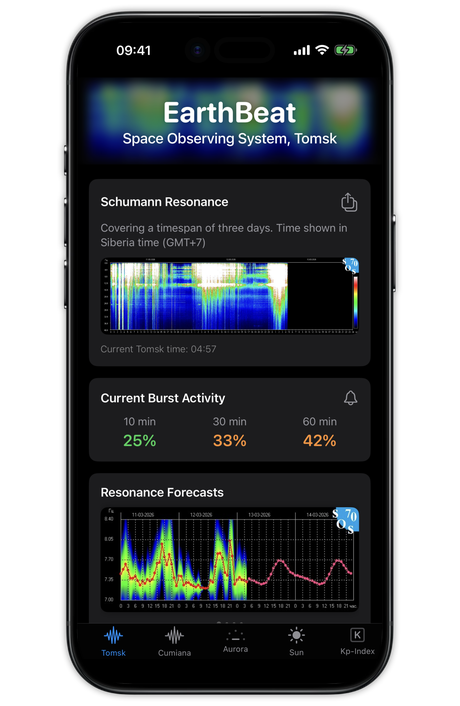
EarthBeat tracks one specific signal: the Schumann resonance, the electromagnetic background of the Earth-ionosphere cavity, driven by global lightning. It is a real, measurable, well-characterised physical signal. It is not qi, prana, lung, or mana, and EarthBeat does not claim it is.
What EarthBeat does claim, modestly: the Schumann resonance is one of the rhythms of the planet, audible in a literal physical sense, that you can choose to attend to as part of a wider relationship with the place where you live. Whether your interpretive frame for that attention is contemporary atmospheric physics, a contemplative tradition you are practicing in seriously (Daoist, yogic, Buddhist, Hawaiian, or other), or simply a felt sense of being part of a larger natural system, is your business and not EarthBeat's.
The honest point is that the SR is real, the older traditions are serious, and the wider Western Earth-energy synthesis has its own complicated history. Holding all three honestly is the goal. The signal does not require any tradition to be correct; the traditions do not require the signal to be measured to be coherent on their own terms; the Western synthesis is interesting as cultural history but should not be presented as the established science of any of them.
Further Reading
Chinese qi and fengshui
- Needham, Joseph (1956). Science and Civilisation in China, Volume 2: History of Scientific Thought. Cambridge: Cambridge University Press. The classical scholarly treatment.
- Parkes, Graham (2003). "Winds, waters, and earth energies: Fengshui and awareness of place." In H. Selin (ed.), Nature across cultures: Views of nature and the environment in non-Western cultures. Springer.
- Matthews, Michael R. (2019). Feng Shui: Teaching About Science and Pseudoscience. Springer. Critical-philosophical treatment.
Indian prana and the subtle body
- Prashna Upanishad, particularly questions 2-4. Standard translations include Eknath Easwaran (1987), Patrick Olivelle (1996, Oxford World's Classics), and Swami Nikhilananda.
- Brihadaranyaka Upanishad and Chandogya Upanishad. Translations by Olivelle (Oxford World's Classics) are scholarly standards.
- Patanjali, Yoga Sutras. Translation and commentary by Edwin Bryant (North Point Press, 2009) is widely cited.
- Samuel, Geoffrey (2008). The Origins of Yoga and Tantra: Indic Religions to the Thirteenth Century. Cambridge University Press.
Tibetan rlung and the vajra body
- Samuel, Geoffrey (2013). Religion and the Subtle Body in Asia and the West: Between Mind and Body. London: Routledge.
- Samuel, Geoffrey (2019). "Unbalanced Flows in the Subtle Body: Tibetan Understandings of Psychiatric Illness and How to Deal With It." Journal of Religion and Health 58: 770-790.
- Deane, Susannah (2019). "rLung, Mind, and Mental Health" in the same 2019 JRH issue.
- The Four Tantras (Rgyud bzhi); standard partial translation by Barry Clark, The Quintessence Tantras of Tibetan Medicine (Snow Lion, 1995).
Polynesian mana
- Codrington, R.H. (1891). The Melanesians: Studies in their Anthropology and Folk-Lore. Oxford: Clarendon Press. The historical foundational text.
- Keesing, Roger M. (1984). "Rethinking Mana." Journal of Anthropological Research 40(1): 137-156. The key critique.
- Tomlinson, Matt, and Tengan, Ty P. Kāwika, eds. (2016). New Mana: Transformations of a Classic Concept in Pacific Languages and Cultures. Canberra: ANU Press. Open access.
The European synthesis
- Tylor, E.B. (1871). Primitive Culture.
- Frazer, James (1906-1915). The Golden Bough, third edition.
- Durkheim, Émile (1912). The Elementary Forms of Religious Life.
- Mauss, Marcel, and Hubert, Henri (1902-03). A General Theory of Magic. English translation Routledge, 1972.
Ley lines
- Watkins, Alfred (1925). The Old Straight Track: Its Mounds, Beacons, Moats, Sites and Mark Stones. London: Methuen. Multiple reprints.
- Williamson, Tom, and Bellamy, Liz (1983). Ley Lines in Question. Tadworth: World's Work. The authoritative archaeological critique.
- Michell, John (1969). The View Over Atlantis. The transition from archaeology to Earth-mysteries.
Archaeoacoustics
- Reznikoff, Iégor, and Dauvois, Michel (1988). "La dimension sonore des grottes ornées." Bulletin de la Société Préhistorique Française 85(8): 238-246.
- Reznikoff, Iégor (2014). "On the Sound Related to Painted Caves and Rocks." Archaeological Society of Finland.
- Fazenda, Bruno, et al. (2017). "Cave acoustics in prehistory: Exploring the association of Palaeolithic visual motifs and acoustic response from the human voice." Journal of the Acoustical Society of America 142(3): 1332-1349.
- Scarre, Chris, and Lawson, Graeme, eds. (2006). Archaeoacoustics. McDonald Institute Monographs, Cambridge.
- Díaz-Andreu, Margarita, et al. (2025). "The archaeoacoustics of rock art sites: a methodological review." UCL Press.