Across cultures that did not know about each other, in languages that did not share a root, contemplatives from at least 2,500 years ago onward reported a remarkably consistent experience: in deep silence, there is not nothing. There is something. The Hindu yogic tradition called it anahata nada, the unstruck sound. The Hebrew Bible called it kol d'mama daka, the still small voice. Sufi teachers point to it in the practice of sama, deep listening. Chán and Tibetan Buddhist texts describe it as the background to which a quiet mind returns.
This page is an attempt to describe, carefully and with sources, what several traditions have said about this inner sound, and what modern science can and cannot say about it. It is not an attempt to claim that the inner sound heard by a meditator is the same thing as the 7.83 Hz Schumann resonance. The frequency overlap is striking and has been noticed. The biological mechanism that would link them remains speculative. Both realities, the traditional and the physical, are worth taking seriously on their own terms.
The Yogic Tradition: Anahata Nada
The oldest continuous written tradition describing the inner sound comes from India. The Nadabindu Upanishad, one of the minor Upanishads, is short, dense, and entirely devoted to the subject. Its dating is uncertain, but the text belongs to the late Vedic or early post-Vedic period and is usually placed at least 2,000 years ago.
The Sanskrit term is anahata nada. Nada means sound or vibration. Anahata means "unstruck" or "unproduced", sound that arises without any physical cause, without two things striking each other. The Hatha Yoga Pradipika (15th century), the classical manual of hatha yoga, devotes the final chapter of its treatment of samadhi to nada practice. It describes a sequence of increasingly subtle inner sounds that the meditator encounters with sustained practice, moving from gross to subtle: bells, conch, lute, flute, drum, thunder, and beyond, eventually dissolving into the silence that holds them all.
The Shurangama Sutra in the Mahayana Buddhist tradition, one of the core texts of Chinese Chán, records a similar teaching in a different idiom. The bodhisattva Avalokiteshvara describes attaining enlightenment through concentration on the subtle inner sound. The Buddha, in the sutra's narrative, calls this the supreme method.
What is striking about the Indian and East Asian material is not the existence of a single metaphysical claim, but the detailed phenomenology. The texts describe what practitioners hear in stages, what to do with the attention, how the sound changes as concentration deepens. It reads less like mysticism and more like a field guide. Whatever anahata nada refers to, people were listening carefully to it for a long time.
The Hebrew Tradition: Kol D'mama Daka
In the Hebrew Bible, 1 Kings 19 tells the story of the prophet Elijah, fleeing for his life and taking refuge in a cave on Mount Horeb. He encounters a great wind, an earthquake, and a fire. The text says explicitly that God is not in any of them. And then, after the fire: kol d'mama daka.
The phrase is famously hard to translate. The King James Bible renders it "a still small voice", a translation that has shaped Western spiritual vocabulary for four centuries. The New Revised Standard Version gives "the sound of sheer silence". The Jewish Publication Society translates "a soft murmuring sound". Hebrew scholars note that kol means voice or sound, d'mama means silence or stillness, and daka means thin, fine, or subtle. "A thin voice of silence" is closer to the grammar. Some scholars argue the phrase should be rendered almost oppositely, as a roaring or thunderous sound, based on an Akkadian root. The ambiguity is part of the text.
What is not ambiguous is what the narrative does with it. Elijah covers his face and leaves the cave to speak with God. The encounter happens in this voice of silence, not in the earthquake or the fire. The tradition that grew from this passage, threaded through Jewish mysticism and later into Christian contemplative practice, treats the still small voice as a description of how the divine is heard when the noise stops.
Rabbi Lawrence Kushner and other modern Jewish teachers have linked the passage to mindfulness practice directly. The scholar Gershom Scholem, one of the great 20th-century historians of Kabbalah, quoted Rabbi Mendel of Rimanov teaching that the actual revelation at Sinai consisted only of the first letter, aleph, which is itself silent, "the preparation for all audible language, but in itself conveys no determinate, specific meaning". The mystical Jewish reading is that the foundational revelation is a hearable silence.
The Christian contemplative tradition inherited Elijah's encounter and built a practice around it. The desert fathers of the 4th century and the tradition of hesychasm in the Eastern Orthodox Church both took his cave experience as a foundational text. The Rhineland mystics of the Middle Ages continued the thread; Meister Eckhart, in particular, speaks repeatedly of the "ground" of the soul as silent. In the 20th century, Thomas Merton and Thomas Keating revived the practice for a contemporary audience. Lectio divina and centering prayer both cultivate the capacity to hear the voice that is not loud.
The Sufi Tradition: Sama
Sufism, the mystical current of Islam, has its own term: sama, Arabic for "listening". The Mawlawi order founded by Jalaluddin Rumi in the 13th century, whose whirling dervishes are probably the most widely recognised image of Sufi practice, places sama at the centre of its spiritual method. The Encyclopedia Britannica describes sama as the practice of listening to music and chanting to reinforce ecstasy and induce mystical trance, though the tradition itself describes it more subtly.
The teaching of the Sufi Way tradition puts it this way: Sama means deep listening, which means not just listening to the audible melody or the sung words or sounds, but listening to the deeper experience, and ultimately, the silence that holds all in its embrace.
Alongside sama, Sufism has dhikr (Arabic; often spelled zikr), meaning "remembrance". Dhikr is the repetition, aloud or silently, of a sacred phrase or name of God. The Naqshbandi order, one of the major Sufi lineages, teaches zikr-e-sirr, or silent zikr, in which the repetition descends from the tongue into the spiritual heart (qalb) and eventually into the breath itself. As the sound refines, the practitioner becomes aware of what underlies the repetition: the silence that was always there.
The parallel to anahata nada and to the Christian contemplative heart prayer (the Jesus Prayer in the hesychast tradition, with its breath synchronisation) is not accidental. Scholars of comparative mysticism (notably William James in The Varieties of Religious Experience in 1902, and Aldous Huxley in The Perennial Philosophy in 1945) have pointed out that contemplative traditions worldwide independently converge on very similar practices: quiet the outer senses, focus the attention inwardly, notice what arises when the noise falls away.
What Modern Neuroscience Can and Cannot Say
Meditation has become, in the last 25 years, a mainstream object of scientific study. What research has and has not established matters for this page, because it sets the boundary of what we can honestly claim.
What research shows. Long-term meditators have measurably different brain activity during and outside meditation. The foundational paper is Lutz, Greischar, Rawlings, Ricard, and Davidson (2004) in the Proceedings of the National Academy of Sciences, showing that experienced Tibetan Buddhist practitioners self-induce high-amplitude gamma-band EEG oscillations (25 to 42 Hz) and phase synchrony during meditation, well above controls. Subsequent work from the same group and others (Sara Lazar's fMRI studies of meditation-related brain structural changes; Judson Brewer's work on the default mode network; Antoine Lutz's ongoing research on attention regulation) has mapped an increasingly detailed picture of what happens in the brain when someone meditates seriously over years.
What research suggests but has not established. The relationship between subjective reports of "inner sound" and specific brain activity has been looked at but is not resolved. Studies of tinnitus (ringing in the ears without external cause) show that it involves specific auditory-cortex and limbic-system activity, but tinnitus is usually pathological, whereas anahata nada is reported as non-distressing and intentionally sought. Some contemplative traditions, notably Ayurveda, explicitly distinguish the two. No peer-reviewed research has cleanly demonstrated that the "inner sound" of deep meditation is the same phenomenon as any specific external electromagnetic or acoustic signal.
What research has not shown, despite popular claims. The idea that brain alpha waves (8 to 12 Hz) and the Schumann resonance fundamental (near 7.83 Hz) directly entrain or couple is popular in wellness literature but remains scientifically speculative. The frequencies overlap numerically. The biological mechanism that would let a 1-picotesla ambient magnetic field couple to brain activity is not established. Researchers like Michael Persinger and Kevin Saroka have published studies suggesting real-time coherence between SR and EEG, but independent replication has been limited and the mechanism remains debated. See our Science Track page on the Schumann resonance and the human body for the full picture.
The scholar of contemplative traditions can say: for thousands of years, meditators in many cultures have reported a subtle inner sound that emerges in silence. The neuroscientist can say: experienced meditators show measurable differences in brain activity, and subjective reports of altered perception are real phenomena worth studying. Neither can yet say: the inner sound is the Schumann resonance, or the Schumann resonance causes the inner sound. Science says one thing. Tradition says another. You might feel or experience something that speaks to both.
Itzhak Bentov and the Modern Bridge
The bridge between the ancient traditions and the modern SR discourse was built, largely, by one person: Itzhak Bentov (1923 to 1979). Born in Czechoslovakia as Tobias Bentov, he emigrated to British-controlled Palestine in the 1940s, worked as a biomedical engineer, and became a meditator. His 1977 book Stalking the Wild Pendulum: On the Mechanics of Consciousness is the single most influential popular text linking meditation to the Schumann resonance.
Bentov's core idea was that the human body, during deep meditation, behaves like a coupled oscillator: the circulation of blood, the breath, and the subtle rhythmic movements of the body all interact. He proposed that in deep stillness these couplings lock into a resonant state that he estimated at roughly 7 cycles per second, close to the Schumann fundamental. He suggested that the meditator, in this state, could entrain with the ambient electromagnetic field of the Earth. His model included specific physiological claims (standing waves in aortic blood flow, resonance in the cerebral ventricles) that have not been independently confirmed in the peer-reviewed literature and that many physiologists consider speculative.
What Bentov did well was write beautifully, draw his own illustrations, and make his ideas accessible. Stalking the Wild Pendulum became a standard text in the 1980s and 1990s New Age and transpersonal psychology scene. Stanislav Grof praised it. Jean Houston praised it. A generation of meditation teachers learned about the Schumann resonance from Bentov.
It is honest to say two things about Bentov at once. His specific physiological model remains unverified and some of his physics is idiosyncratic. And his core intuitions (that biological systems are oscillatory, that meditation changes measurable brain rhythms, that the human body resonates) have been supported, in more cautious forms, by subsequent neuroscience and biophysics. Bentov is the reason so many people associate the Schumann resonance with meditation. Whether the specific mechanical claims he made are correct is a separate question.
What EarthBeat Shows
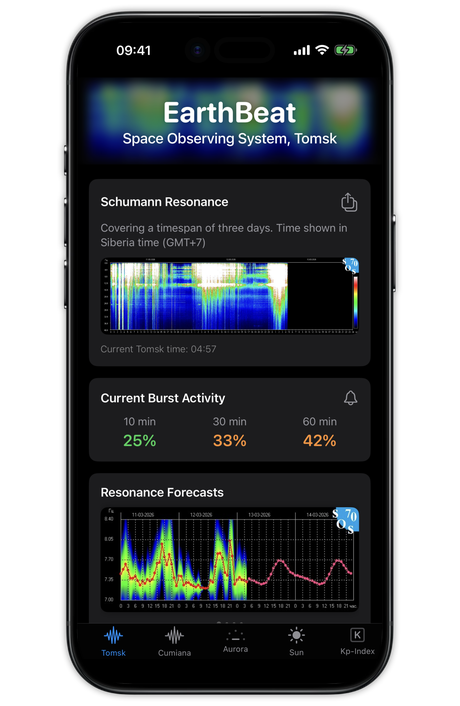
EarthBeat displays the Schumann resonance fundamental in real time, at roughly 7.83 Hz, along with its higher modes. The signal is the electromagnetic background of the planet, driven by lightning activity, and it has been measured continuously since the early 1960s. It is not the inner sound of the meditator. It is the physical electromagnetic environment in which the meditator is sitting.
A few honest framings for how practitioners use the data.
As a reference point. Checking the SR reading before sitting is, for many users, a simple act of noticing. The number does not tell you what your practice will be. It gives you a baseline for the day. Over weeks of observation, people develop their own sense of what the signal is doing and whether it correlates with anything in their experience.
As a context for silence. Whether or not the SR couples to brain activity in any specific way, it is a reminder that "silence" is never silent at the electromagnetic level. The physical world hums. The contemplative tradition has said this for millennia. The instruments now confirm the physical reality of the hum, which does not resolve the metaphysical question of what the hum is, but gives the meditator a piece of accurate information to sit with.
Not as a substitute for practice. No app can replace the work of actually sitting in silence. The SR reading on your home screen is the barest hint of what the contemplative traditions are pointing to. The inner sound that the Nadabindu Upanishad describes, the kol d'mama daka that Elijah heard, the silence at the centre of sama, these are reported to be found in practice, not in instruments. The app is a pointer. The listening is yours.