This page is an attempt to tell the honest history of a few of these numbers. Not to debunk them, and not to endorse them, but to describe where they actually came from, what the people who introduced them actually said, and what scientific evidence there is for and against the claims made on their behalf. The frequencies themselves are real, in the sense that you can play a 528 Hz sine wave and measure it. What they mean is a different question, and the tradition that answers it is younger and thinner than most people assume.
Pythagoras and the Music of the Spheres
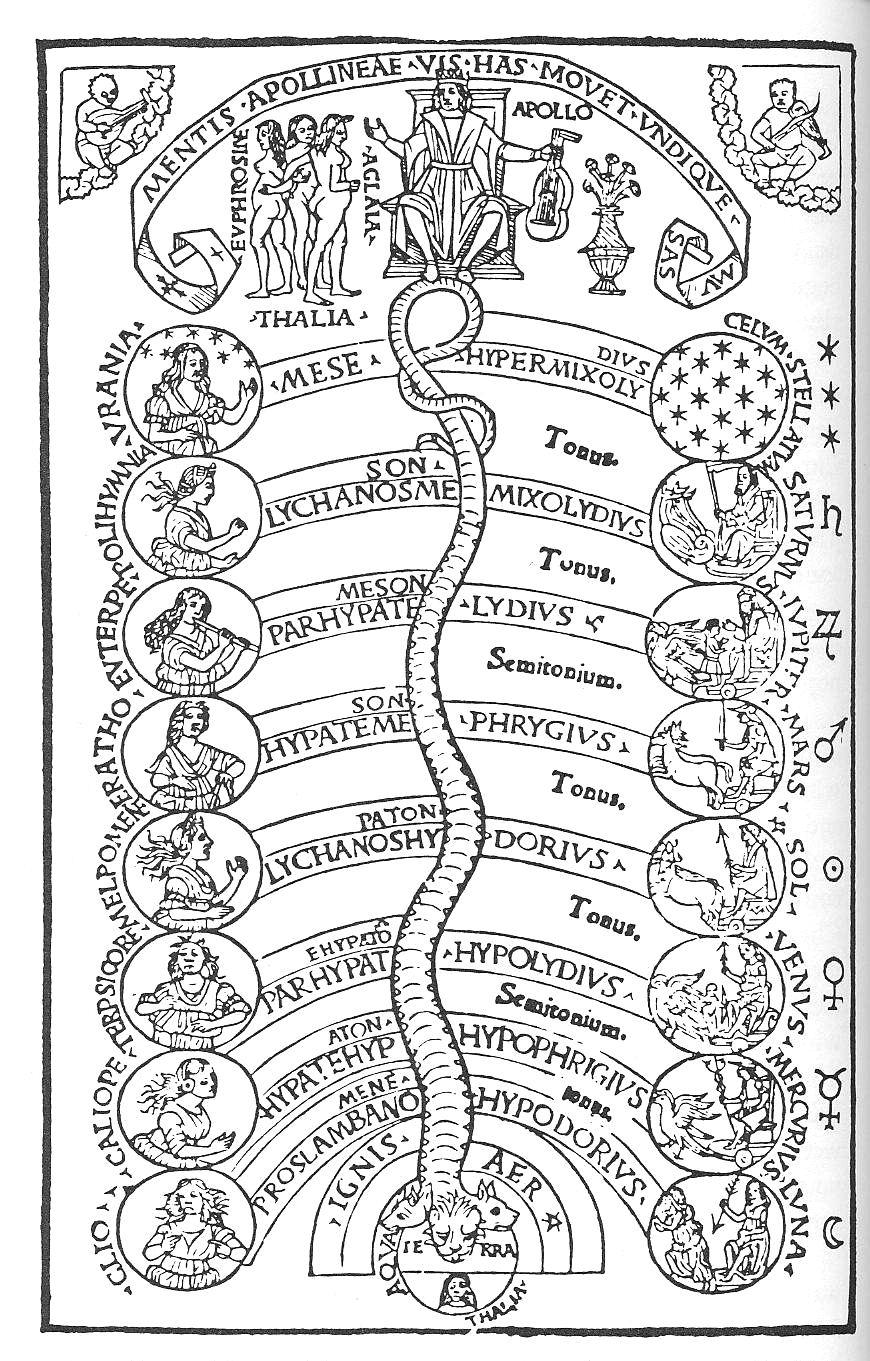
The idea that the cosmos is tuned, that numerical ratios govern both music and the heavens, is genuinely old. Its earliest clear expression in the Western tradition comes from Pythagoras of Samos in the 6th century BCE, though none of his own writings survive. What we have are later sources, principally the 2nd-century Enchiridion Harmonices of Nicomachus of Gerasa, reporting the Pythagorean teaching.
The core observation was physical. A string vibrating at half its length produces a note an octave higher. At a 2:3 ratio, it produces a perfect fifth. At 3:4, a perfect fourth. Pythagoras and his followers concluded that musical consonance is a matter of simple whole-number ratios, and from there made the larger claim: if strings and columns of air vibrate according to numerical law, so must the heavenly bodies. Each planet, as it moves through its sphere, produces a tone. Together they make a musica universalis, the music of the spheres, inaudible to most ears but heard, according to legend, by Pythagoras himself.
The idea was taken up by Plato in the Timaeus, where the Demiurge shapes the world soul according to harmonic ratios. It passed through Claudius Ptolemy's Harmonics (2nd century CE) and Boethius's De Institutione Musica (6th century CE), where it became the foundation of medieval music theory. Boethius divided music into three kinds: musica mundana (the music of the cosmos), musica humana (the internal harmony of body and soul), and musica instrumentalis (the music of instruments). All three were expressions of the same numerical order.
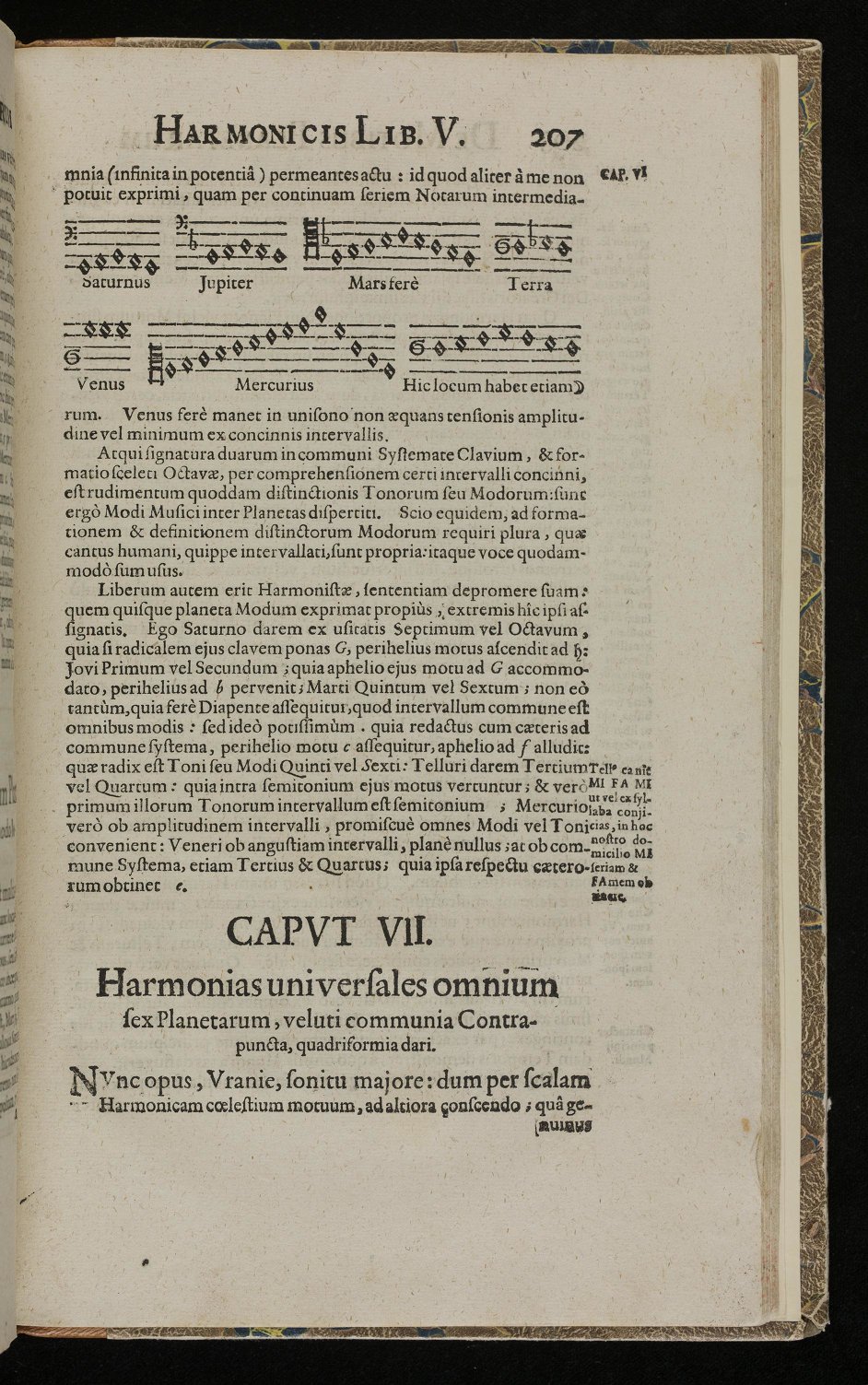
The Renaissance revived the theme. Marsilio Ficino at the Medici court in Florence wrote about the soul's resonance with cosmic harmonies. Johannes Kepler, working on planetary motion in the early 17th century, published Harmonices Mundi (The Harmony of the World) in 1619. In it, Kepler calculated the "songs" of the planets based on their orbital motions around the Sun and argued that the proportions he found were evidence of divine design. He did not think the planets literally sang in the audible range, but he believed the ratios were real and that the soul could perceive them.
This is the authentic ancient pedigree for the idea that sound and number are linked to cosmos and consciousness. Much of what gets called "sacred sound" in contemporary wellness literature reaches back, directly or indirectly, to this tradition. The reach is not always accurate. Many specific frequency claims presented as "Pythagorean" or "ancient" turn out, on examination, to be 20th-century constructions draped in older vocabulary. Knowing the difference matters.
Walter Russell drew the same intuition as a periodic table. See Walter Russell's Ten Octaves of Light.
The History of Tuning: Why A = 440 Hz Is Not Ancient
Before getting to specific frequency claims, one piece of background. There has never been a single universal tuning standard until the 20th century. Before electronic frequency measurement was possible, orchestras tuned to whatever local instruments were available, and pitch drifted upward gradually over centuries because brighter, sharper tuning is more exciting in concert halls.
Surviving tuning forks document the range. A tuning fork from Versailles Chapel in 1795 sounds at A = 390 Hz. An 1810 Paris Opera tuning fork gives A = 423 Hz. An 1822 fork gives A = 432 Hz. An 1855 fork from La Scala gives A = 451 Hz. Baroque ensembles today generally retune to A = 415 Hz when playing period repertoire. None of these was "the ancient standard". There was no ancient standard.
In 1713, the French physicist Joseph Sauveur proposed a mathematical tuning called scientific pitch or philosophical pitch, in which middle C is set to 256 Hz. This is a power of two (28), which means every octave of C lands on a clean integer. In equal-tempered tuning, this makes A = 430.54 Hz, not exactly 432 but close. Sauveur's system was never widely adopted, mostly because it conflicted with the pitch standards orchestras had already converged on.
In the 19th century, the composer Giuseppe Verdi intervened in the Italian tuning debates. Verdi was concerned that the upward creep of orchestral pitch was damaging the voices of opera singers. In a letter to the Italian government in 1884, he argued for regulation and proposed A = 432 Hz as a practical compromise. His letter reads, in part: "For mathematical exigencies I could wish that a single tuning fork be adopted throughout Italy; and it might be desirable to have the note A of the medium octave equal to 432 vibrations." The Italian government, briefly, legislated A = 432 Hz for military bands. The following year, at a pitch conference in Vienna, the proposal was dropped. Verdi's motivation was vocal health and mathematical convenience. It was not a claim about healing or cosmic harmony.
A = 440 Hz became the international standard through a 1939 conference in London and was formalised in ISO 16:1975. The choice was practical coordination, not metaphysics. Any attempt to read a deeper significance into either 440 or 432 has to reckon with the fact that both numbers are arbitrary historical choices, each with its own partisans, and that for most of music history, "the" pitch standard did not exist.
432 Hz: Verdi, Sauveur, and the Schiller Institute
The modern movement to adopt A = 432 Hz as a "healing frequency" is a recent construction, not a revival of ancient practice. The technical basis for A = 432 is, as above, Sauveur's 1713 scientific pitch (which gives A ≈ 430.54 Hz in equal temperament) and Verdi's 1884 proposal (A = 432 Hz, apparently based on Pythagorean ratios). Neither Sauveur nor Verdi made claims about healing, cosmic alignment, or DNA resonance.
The contemporary "432 Hz as healing frequency" claim traces largely to the Schiller Institute, founded in 1984 by followers of Lyndon LaRouche, which began a public campaign in the late 1980s to restore "Verdi tuning" as concert standard. The Institute linked the tuning to historical and aesthetic arguments (protecting singers, preserving the sound Verdi intended) as well as to some of its own more controversial political framing. From there the number migrated into wellness culture, where it accumulated additional claims: that 432 Hz corresponds to natural law, that it resonates with water, that it activates DNA, that it aligns with the Schumann resonance. None of these claims are documented in the historical sources for A = 432 Hz. They are modern attachments.
Clinical research comparing 432 Hz and 440 Hz is limited. A 2019 study (Calamassi and Pomponi, published in Acta Biomedica) compared subjective responses to the same music played at the two tunings and reported slightly lower heart rates and subjective stress scores for 432 Hz. The effect sizes were small, the sample was small, and independent replication is limited. Most measured differences between 432 Hz and 440 Hz in clinical settings are consistent with an expectation effect, meaning that listeners who know they are hearing "healing frequency" music tend to report feeling more relaxed regardless of the actual tuning.
What is honest to say: many musicians genuinely prefer the sound of lower tunings. The difference between 432 and 440 is about 31.8 cents, which is audible to trained ears and subjectively "warmer" to many listeners. This is a legitimate aesthetic preference. It does not require the wellness narrative to be valid.
The Solfeggio Scale: A 1974 Construction
The "ancient Solfeggio frequencies" (typically 396, 417, 528, 639, 741, and 852 Hz, with later additions of 174, 285, and 963 Hz) are frequently presented in contemporary wellness material as a rediscovered set of tones used in medieval Gregorian chant, suppressed by the Catholic Church, and reconstructed in the 20th century. The second half of that story is correct. The first half is not.
The name "solfeggio" does have a medieval origin, in the 11th-century work of Guido of Arezzo, a Benedictine monk who developed the six-syllable mnemonic (ut, re, mi, fa, sol, la, with si added later) to help singers memorise chant intervals. The syllables come from the Latin hymn to John the Baptist, Ut queant laxis: Ut queant laxis / Resonare fibris / Mira gestorum / Famuli tuorum / Solve polluti / Labii reatum / Sancte Iohannes. Guido's solfège is a teaching device, still used in music education today. It has nothing to do with specific Hertz frequencies, which could not have been measured in the 11th century. The measurement of frequency in cycles per second requires a precise definition of the second, which was not available until the 17th century.
The six specific frequencies that circulate today were introduced by Joseph Puleo, a naturopath working in the American alternative health scene, in 1974. Puleo described receiving the frequencies through a vision and deriving them using a method he called Pythagorean numerological reduction, applied to verse numbers in the Book of Numbers, chapter 7, of the King James Bible. The method reduces each verse number to a single digit by repeatedly adding its digits (for example, 12 becomes 1+2 = 3). Puleo claimed that this procedure, applied to verses 12 through 83 of Numbers 7, revealed a repeating pattern: 3, 6, 9, 4, 8, 5, 7, 2, 1. From these digits, extended to three-digit numbers, he derived the frequencies.
Puleo's work was popularised in 1999 by Leonard Horowitz, a public health writer and prominent promoter of alternative medicine, in the book Healing Codes for the Biological Apocalypse. Horowitz attached specific healing claims to each frequency and added three more (174, 285, and 963 Hz) by extending the numerical pattern. His 2011 follow-up, The Book of 528, made 528 Hz in particular the centerpiece of the movement, claiming it repairs DNA and corresponds to "the love frequency".
There are several problems with the historical claim. Frequency in Hertz depends on a standardised second, which did not exist in Guido of Arezzo's time. Medieval musicology has no record of specific numerical frequencies assigned to chant. The Pythagorean reduction method Puleo used applies only in base 10, meaning the "pattern" he found depends entirely on a number system that was not in use when the Book of Numbers was written. Any number of alternative numerological procedures applied to any religious text can produce interesting-looking patterns; this is a known property of numerology, not evidence of hidden meaning.
What is honest to say: the Solfeggio frequencies are a 20th-century compositional material, with a specific origin in Puleo's 1974 vision and Horowitz's 1999 popularisation. Composers and listeners who find them musically or meditatively useful are working with a legitimate modern system. The system is not ancient, and the Gregorian chant link is not supported by historical scholarship.
Hans Cousto's Cosmic Octave
A different approach to "cosmic" frequencies, more mathematically rigorous than Puleo's numerology, was developed by the Swiss mathematician and musicologist Hans Cousto in 1978. Cousto's method is documented in his 1984 book Die Kosmische Oktave (The Cosmic Octave) and his subsequent tuning-fork work.
The method is simple. Take any naturally occurring periodic phenomenon: the rotation of the Earth on its axis, the Earth's orbit around the Sun, the synodic period of the Moon, the orbital periods of the planets. Calculate its frequency in cycles per second. Then transpose it up into the audible range by repeatedly doubling (each doubling is one musical octave). The result is an audible tone mathematically related to the original cosmic period.
Using this method, Cousto calculated specific tones for each cosmic cycle:
- The Earth day (rotation) gives 194.18 Hz after 24 octave doublings
- The Earth year (orbit) gives 136.10 Hz after 32 octave doublings
- The synodic Moon cycle gives 210.42 Hz
- The Platonic year (the ~25,920-year cycle of the precession of the equinoxes) gives 172.06 Hz
- Planetary orbital periods give their own characteristic tones
The mathematics is unambiguous. If you define the periods precisely, the resulting frequencies follow from the octave doublings. Cousto did the arithmetic carefully, using astronomical periods accurate to fractions of a second. The 136.10 Hz Earth-year tone, in particular, happens to be very close to the pitch to which the sitar and tambura drones of Indian classical music are traditionally tuned, a coincidence Cousto and others have remarked on.
What the method cannot tell you is whether these frequencies have any special effect on the human body or mind beyond what any other musical note would have. That is a separate claim, and the evidence is the same ambiguous picture as for 432 Hz or the Solfeggio set. What Cousto provides is an honest mathematical procedure. What is done with the output is interpretation.
Cymatics: Sound Made Visible
One piece of 20th-century work that deserves a careful mention here, because it shapes a lot of contemporary sound-healing aesthetics, is the cymatic research of Hans Jenny.
Hans Jenny (1904 to 1972) was a Swiss physician and natural scientist. Beginning in the 1950s, he spent fourteen years photographing and filming the geometric patterns that appear in sand, water, powders, and viscous fluids when they are placed on plates or membranes vibrating at controlled frequencies. He coined the term cymatics (from the Greek kyma, wave) and published his findings in a two-volume illustrated work, Kymatik / Cymatics: The Structure and Dynamics of Waves and Vibrations, in 1967 and 1972. Jenny built custom apparatus including a device he called the tonoscope, which displayed patterns directly in response to the human voice.
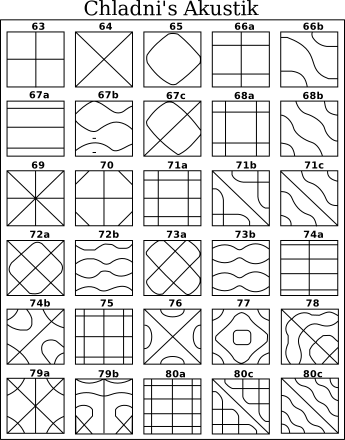
The physical phenomenon Jenny documented is real and straightforward. A vibrating plate will produce standing-wave patterns; particles on the plate gather at the nodes where the plate is not moving. The Prussian physicist Ernst Chladni had demonstrated this in 1787 with bowed metal plates, and the patterns are called Chladni figures in his honour. Jenny extended Chladni's method across a far wider range of frequencies, materials, and media, and produced striking photographs of structured patterns that resemble, in some cases, crystals, flowers, mandalas, and biological forms.
Jenny's interpretation of what he observed was shaped by anthroposophy, the spiritual movement founded by Rudolf Steiner, at whose Goetheanum in Dornach Jenny had studied. Jenny understood the patterns as expressions of underlying formative principles in nature, not merely as acoustic artefacts. This is an interpretive claim layered on top of the physical observations. The observations are solid; the interpretation is philosophical.
Cymatic imagery and videos have become a standard visual language for sound-healing content. The phenomenon is genuine, the patterns are beautiful, and the underlying physics (standing waves on vibrating surfaces) is taught in any undergraduate acoustics course. Where it becomes overstated is in claims that specific Solfeggio or cosmic-octave frequencies produce uniquely "sacred" geometric patterns compared to other frequencies. Any frequency produces a pattern. The claim that specific frequencies produce uniquely spiritually meaningful patterns is an aesthetic judgement, not a physical finding.
What These Frequencies Share
Stepping back across all these systems (Pythagorean ratios, Verdi's A = 432 Hz, the Solfeggio set, Cousto's cosmic octaves, cymatic frequencies), a pattern emerges that is honest to name.
First: the genuine mathematical or historical foundation is usually real. Pythagoras did identify whole-number ratios in musical consonance. Verdi did advocate for A = 432 Hz. Cousto did calculate octave transpositions of planetary periods. Chladni and Jenny did photograph real vibrational patterns.
Second: the wellness-culture narrative that layers healing, DNA activation, cosmic alignment, and ancient sacred use on top of these frequencies is almost entirely a 20th and 21st century construction, often without textual support from the traditions or figures it invokes.
Third: the frequencies themselves work as compositional material regardless of whether the larger narrative holds up. A musician can choose to tune to A = 432 Hz, compose with Solfeggio intervals, or use Cousto's planetary tones because they are aesthetically interesting, subjectively pleasant, or meditative in practice. This does not require the metaphysical claims to be true. Many traditions of music are built on specific tuning systems with their own internal logic. These are recent additions to that longer history.
Fourth: scientific evidence for unique healing or consciousness-altering properties of any specific frequency, above and beyond the general effects of music, tuning, and listener expectation, is limited. What research there is tends to show small effects consistent with what one would expect from any calming, intentional listening experience.
The science says one thing. The traditions and systems say other things, sometimes contradicting each other. Listeners and musicians often experience something real in the music, even when the metaphysical story behind a specific frequency set does not hold up. All three are worth holding together.
Composers Working with These Tunings
A note on the wider context for using these frequency systems compositionally. Contemporary composers working outside standard A = 440 Hz equal temperament are not unusual. La Monte Young has spent decades composing in just intonation based on small-integer ratios. Éliane Radigue composed long-form electronic drone pieces informed by Tibetan Buddhist cosmology. Terry Riley's In C (1964) was written in a period when tuning was a contested compositional choice. Indian classical music has always worked in tuning systems unrelated to European equal temperament. The act of composing with a non-standard tuning is an old and legitimate musical choice.
More specifically relevant to this page, a number of contemporary musicians have made albums using one or more of the frequency systems discussed above, treating them as compositional material rather than medical treatment.
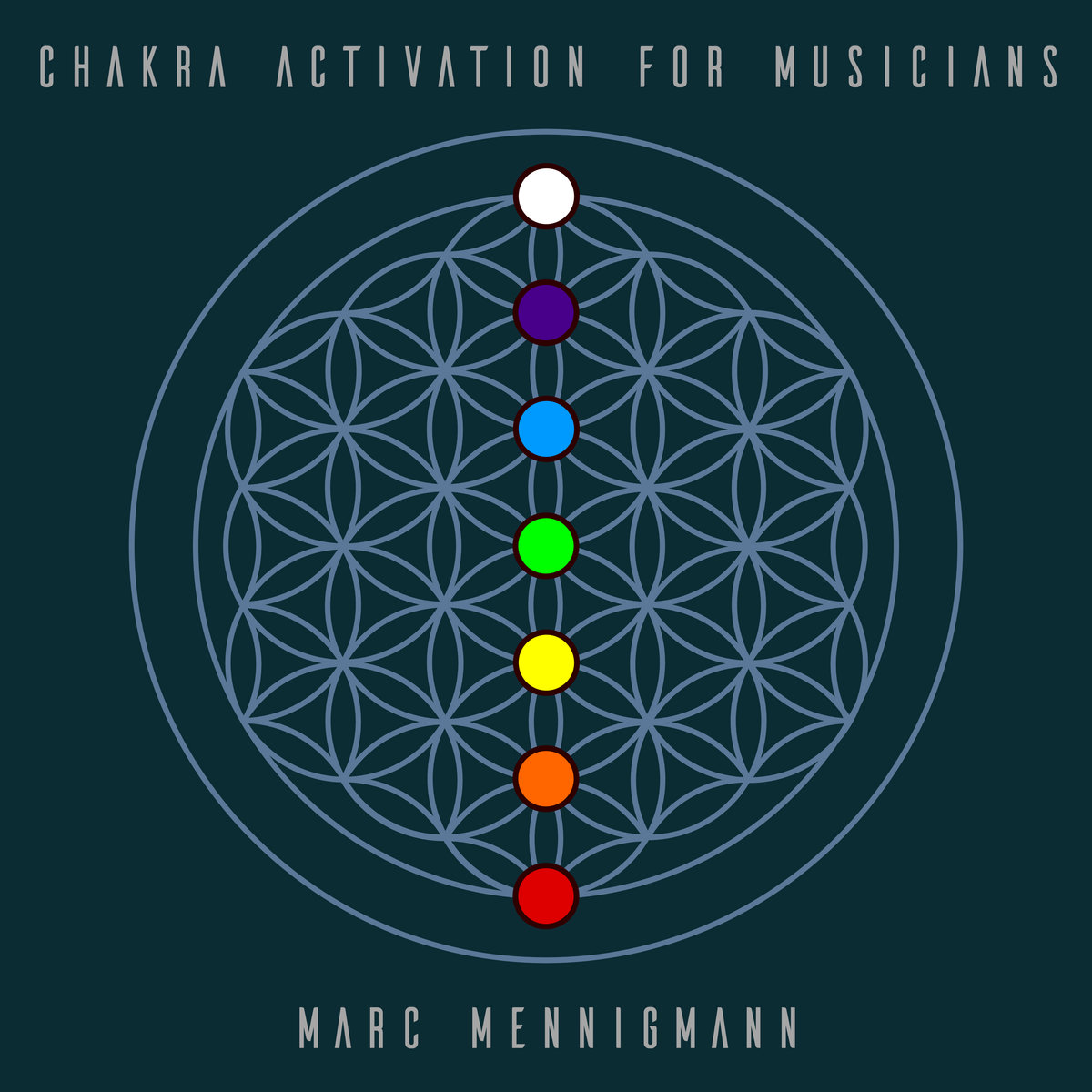
Disclosure: the author of this page is the developer of EarthBeat and released an album in 2018 called Chakra Activation for Musicians that engages with three of the frequency systems discussed here. The album uses Cousto's Cosmic Octave frequencies, the Solfeggio set, and a third "chakra carrier wave" set (256, 288, 320, 341, 384, 448, 480 Hz) that circulates on the internet without a single clear authoring source. The album was composed before the author encountered the Schumann resonance; EarthBeat itself is a later outgrowth of the same interest in non-standard natural frequencies. The album is mentioned here as a worked example of how a musician can engage with these tuning systems in good faith, treating them as sound material to compose with rather than as verified medical or metaphysical instruments. The liner notes describe the compositional choices in detail.
The album is one data point among many. It illustrates something about this whole territory: a composer can find the frequency systems worth working with, and the results can be musically and meditatively valuable, without the listener or composer needing to sign onto any specific claim about what the frequencies do. The music does what music does. The rest is interpretation.
What EarthBeat Shows
EarthBeat does not play tones or music. It displays real-time electromagnetic measurements, principally the Schumann resonance, which sits at around 7.83 Hz with higher modes near 14, 20, 26, and 33 Hz. These are not audible frequencies. They are extremely-low-frequency (ELF) electromagnetic oscillations of the Earth-ionosphere cavity, driven by global lightning activity. The connection between them and audible sound frequencies (432 Hz, 528 Hz, 136.10 Hz) is indirect at best.
Some contemporary wellness writing claims that A = 432 Hz is related to the Schumann resonance because 432 = 54 × 8 and 54 × 0.145... approximately equals 7.83. These are numerological constructions. There is no physical mechanism by which an audible-range acoustic tone couples to an ELF electromagnetic field; the physics does not work that way. The frequencies are not unrelated in the sense that they are all real phenomena in nature, but they are not related in the sense of producing or entraining each other. For the honest picture of what the Schumann resonance is and what is and is not known about its relationship to human physiology, see our Science Track page on the Schumann resonance and the human body.
EarthBeat's value, as we have said before, is as a window onto a real physical signal. It is not a tuning source and does not claim to be one. The music you use in your practice, whatever tuning system it is in, is a separate and personal choice. This page exists to help you make that choice with accurate information about where your frequencies come from.
Further Reading
Historical sources
- Nicomachus of Gerasa, Enchiridion Harmonices (2nd century CE). Primary ancient source for Pythagorean music theory.
- Plato, Timaeus. Harmonic ratios in the world soul.
- Boethius, De Institutione Musica (6th century CE). Medieval synthesis.
- Johannes Kepler, Harmonices Mundi (1619). The planetary tones calculation.
Tuning history
- Bruce Haynes, A History of Performing Pitch: The Story of "A" (Scarecrow Press, 2002). Definitive academic reference on pitch standards.
- Ellen Lockhart, various articles on Verdi and 19th-century Italian pitch debates.
Modern frequency systems (primary sources)
- Hans Cousto, Die Kosmische Oktave (1984). Primary source for the cosmic octave system.
- Leonard Horowitz and Joseph Puleo, Healing Codes for the Biological Apocalypse (Tetrahedron, 1999). Primary source for the Solfeggio frequency set in its modern form.
- Hans Jenny, Kymatik / Cymatics: The Structure and Dynamics of Waves and Vibrations, Volumes 1 and 2 (1967, 1972). Primary source for cymatic research.
Critical analysis
- Concert pitch and Scientific pitch entries, English Wikipedia. Solid summaries with references.
- Solfeggio frequencies entry, RationalWiki. Technical critique of the numerological construction.
- Calamassi D, Pomponi GP (2019). "Music Tuned to 440 Hz Versus 432 Hz and the Health Effects." Acta Biomedica. One of the few peer-reviewed comparative studies.