What HRV Measures
HRV is the variation in time between successive heartbeats. A healthy heart does not beat like a metronome. The interval between beats changes from second to second, reflecting continuous adjustments by the autonomic nervous system to breathing, blood pressure, emotion, physical activity, and circadian state. Low HRV is a well-established risk factor for cardiovascular disease and all-cause mortality; it is one of the standard research tools in cardiology, psychophysiology, and sports science.
Standard frequency-domain HRV analysis divides the heart rate signal into three main bands (Task Force Report 1996; reviewed in Shaffer and Ginsberg 2017):
High frequency (HF): 0.15 to 0.4 Hz. Reflects parasympathetic (vagal) modulation, driven largely by respiratory sinus arrhythmia, the speeding and slowing of the heart with each breath.
Low frequency (LF): 0.04 to 0.15 Hz. Reflects a mix of sympathetic and parasympathetic activity, with contributions from baroreceptor loops. The dominant peak typically sits near 0.1 Hz, which corresponds to slow breathing rates around 5 to 7 breaths per minute (the "resonance frequency" used in HRV biofeedback).
Very low frequency (VLF): 0.003 to 0.04 Hz. Physiological origin less well-established; related to thermoregulation, hormonal rhythms, and longer-period autonomic fluctuations.
HRV is typically measured from a continuous ECG record over five minutes (short-term), 24 hours (Holter), or longer. The reproducibility is good within individuals but varies considerably between them, which is why HRV epidemiology generally uses within-person repeated measures.
The Epidemiology
Several peer-reviewed epidemiological studies have examined whether geomagnetic activity correlates with cardiovascular outcomes at population scale. The pattern across studies is reasonably consistent: small positive associations between Kp index and mortality, blood pressure, and inflammatory markers, surviving adjustment for meteorological confounders.
Zilli Vieira et al. (2019, Environmental Health). The largest study of its kind. Daily mortality data from 263 US cities over multiple years, correlated with daily Kp index. Found significant associations between Kp and total, cardiovascular, and myocardial-infarction mortality after adjustment for particulate matter and season. A one-standard-deviation increase in Kp was associated with 0.13 to 0.47 percent increases in total daily mortality depending on season. No significant association with stroke mortality. Effects were larger in fall and winter.
Kim et al. (2022, PLOS ONE). Normative Aging Study cohort (male US veterans). Found significant associations between Kp index and circulating biomarkers of endothelial activation (sICAM-1, sVCAM-1) and systemic inflammation (C-reactive protein), with effects surviving adjustment for demographic and meteorological variables. Interpretation: geomagnetic disturbances may modestly promote vascular inflammation in older men.
Dimitrova et al. (various dates, reviewed in Alabdulgader et al. 2023). Bulgarian cohort studies reporting blood pressure increases during geomagnetic storms, with about 12 percent mean increase reported, and with hypertensive subjects more affected than normotensives.
Palmer et al. (2006), Chernouss, Vinogradov, and Vlasova (2004). Earlier reports from arctic latitudes, which experience stronger geomagnetic effects than mid-latitudes, linking Kp index variations to melatonin secretion rhythms measured by overnight 6-hydroxymelatonin sulfate excretion. Consistently reported reductions in melatonin output during high-Kp periods.
The effects are small in relative terms (fractions of a percent on mortality; single-digit percent on biomarkers). They are detectable because the datasets are large. For an individual person, the increment in risk from a single geomagnetic storm is negligible against background risk. For a population of 300 million over 20 years, the cumulative numbers matter enough to generate statistically significant excess deaths attributable to Kp variability.
The Small-Cohort HRV Studies
A separate literature, largely but not exclusively associated with the HeartMath Institute and the Global Coherence Initiative, has examined HRV directly in small cohorts over weeks to months.
Alabdulgader et al. (2018, Scientific Reports). 16 participants, 72 hours of continuous HRV per week for 5 months, correlated with solar wind speed, Kp, Ap, sunspot number, F10.7 solar radio flux, polar cap index, and local magnetic field data. Reported positive correlations between Schumann resonance power and several HRV measures (HF, LF, VLF power), and between solar wind variables and HRV. Funded by King Abdulaziz City for Science and Technology.
Timofejeva, McCraty, et al. (2018, Journal of Complexity in Health Sciences). Extension of the 2018 study, examining whether the HeartMath "Heart Lock-In" coherence technique modulated the HRV-geomagnetic coupling. Reported that the technique strengthened the observed synchronisation.
Alabdulgader, Timofejeva, et al. (2021, Applied Sciences). 104 participants across California, Lithuania, Saudi Arabia, New Zealand, and England, 15 days of continuous HRV monitoring. Reported synchronisation between slow HRV rhythms and local magnetic field data, with the synchronisation varying across the global cohort in a way the authors interpreted as consistent with a coherent global signal.
These studies are peer-reviewed but appear in journals at varied impact levels, and their methodology has been debated in the literature. The common critical points are:
- The effect sizes are small and the analyses involve many multiple comparisons across HRV bands and solar/geomagnetic variables, raising the risk of spurious correlations even with Bonferroni correction.
- The participant groups are self-selected from networks with an interest in biofield and coherence research, which may introduce systematic biases.
- The SR-HRV correlations specifically depend on the SR power estimate from the Global Coherence Initiative's own sensor network, which is small relative to the standard geomagnetic monitoring network.
- Independent replication by groups outside the HeartMath collaboration has been limited.
None of these critiques invalidates the work; they mean the findings should be treated as provisional rather than established.
Proposed Mechanisms
Four main biophysical mechanisms have been proposed for how geomagnetic activity might affect human cardiovascular regulation. The evidence is strongest for the first, weakest for the fourth.
Melatonin disruption via cryptochromes. Cryptochrome proteins in the retina and elsewhere are magnetoreceptors in many animal species and are known components of the circadian system, including melatonin regulation. Close (2012, Proceedings B) proposed that geomagnetic storms may act as disrupted zeitgebers for the circadian pacemaker by altering cryptochrome-mediated signalling, leading to reduced melatonin and downstream cardiovascular effects. Consistent with arctic-latitude observations of reduced melatonin during high-Kp periods (Burch et al. 2008; Weydahl et al. 2001 at 70 N). [Inference] This mechanism is biologically plausible and has supporting animal data, but direct human mechanistic evidence remains limited.
Increased oxidative stress from reduced melatonin. Melatonin is a potent antioxidant. Reduced melatonin under high-Kp conditions could plausibly increase reactive oxygen species and promote endothelial dysfunction, connecting the Kim et al. (2022) biomarker findings to the mortality epidemiology.
Direct magnetic effects on cardiomyocyte calcium handling. Laboratory experiments have reported that exposing rat cardiomyocytes to weak magnetic fields at the Schumann fundamental (7.83 Hz) alters calcium release from the sarcoplasmic reticulum, changing contractility (reviewed in Rivera et al. 2023, Life). The experimental effect is real at laboratory field strengths but is typically demonstrated at stronger fields than the ambient natural SR magnetic field (of order 1 pT). Whether the natural-strength signal reaches the calcium-handling machinery in intact humans is not established.
Direct frequency entrainment of heart or brain rhythms. The strongest and most speculative claim: that brain alpha waves (7-12 Hz) and the SR fundamental (near 7.83 Hz) spectrally overlap, and that real-time entrainment can be detected. Persinger, Saroka, and colleagues (2015, 2016) have published supporting data from EEG recordings. Independent replication has been limited, and critics have argued the observed "coherence" may reflect shared instrumentation noise or measurement artefacts rather than biological coupling. The heart-rate extension of this claim, that HRV rhythms directly entrain to SR or geomagnetic signals in real time, is supported primarily within the HeartMath literature and has not been clearly demonstrated by independent replication.
What Is and Is Not Established
Reasonable summary of the current state of evidence:
Reasonably well established. Geomagnetic storms are associated with small increases in cardiovascular mortality and morbidity markers at the population level, probably mediated at least partly by melatonin disruption and stress-response activation. Effect sizes are small and matter at population scale rather than individual scale.
Plausible, moderately supported. HRV shows correlations with geomagnetic activity over longer measurement periods, detectable in careful studies. The mechanism is likely autonomic response to the same stressors that show up in the mortality data, though direct magnetic-field coupling cannot be ruled out.
Not established. Real-time entrainment of cardiac or brain rhythms to the Schumann resonance. The frequency overlap between alpha waves (7-12 Hz) and the SR fundamental (~7.83 Hz) is numerical rather than mechanistic. Correlations reported in the literature are modest and open to methodological critique. [Unverified] Popular claims that the SR "tunes" human consciousness or that specific SR frequencies have health-modulating effects lack peer-reviewed support at the level of established biomedical science.
Genuinely unknown. Whether individual sensitivity to geomagnetic activity varies meaningfully between people in a way that could guide personal health decisions. [Speculation] Some sensitivity variation likely exists, but identifying it reliably in individuals would require more longitudinal data than current studies provide.
How This Connects to EarthBeat
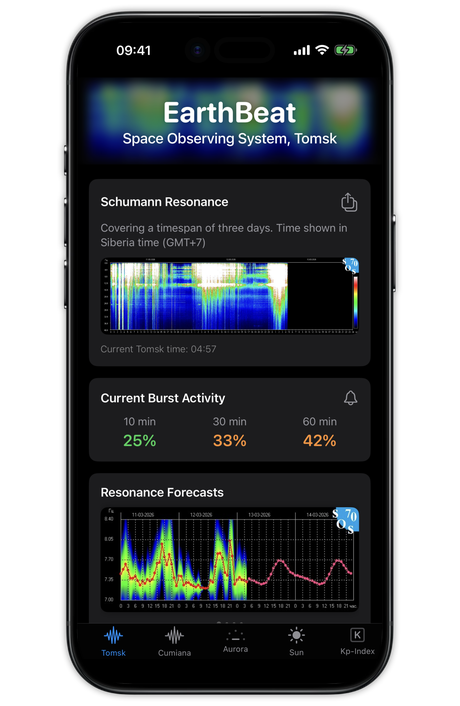
EarthBeat displays both the Schumann resonance and the Kp index side by side. The Kp track is the same variable used in the mortality and biomarker studies cited above; the SR track is the ELF electromagnetic environment whose direct effect on humans is less well-established but actively researched.
Two practical things a reader can take from this.
Seeing your space weather. The Kp index on the EarthBeat display during the day of a geomagnetic storm (Kp greater than or equal to 5) corresponds to the same index values used in the cardiovascular epidemiology. A storm of Kp 7 or 8 is a period when population-level studies would predict a small uptick in cardiovascular events. This does not mean any individual user should change behaviour, but it does connect the numbers on the app to the published literature.
Not overclaiming. The SR amplitude trace in EarthBeat is the natural-level SR, not an experimentally amplified field. The epidemiological associations linked to Kp have stronger support in the peer-reviewed literature than direct SR-health associations do. Users who notice they feel unwell during storms may be observing a real population-level signal; users who believe specific SR frequencies cause specific effects are extrapolating beyond the peer-reviewed evidence.
For the broader framework of how the Schumann resonance relates to human physiology, see The Schumann Resonance and the Human Body. For how the Kp index is constructed and what it measures, see The Kp Index.
Summary
- HRV is a well-established physiological signal reflecting autonomic nervous system balance. Standard bands are VLF, LF, and HF; each band has different physiological correlates.
- Large peer-reviewed epidemiology has found small but significant positive associations between Kp index and total, cardiovascular, and myocardial-infarction mortality across hundreds of US cities.
- Smaller cohort studies have reported HRV correlations with solar and geomagnetic variables, supporting the autonomic pathway. The strongest claims of direct SR entrainment remain provisional.
- Proposed mechanisms include melatonin disruption via cryptochrome magnetoreception, oxidative stress pathways, direct effects on cardiomyocyte calcium handling, and direct rhythm entrainment. The first two have the strongest support; the fourth remains speculative.
- Effect sizes are small: matter at population scale, negligible individual-level. Individual users should not draw strong conclusions from Kp values or SR amplitudes about their personal cardiovascular state.
- EarthBeat's pairing of SR and Kp data reflects this scientific landscape: Kp has the better-established health literature, SR is more actively researched and less settled.