The Frequency Coincidence
One important scale correction is worth keeping in mind. The Schumann resonance magnetic field at the ground is around 1 picotesla. Earth's static magnetic field is 30 to 50 microteslas, a factor of about 10^8 stronger. The SR electric field at ground level is around 300 microvolts per meter, while the electric field across a neuron's cell membrane is approximately 10^5 volts per centimeter. By direct field-strength comparison, the SR signal is vastly weaker than the electromagnetic environment the body already operates in. Any biological effect therefore has to work through a resonance or amplification mechanism, not through raw energy transfer.
EEG and the Persinger-Saroka Studies
The most systematic work on Schumann resonance and the human brain has come from Michael Persinger and Kevin Saroka at Laurentian University in Canada.
Persinger and Saroka (2015, published in the Journal of Signal and Information Processing) measured simultaneously the Schumann resonance at a local ELF receiver and the brain electrical activity of a single participant sitting quietly outdoors with eyes closed. They reported transient episodes of coherence between the EEG signal and the SR signal. The coherence episodes were brief, 200 to 300 milliseconds, and appeared at three specific frequency bands: near 8 Hz, near 14 Hz, and near 20 Hz, corresponding to the first three SR harmonics.
Saroka, Vares and Persinger (2016, published in PLOS ONE) extended this to a larger sample: 238 quantitative EEG measurements compared against simultaneous local SR measurements. They reported similar spectral power density patterns between the EEG and SR recordings in aggregate, and cross-channel coherences that were stronger during geomagnetically quiet periods. An earlier Russian study by Pobachenko et al. (2006, in Complex Systems Biophysics) had reported real-time coherence between SR and EEG spectra in the 6 to 16 Hz range for a small sample.
A few things about these studies are worth noting for a careful reader.
What they found. Statistical coherence between two electromagnetic signals in overlapping frequency bands. The coherence was intermittent, small in effect size, and strongest at the known SR harmonic frequencies.
What they did not find. They did not demonstrate that the SR causes EEG changes, did not identify a physiological receptor for the SR signal, and did not show that this coherence produces any behavioral, cognitive, or health effect. The authors themselves noted that third factors (such as geomagnetic activity affecting both the SR and the EEG independently) cannot be ruled out.
Reproducibility. Independent replication of these specific findings outside the Laurentian group is limited. The Pobachenko 2006 work is cited as supportive but was a small study in a less prominent journal. The field is active but not large.
Heart Rate Variability: The HeartMath Studies
A second cluster of peer-reviewed work on SR-body interaction comes from the HeartMath Institute in Boulder Creek, California.
McCraty et al. (2017, published in the International Journal of Environmental Research and Public Health) monitored heart rate variability continuously for 31 days in 10 participants going about their normal lives. HRV was compared against solar wind speed, the Kp and Ap indices, solar radio flux, cosmic ray counts, Schumann resonance power, and total magnetic field variation. The study reported significant correlations between HRV measures and all these environmental variables, with the pattern differing across quiet, storm, and post-storm periods. Correlations with Schumann resonance power were weak during unsettled conditions and became stronger (and negative) during severe geomagnetic storms.
Alabdulgader et al. (2018, published in Scientific Reports) extended the methodology to 16 participants monitored for 72 consecutive hours per week over five months, with multivariate regression and Bonferroni corrections for multiple comparisons. They reported that ANS activity responds to solar and geomagnetic changes during normal background periods, with different variables producing responses at different lags.
Two further HeartMath-led studies are worth mentioning. Timofejeva et al. (2017) reported statistical synchronisation of physiological rhythms across geographically dispersed participants, attributed to a shared response to the geomagnetic environment. A separate line of work connects the Schumann resonance amplitude band with HRV synchrony patterns measured through the Institute's Global Coherence Initiative magnetometer network.
Honest framing matters for these studies. They are published in peer-reviewed journals, use conventional statistical methods, and use Bonferroni corrections where appropriate. They are also funded by the HeartMath Institute, which has a stated interest in demonstrating human-Earth electromagnetic coupling. The findings are statistical correlations with modest effect sizes, not demonstrations of causation. Independent replication outside HeartMath-affiliated teams is limited, which is a known issue in the field.
The Insomnia Randomised Trial
Chen et al. (2022, published in Nature and Science of Sleep) conducted a double-blind, randomised controlled trial testing a Schumann-resonance-frequency exposure device on 40 insomnia patients (70 percent female, mean age 50). Half received an active device, half received a placebo device identical in appearance. Polysomnography (objective sleep measurement) and standard questionnaires (Pittsburgh Sleep Quality Index, Epworth Sleepiness Scale, SF-36 quality of life) were used to measure outcomes over a four-week follow-up.
The active group showed measurable improvements on several sleep indicators compared to the placebo group. This is, as of this writing, the strongest single study of a direct SR-frequency intervention in a clinical population, and it used a design (double-blind, placebo-controlled, polysomnography-based) that is the standard in sleep medicine.
One study is not definitive, and a 40-patient trial is small by pharmaceutical standards. The result is noteworthy because it is a direct test with proper blinding, and because it replicates the intent (if not the exact methodology) of earlier single-arm studies that suggested ELF-frequency interventions can affect sleep.
Proposed Physiological Mechanisms
How could a 1-picotesla field affect a human body at all? The peer-reviewed literature proposes several candidate mechanisms, none fully established.
Resonant absorption in ion channels. Cherry (2002) argued that biological systems responsive to very weak signals (fish, birds, humans) can detect ULF/ELF fields at thresholds of 10^-7 to 10^-8 volts per centimeter through nonlinear resonant absorption into ion oscillation systems in cell membranes. Adey, Bawin and others in the 1970s showed that environmental electromagnetic fields at the 10^-7 V/cm level can alter calcium ion flux across neural tissue. This is the classical "window" effect: specific frequencies and intensities produce effects that stronger or weaker fields do not.
Voltage-gated calcium channels. Pall (2013) proposed that ELF fields act primarily through activation of voltage-gated calcium channels, producing cascades of calcium-dependent signalling effects. This mechanism is consistent with the Adey/Bawin findings and has been invoked in the broader debate about health effects of electromagnetic fields at very low intensity.
Magnetite biomineralisation. Kirschvink and colleagues showed in the 1990s that the human brain contains biogenic magnetite crystals, primarily in the hippocampus and cerebellum. These crystals can in principle couple mechanical motion to ionic currents and provide a transduction pathway for weak magnetic fields. Whether they do so at SR intensities has not been demonstrated.
Melatonin and pineal pathway. Several studies (Burch et al. 1999; Rapoport et al. 1997) have reported reduced nocturnal melatonin metabolite excretion during geomagnetic disturbances. If SR variations drive part of the geomagnetic environment relevant to the pineal gland, this would give a route from SR to circadian and immune function. The mechanism is plausible but the specific SR contribution is not cleanly separable from the broader geomagnetic signal.
All four mechanisms are speculative at the SR intensity level. They are cited in the literature as candidate explanations, not as established causes. EarthBeat is a monitoring tool, not a medical device, and nothing on this page should be read as medical advice.
What the Record Does Not Support
The scientific record on Schumann resonance and the body is genuinely interesting, and also genuinely limited. Several claims that circulate widely online are not supported by peer-reviewed evidence, and in some cases are explicitly described as misinformation in scientific fact-checking sources.
"The Schumann resonance is rising." The fundamental frequency has remained centred near 7.83 Hz across all instrumented observations since the first measurements in 1960. Short-term fluctuations of a few tenths of a hertz are normal and explained by ionospheric variation and lightning activity. No peer-reviewed study has documented a monotonic long-term rise in the SR fundamental. Wikipedia's dedicated page on Schumann resonances conspiracy theories notes that the "rising frequency" claim has been traced in online wellness communities since at least 2016 and has been judged false on physical grounds. See Is the Schumann Resonance Rising? for the full treatment.
"Time is speeding up because of Schumann resonance changes." Earth's rotation is measured continuously by atomic clocks. Day-length variations are on the order of milliseconds per day, not hours. The claim that a 24-hour day now "feels like" 16 hours has no basis in either the physical measurement of Earth's rotation or in any peer-reviewed study of the Schumann resonance.
"The Schumann resonance directly entrains brain waves." The EEG-SR coherence studies report statistical coupling, not entrainment in the sense of external driving of brain rhythms. Brain wave frequencies are generated by neuronal circuits and are only weakly affected, if at all, by external fields at SR intensity.
"Schumann generators and bracelets produce health benefits." Commercial devices marketed as "Schumann resonators" do not have published evidence for clinical efficacy. The Chen et al. (2022) insomnia trial used a specific device under controlled conditions, which is a different kind of evidence than consumer marketing claims for wearable products.
"Global events register as Schumann spikes." The SR signal is driven by global lightning and modulated by ionospheric conditions and geomagnetic activity. Apparent "spikes" during notable world events are either coincidental with normal variation or caused by geomagnetic storms that happened independently.
Acknowledging these limits is not a rejection of the research. It is what the research itself says when read carefully.
How to Think About This in EarthBeat
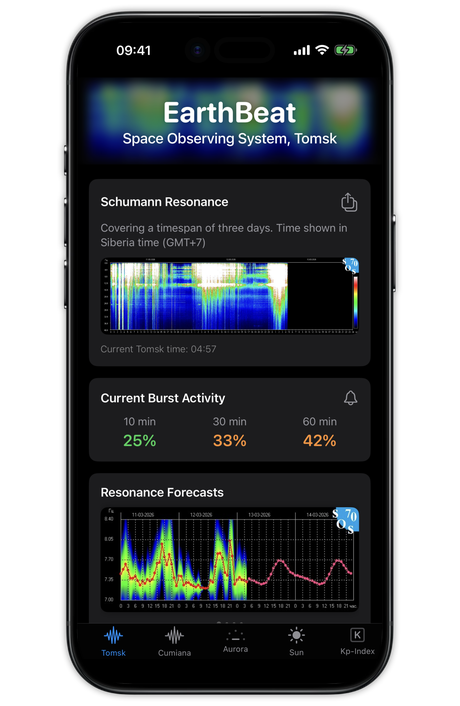
EarthBeat shows real Schumann resonance data from the Tomsk and Cumiana observatories, alongside space weather indices and the Global Consciousness Project output. The app is a monitoring tool, not a health device or a consciousness instrument.
A reasonable way to engage with the data, if you are interested in the body-environment question, is to watch the signal over weeks and months and note your own patterns alongside it, as McCraty et al. (2017) did in a more formal way. This is a personal observational exercise rather than a clinical protocol. It can be interesting. It is not medical advice, and no readings in the app should be used to make health decisions.
If sleep, mood, cardiovascular, or other symptoms concern you, the appropriate step is consultation with a medical professional, not pattern-matching against an electromagnetic signal.
Summary
The Schumann resonance and the human body share a frequency range. That coincidence has motivated sixty years of research across three main threads: brain-wave coherence (Persinger, Saroka, Konig, Pobachenko), heart rate variability and autonomic function (McCraty, Alabdulgader, Timofejeva), and targeted clinical interventions (Chen et al. on insomnia). The findings are real but modest in effect size, proposed mechanisms are plausible but unproven, and independent replication is limited. A large ecosystem of online claims goes well beyond what the research supports, and scientific fact-checkers have identified several specific claims as misinformation. EarthBeat presents the signal honestly and leaves interpretation to the reader.