This page walks through what Russell saw, what modern physics has confirmed and what it has not, and why the diagram still rewards careful attention.
Who Was Walter Russell
Walter Bowman Russell was born in Boston on May 19, 1871, the second of nine children of immigrants from Nova Scotia. He left school at age nine to support himself and never returned to formal education. Despite this, he went on to become a successful Boston School impressionist painter, a sculptor whose monumental works stood in public buildings across the United States, an architect credited with developing the cooperative-ownership model for New York apartment buildings, an author of children's books, and a self-taught church organist and music teacher. The New York Herald Tribune called him the modern Leonardo. The Hotel des Artistes on West 67th Street in Manhattan, which still stands, is generally considered his architectural masterpiece.
In May 1921, at age forty-nine, Russell described undergoing a thirty-nine day experience he called an illumination. By his own account, the experience gave him a sustained vision of the structure of the universe. His family briefly considered hospitalisation. The doctors who examined him were impressed by his recordings, and Russell spent the rest of his life trying to render the vision in books, lectures, paintings, and diagrams.
The Universal One came out in 1926. The Secret of Light followed in 1947. The Message of the Divine Iliad appeared in 1948 and 1949. Atomic Suicide?, co-written with his second wife Lao Russell, came out in 1957, the same year the Commonwealth of Virginia chartered the University of Science and Philosophy at Swannanoa, a former railroad-magnate's estate the Russells had leased in 1948. The university operated as a correspondence school and continues in some form today.
Russell corresponded with Nikola Tesla. The often-quoted story that Tesla advised him to lock his ideas in a safe for a thousand years until humanity was ready for them comes from Russell's own account and is not independently verifiable. Russell died on his ninety-second birthday, May 19, 1963, in Swannanoa.
He was neither a credentialed physicist nor a fraud. He was an artist with a vision, working at the edge of what could be said about matter at a time when quantum mechanics was just being formalised by Bohr, Schrödinger, Heisenberg, and de Broglie.
What the Diagram Shows
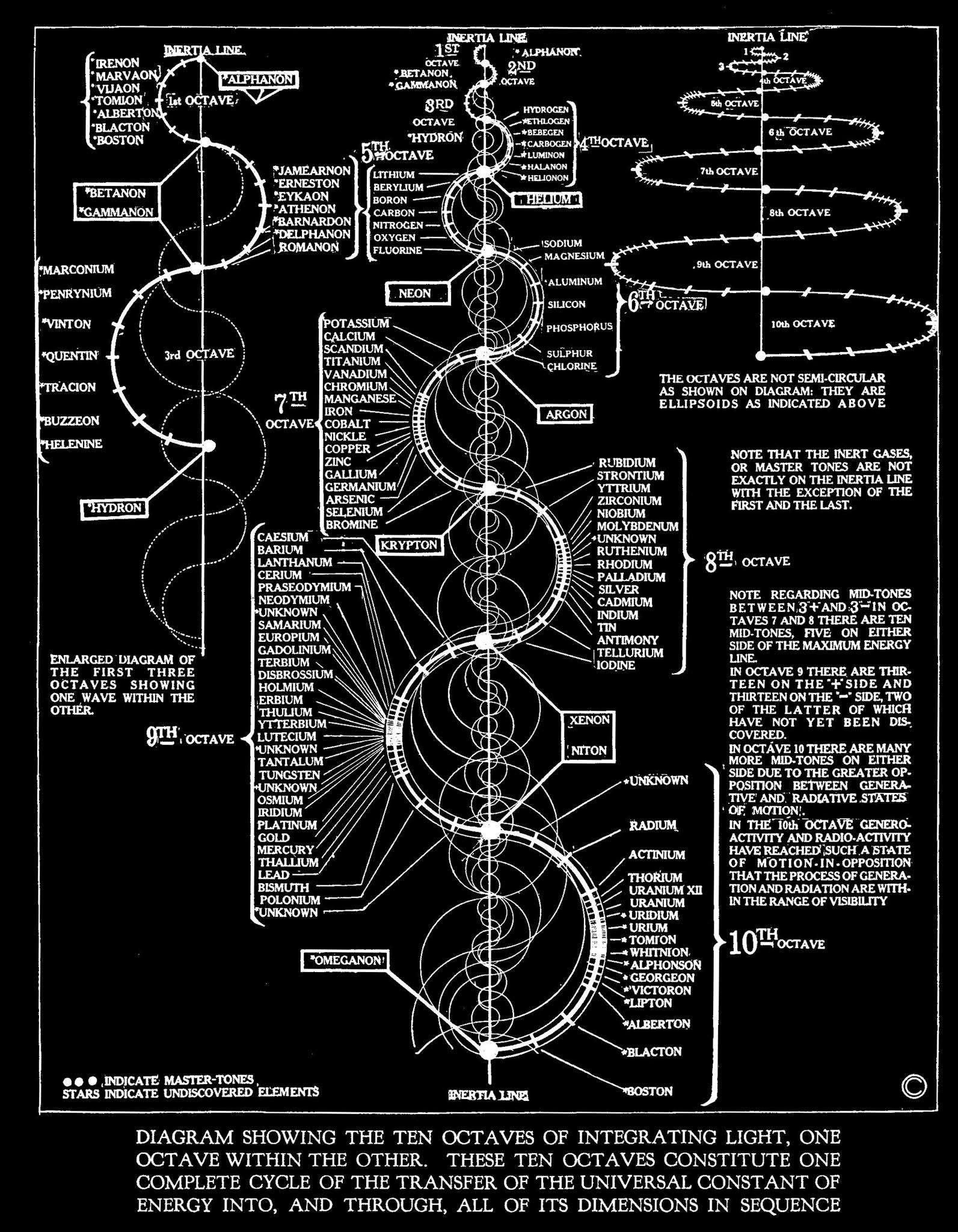
The chart depicts ten octaves stacked along a vertical inertia line. Each octave is drawn as a wave or spiral, and each one begins and ends at an inert gas which Russell called a master tone. The familiar elements (hydrogen, helium, carbon, iron, gold, uranium, and the rest) are arrayed along these waves between the master tones.
There are three diagrams on the page. The central one shows all ten octaves nested together. The left panel zooms into the first three octaves, which Russell believed contained pre-physical "elements" finer than hydrogen, with names he invented (Alphanon, Betanon, Gammanon, and so on). The right panel reminds the reader that the octaves are not actually semi-circular as drawn but ellipsoidal, nested inside one another like Russian dolls.
The asterisks throughout the chart mark elements Russell predicted but that had not been discovered when he drew it. Several of the labels reflect the chemistry of his time. The chart marks the noble gas at atomic number 86 as Niton, the name given to it by William Ramsay and Robert Whytlaw-Gray in 1908 and used until IUPAC officially renamed it radon in 1923. Russell's diagram, published three years later, retained the older name.
The core idea is that elements are not things but conditions. Each element is a stage of compression or expansion of light along a wave. The inert gases, sitting at the boundaries between octaves, are the still points where the wave crosses zero. The lighter elements ascend on the generative side of the wave, charging with energy. The heavier elements descend on the radiative side, discharging it.
Substitute the word vibration or frequency for light throughout, and a lot of Russell's language starts to sound surprisingly contemporary.
Where Russell Was Right, Structurally
Modern quantum field theory describes every particle as an excitation of an underlying field. An electron is a localised vibration in the electron field. A photon is a vibration in the electromagnetic field. The Higgs boson, confirmed at CERN in 2012, is a vibration in the Higgs field. In a real and technical sense, matter is patterned vibration.
Inside atoms, electrons exist as three-dimensional standing waves around the nucleus. The shell structure that gives the periodic table its rows and columns emerges directly from which standing-wave patterns are allowed by the boundary conditions of the atom. The noble gases (helium, neon, argon, krypton, xenon, radon) are stable precisely because their electron waves close into complete shells. Russell's instinct to anchor each octave with an inert gas turns out to mirror something real about how atomic structure actually works.
The principle goes much wider than atoms. Standing waves in bounded cavities appear everywhere in nature. The Earth-ionosphere cavity hosts the Schumann resonances. The Sun has helioseismic modes oscillating with five-minute periods. Stars, planets, oceans, drumheads, and concert halls all express the same mathematics: a closed space allows only certain wavelengths, and those wavelengths form a discrete spectrum.
Russell's diagram, read generously, is an early attempt to depict this nested-resonance structure of nature. He drew it as ellipsoids inside ellipsoids, with master tones at every boundary. As topology, that is not a bad picture of how the universe actually organises itself across scales.
Where Russell Was Wrong, Specifically
His three pre-hydrogen octaves have no physical counterpart. Hydrogen is the simplest stable atom. Below it sit subatomic particles (protons, electrons, quarks), not finer "elements".
His specific element names in the higher octaves do not correspond to the actual transuranic elements that have since been synthesised, from neptunium (1940) through oganesson (2002). The naming scheme was poetic, not predictive in any quantitative sense.
His framework lacks the mathematical precision that quantum mechanics provides. Modern atomic physics calculates ionisation energies, bond lengths, and spectral lines to many decimal places. Russell's chart predicts none of these.
The claim that elements are conditions rather than things is suggestive as philosophy and unfalsifiable as science. It is the kind of statement that points at something real (matter is dynamic, not static) without being testable in its own terms.
This is the honest accounting. The chart is not modern chemistry. It does not replace the periodic table. It does not encode hidden laws that physics has missed. It is a 1920s artist's vision, drawn in the language available to him.
Russell, Tesla, and the Vibrational Lineage
Russell sits in a long lineage of thinkers who treated vibration as the fundamental language of reality. Pythagoras heard the planets as music. John Worrell Keely, in the 1880s, claimed to extract energy from sympathetic vibration. Tesla, in a much-quoted line, said that to understand the universe, you should think in terms of energy, frequency, and vibration. Hans Jenny's cymatics work in the 1960s showed how sound shapes matter into geometric patterns. Royal Rife, the Solfeggio frequency tradition, the 432 Hz movement, all trace back to a similar intuition. For a closer look at how specific frequencies gathered cultural meaning, see Sacred Sound and Frequency.
Most of these thinkers got the specifics wrong. Most of them also got something structural right: that the universe rhymes with itself across scales, and that the rhyme is rhythmic.
Russell's contribution is that he tried to draw it. The Ten Octaves of Integrating Light is one of the most ambitious visual cosmologies of the twentieth century, and it deserves to be read as a work of philosophical imagination rather than dismissed as failed chemistry. The same disposition (reading a tradition seriously while staying honest about its limits) runs through other Awareness Track pages. For a parallel example treating contemplative traditions of the heart alongside modern heart-rate-variability research, see The Heart as an Organ of Perception.
The Schumann Bridge
Here is where Russell's diagram becomes practically interesting for anyone tracking Earth's electromagnetic environment.
If you accept that the universe is organised as nested resonant cavities, then the Schumann resonance is simply our planetary octave. It sits between the atomic-scale modes (chemistry, spectral lines) and the solar-scale modes (helioseismology, the eleven-year solar cycle). The Earth-ionosphere cavity is roughly 100 kilometres tall and 40,000 kilometres in circumference, and only certain electromagnetic wavelengths fit inside it. The fundamental at 7.83 Hz is the lowest of these. The harmonics at roughly 14.3, 20.8, 27.3, and 33.8 Hz are its octave neighbours.
This cavity is not isolated. Solar flares ionise the lower ionosphere and shift the Schumann modes measurably. Geomagnetic storms broaden and dampen the peaks. The eleven-year solar cycle modulates the cavity's tuning over decades. Lightning, roughly fifty strikes per second globally, is what keeps the cavity ringing in the first place. For the full physics, see the Science Track page on Schumann resonance. Winfried Schumann published his calculation in 1952, twenty-six years after Russell's diagram appeared, and the resonance was first reliably measured by Balser and Wagner between 1960 and 1963.
Russell would have recognised this picture instantly. A bounded cavity, a continuous excitation, a discrete set of allowed tones, and a wider system of nested cavities surrounding it. He drew exactly this, just at a different scale and with different labels.
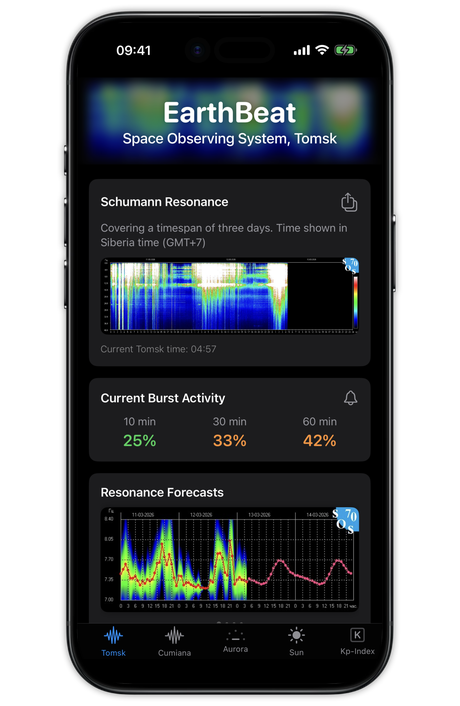
EarthBeat exists to listen to the planetary octave specifically. The Schumann resonance is the part of Russell's nested-resonance vision that scientific instruments at observatories like the Tomsk Space Observing System can actually record in real time, and that we relay through the app. The diagram on the wall is the philosophical genealogy. The live spectrogram is the contemporary expression. For how the mindfulness community engages with the daily signal, see Schumann Resonance and Mindfulness.
A Mindful Way to Read Russell
The temptation with Russell is to go in one of two directions. You can dismiss him as a crank because his specific chemistry does not check out. You can also embrace him uncritically as a misunderstood genius whose work supposedly contains all the answers modern physics is still catching up to. Both readings are too easy.
A more useful approach is to read the diagram the way you might read a poem or a piece of sacred geometry. Ask what it is pointing at. Notice where its structure aligns with things we now know, and where it diverges. Treat it as one map among many, drawn by an artist who was honestly trying to describe something real.
This is the same disposition that makes the Schumann resonance worth tracking even when its effects on human wellbeing remain unproven. Stay curious. Notice patterns. Hold conclusions lightly. Let the data and the diagrams speak for themselves, without rushing to make them say more than they actually do.
Russell's caption on his diagram says the ten octaves constitute one complete cycle of the transfer of the universal constant of energy into, and through, all of its dimensions in sequence. Read literally, that is hard to defend. Read as a description of how energy moves through nested resonant systems, it is hard to argue with.
The map is not the territory. But some maps reveal the territory's shape.