A Brief Taxonomy
TLEs come in several distinct varieties, classified by altitude, morphology, duration, and which atmospheric layer they inhabit.
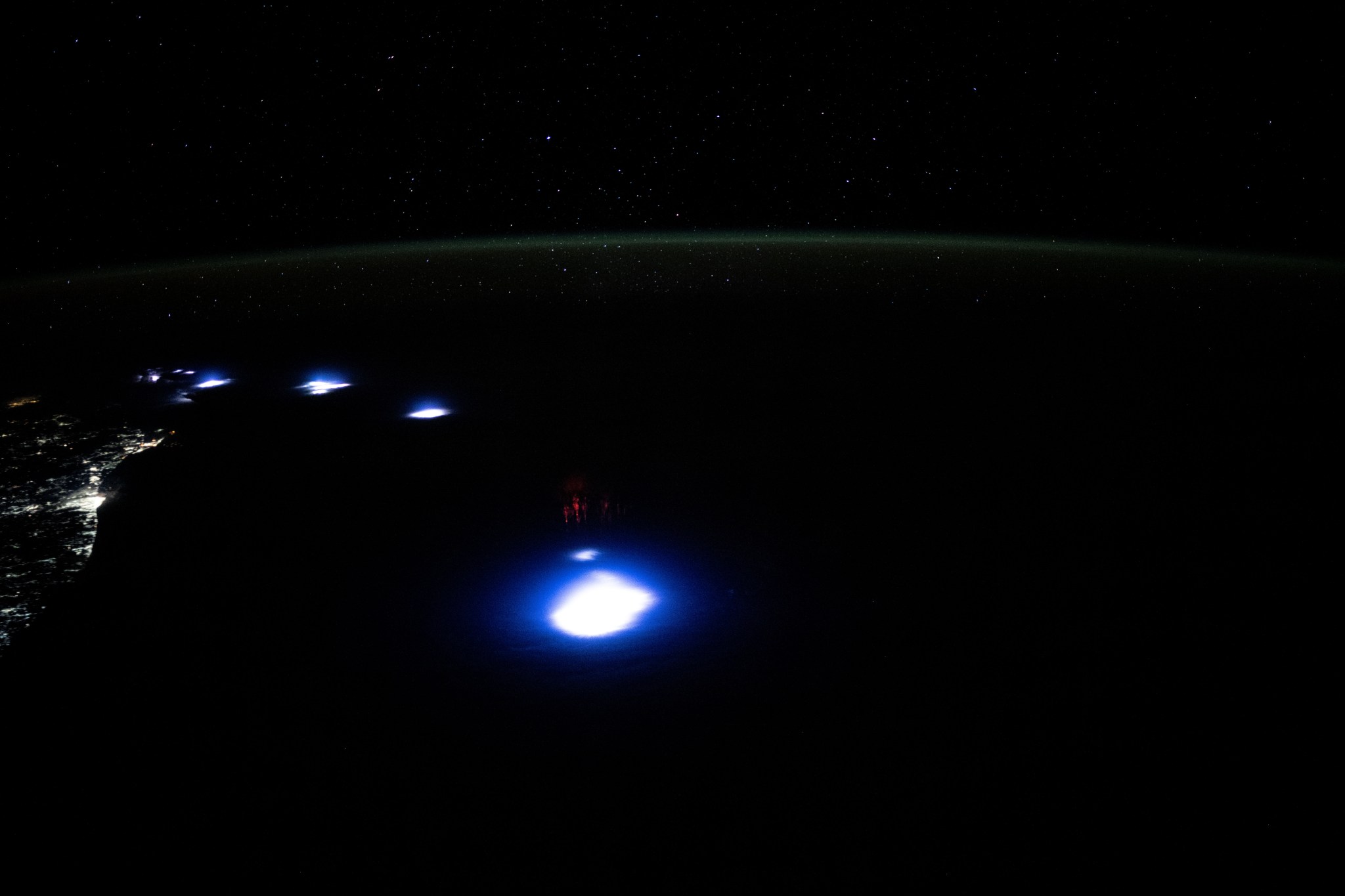
Sprites. Reddish-orange discharges that appear between roughly 50 and 90 km altitude, directly above the parent thunderstorm or slightly offset from it. They last tens of milliseconds, are visible to the naked eye from a dark site if you know where to look, and resemble jellyfish, columns, or carrots depending on the scale. The acronym "sprite" is a backronym for "Stratospheric/mesospheric Perturbations Resulting from Intense Thunderstorm Electrification", but the name was chosen by Davis Sentman as a reference to mischievous characters in Shakespeare. Sprites are the most common type of TLE in the mesosphere and the best-studied.
Elves. Short for "Emissions of Light and Very Low Frequency perturbations due to Electromagnetic pulse Sources". These are flat, rapidly expanding rings of red light at approximately 90 km altitude, around 400 km in diameter at full extent, lasting roughly one millisecond. Elves are caused by the impulsive electromagnetic pulse from a lightning return stroke heating electrons at the bottom of the ionosphere. They were predicted theoretically by Inan and colleagues in 1991 before being confirmed observationally, and they are actually the most frequent type of TLE (roughly 35 events per minute globally, compared with about 1 per minute for sprites and halos).
Blue jets. Narrow conical discharges that shoot upward from thunderstorm tops, reaching approximately 40 to 50 km altitude at speeds around 100 to 140 km/s. Their blue color comes from nitrogen emission lines excited at lower altitudes where the air is denser. Blue starters are shorter, lower-altitude versions (up to about 20 km above cloud top); gigantic jets are the rare, energetic extreme, reaching 70 km or even up to the ionosphere and sometimes connecting the cloud top directly to the upper atmosphere.
Halos. Diffuse, disc-shaped glows at roughly 75 to 85 km altitude, a few tens of km across, lasting milliseconds. They often precede sprites and are thought to be caused by heating of the lower ionosphere by the quasi-electrostatic field above the thundercloud, just before a full sprite develops.
Other names in the literature. Trolls, gnomes, pixies, ghosts, sprelves, c-sprites, and carrot sprites have all been used for morphological variants. These are subtypes rather than new physical categories.
The Physical Sequence
The sequence from a thunderstorm to a TLE, and from a TLE to a Q-burst in the Schumann resonance band, has been traced out in detail through a combination of aircraft campaigns, balloon flights, ground-based photometry, and satellite observations.
A positive cloud-to-ground lightning stroke occurs. Most sprites are triggered by +CG (positive cloud-to-ground) lightning, which lowers positive charge from the thundercloud to the ground. +CG strokes are rarer than -CG strokes but carry much larger charge moments because they often tap the stratiform anvil region of a mesoscale convective system, where accumulated positive charge is spread over a large area.
The charge moment drives a quasi-electrostatic field to mesospheric altitudes. The large, rapid removal of positive charge leaves the upper thundercloud and the atmosphere above it briefly at a strong electric field. Below the breakdown threshold, this field simply drives a transient current. Above the breakdown threshold at 50 to 90 km altitude, air molecules ionise and a sprite develops through streamer breakdown propagating downward from an altitude around 75 km.
Electromagnetic energy radiates into the global cavity. The lightning stroke, plus the currents flowing in the sprite itself, plus any associated continuing current, radiate broadband electromagnetic energy across the ELF band (3 to 3000 Hz). Most of this energy dissipates quickly, but the subset within the Schumann resonance bands (near 8, 14, 21, 27, 34 Hz) excites the cavity coherently.
The resonance rings down. The Earth-ionosphere cavity rings at its resonant frequencies with a quality factor of 4 to 6, so the transient excitation decays over roughly 0.3 to 1 second after the lightning stroke. An ELF receiver sees this as a brief envelope of oscillation rising above the background noise, the Q-burst.
What a Q-Burst Is
The term Q-burst was introduced by Ogawa, Tanaka, Miura, and Yasuhara in 1967 for a specific class of transients that Ogawa had been observing in Japanese ELF records. The Q is conventionally understood as "quiet", because the bursts stand out most clearly against the quiet nighttime ELF background, but the technical definition is operational.
A Q-burst is a transient ELF signal that:
- rises at least a factor of 5 to 10 above the Schumann resonance background,
- contains coherent oscillations at the cavity resonance frequencies,
- decays over several hundred milliseconds to about one second,
- appears at intervals of approximately 10 seconds in a typical record (a global rate equivalent to roughly 10 strong sprite-capable +CG strokes per minute, depending on lightning activity).
The burst pattern in time is characteristic enough that modern Schumann resonance pipelines routinely detect Q-bursts as separate events and subtract them from the background spectrum. Mushtak and Williams (2009) developed the Isolated Lorentzian (I-LOR) technique specifically to separate the smooth background SR spectrum from the transient Q-burst contributions, because the two carry different physical information.
The connection between sprites and Q-bursts was established in detail by Boccippio, Williams, Heckman, Lyons, Baker, and Boldi (1995, Science). They used simultaneous optical observations of sprites in the American Midwest and ELF recordings from a Rhode Island receiver. Each sprite event was associated, within milliseconds, with a Q-burst in the SR band, and the parent lightning strokes carried unusually large charge moment changes of several hundred coulomb-kilometres. This was the first time the connection had been made quantitatively, and it turned Q-bursts from a curiosity into a usable remote-sensing signal.
Where Q-Burst Detection Gets Used
A Q-burst in an ELF receiver carries location information. The arrival time difference between the direct wave and the wave that has travelled the long way around the planet (the "antipodal" arrival) can be used to estimate the source distance. Multi-station networks improve the accuracy to tens of kilometres; single-station methods based on the envelope shape and the E/H field ratio give a few hundred kilometres.
Sprite-producing storm tracking. If you know a Q-burst occurred and can localise it, you know that somewhere on Earth there is a thunderstorm producing large-charge-moment +CG strokes, which strongly implies mesoscale convective systems with stratiform anvils. This lets researchers study sprite-producing meteorology from a single remote station.
Global TLE statistics. Fullekrug and colleagues, Bosinger and colleagues, Guha and colleagues, and others have used multi-year Q-burst records to estimate global rates of sprite-capable strokes without requiring optical observations. These ELF-based rates are consistent with satellite and ground optical campaigns, which have estimated roughly 1 sprite per minute globally and roughly 35 elves per minute (Chen et al. 2008).
Ionospheric sensing. The frequency and quality factor of the resonance ringing during a Q-burst is sensitive to the lower ionosphere's height and conductivity. Because Q-bursts are approximately point-source excitations, they provide a cleaner probe of the cavity's propagation characteristics than does the continuous background.
Satellite cross-validation. The China Seismo-Electromagnetic Satellite (CSES) has now observed Schumann resonance lines from orbit and has recorded ionospheric signatures of TLEs (Parrot et al., Guha et al., and others, reviewed by Zhou et al. 2023). This extends the sprite-SR connection from ground-based to space-based observation.
What EarthBeat Shows
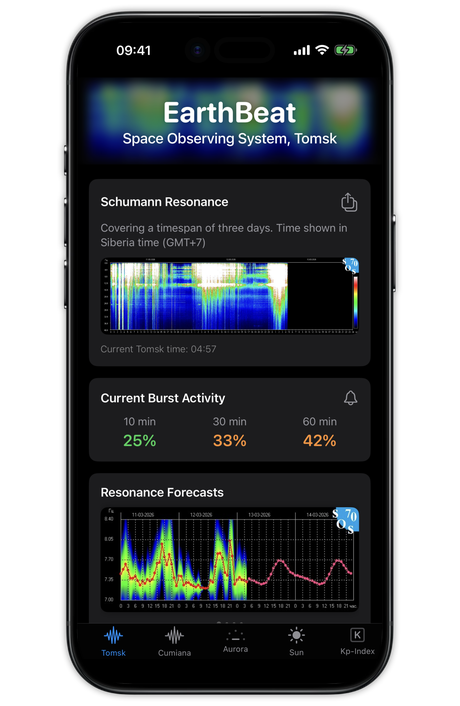
EarthBeat displays Schumann resonance spectrograms from the Tomsk and Cumiana stations. In a typical week's data, the background SR appears as smooth horizontal bands near 8, 14, 21, 27, and 34 Hz, modulated diurnally by the three tropical thunderstorm chimneys.
Q-bursts appear as brief bright streaks: sharp, short-duration amplitude elevations visible across multiple modes at once. In a high-time-resolution display, an individual Q-burst lasts under a second. In the lower-resolution weekly view, clusters of Q-bursts from an active sprite-producing storm can appear as short-duration broadband enhancements.
EarthBeat's data does not label individual Q-bursts, and the stations are not part of a multi-station network optimised for TLE localisation. What users can reasonably infer from the data:
Periods of active sprite-producing storms tend to show elevated amplitude across multiple modes with a bursty rather than smooth diurnal profile. This is common during boreal summer over the American chimney in the late UTC afternoon, when mesoscale convective systems over the central United States produce frequent +CG strokes.
Clean background SR periods tend to show smooth diurnal modulation without the bursty signature, typical of periods when global lightning is concentrated in smaller, more isolated storms without large stratiform anvils.
For a direct link between a Q-burst in EarthBeat and a specific sprite event, users would need to cross-reference with optical TLE observation networks. Three useful sources are the Sprite-Watch network (Europe), the ISUAL instrument archive from the Taiwan FORMOSAT-2 mission (though that mission ended in 2016), and the Atmosphere-Space Interactions Monitor (ASIM) on the International Space Station, which is currently operating.
Why These Phenomena Matter Beyond Curiosity
The study of TLEs and their SR signatures has concrete scientific value beyond being visually spectacular.
Mesospheric chemistry. Sprites deposit energy in the mesosphere through streamer breakdown, producing excited nitrogen species and transiently altering the local chemistry. The long-term consequences for mesospheric composition, if any, remain actively researched (Sentman and Wescott 1996; more recent reviews).
Global electric circuit perturbation. A large +CG stroke with an associated sprite can transiently change the ionospheric potential. Rycroft and Odzimek (2010) modelled +CG strokes in the context of the full DC Global Electric Circuit and showed that sufficiently large charge moments can lower the ionospheric potential by tens of volts, enough to meet the breakdown threshold at mesospheric altitudes and trigger the sprite. The sprite in turn redistributes charge; the whole sequence is a coupled event in the full planetary circuit. See the Global Electric Circuit page for the larger context.
Planetary comparative physics. Sprites have been proposed to occur on other planets with active lightning, especially Jupiter and Saturn. The electromagnetic sequence (large lightning stroke, mesospheric discharge, ELF ringing in a planetary cavity) generalises wherever the three requirements are met. See The Schumann Resonance on Other Planets.
Historical interest. TLEs went from scientific curiosity (scattered reports from the 1920s onward, dismissed by most researchers as observational artefacts) to established physics over a remarkably short period. The 1989 Franz discovery, the 1993 aircraft campaigns, and the 1995 Boccippio-Sentman papers essentially built a new field in six years. This is one of the best modern examples of a well-attested atmospheric phenomenon that remained undiscovered because nobody was looking in the right way, and it provides a useful reminder that gaps in knowledge are not always in the obvious places.
Summary
- Transient Luminous Events (TLEs) are short-lived optical discharges above thunderstorms: sprites (50 to 90 km altitude, reddish-orange), elves (~90 km, expanding rings, red), blue jets (cloud tops to ~50 km, blue), and gigantic jets (up to ~90 km).
- The first confirmed TLE was a sprite imaged in 1989 by Franz et al. Aircraft and ground campaigns starting in 1993 rapidly matured the field.
- Sprites are triggered by positive cloud-to-ground lightning strokes with large charge moments, typically from stratiform anvil regions of mesoscale convective systems.
- The large +CG strokes that produce sprites also excite the Schumann resonance cavity strongly enough to produce Q-bursts: transient amplitude spikes exceeding ten times the background, decaying over about a second.
- Q-burst timing and amplitude carry location information, allowing sprite-producing storms to be tracked remotely from a single ELF observatory or with higher precision from multi-station networks.
- In EarthBeat's data, Q-burst activity is visible as brief bright streaks across multiple modes and tends to be elevated during boreal summer afternoons over the American chimney, the period when +CG-rich mesoscale systems are most common.