The Conditions for a Planetary Cavity
The Earth-ionosphere cavity is a textbook electromagnetic resonator: two concentric conductive spheres, a poor dielectric between them, and a broadband source maintaining the oscillation. Schumann (1952) showed that the first eigenfrequency of such a cavity is approximately c / (2π R), where c is the speed of light and R is the planet's radius. For Earth (R ~ 6371 km) this gives a fundamental near 10.6 Hz; the observed value of 7.83 Hz is lower because the finite conductivity of the ionosphere adds loss and shifts the modes down.
For another body to show a similar resonance, three conditions have to be satisfied at once.
The surface must reflect ELF waves. A rocky planet does this if its conductivity is high enough; liquid water does this very well; a gas giant has no true surface, so whether a reflective inner boundary exists at all depends on where hydrogen metallises at depth. Ice without liquid underneath is a poor reflector.
The ionosphere must reflect ELF waves. This requires a layer where electron density rises with altitude to form an upper cavity wall. Any body with a substantial atmosphere and solar ultraviolet flux tends to develop one. Mars and Titan both have ionospheres; so does Venus.
Something must excite the cavity. On Earth, that is around 50 lightning strikes per second globally. Other possibilities exist: volcanic lightning, dust-devil discharges, solar-wind-driven currents induced in the ionosphere, and galactic cosmic ray ionisation. The mechanism changes the observed spectrum and sometimes the mode structure.
When all three conditions are met but with different numerical values, the resulting cavity has different eigenfrequencies. The fundamental scales roughly inversely with the planet's radius, so smaller bodies give higher fundamentals and larger bodies give lower ones.
Titan: the Only Measurement
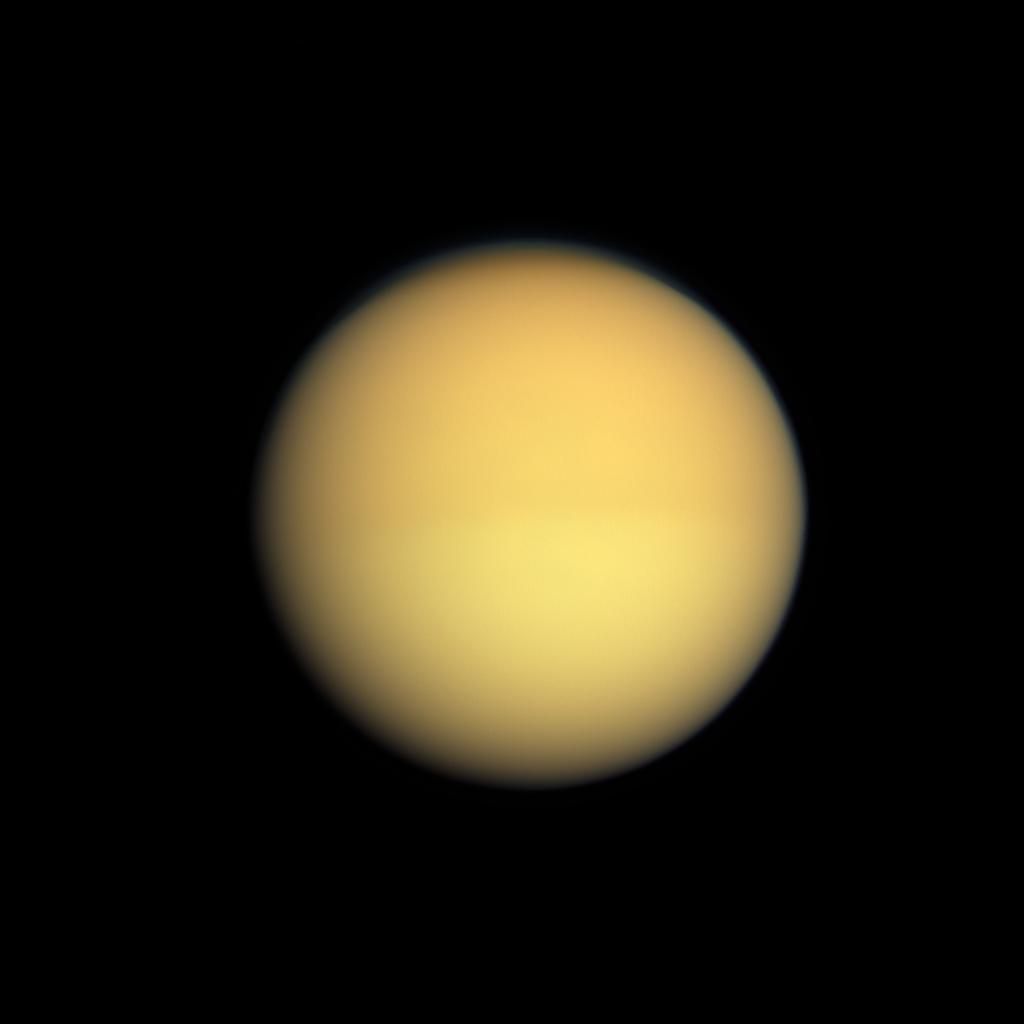
Titan is the most thoroughly studied non-Earth case. Before the Cassini-Huygens mission arrived at Saturn in 2004, the community modelled Titan as a possible SR cavity with a predicted fundamental near 6 to 12 Hz (Nickolaenko et al. 2003; Simoes et al. 2007). Titan is a small body (mean radius 2575 km), so the geometric part of the calculation gives a low value. The cavity itself is unusual: the atmosphere is thicker than Earth's, and the "surface" may not be a good reflector, since it is covered by hydrocarbon sands and liquid methane rather than a conductive medium.
The Huygens probe descended through Titan's atmosphere on 14 January 2005, carrying the HASI (Huygens Atmospheric Structure Instrument) package, which included the PWA (Permittivity, Wave and Altimetry) experiment. Throughout the descent the PWA electric antenna recorded a quasi-monochromatic signal at approximately 36 Hz, a few Hz wide, present nearly continuously from the upper atmosphere down to the surface.
Two features of the 36 Hz signal immediately attracted attention.
It matched a predicted Schumann mode. The 36 Hz line falls close to theoretical models of the second eigenmode of Titan's cavity (Simoes et al. 2007; Beghin et al. 2007).
It was the wrong polarisation for lightning. The electric field component was predominantly horizontal, modulated by the rotation of the probe. A lightning-driven Schumann resonance on Earth produces a signal with a strong vertical electric field component (the transverse magnetic mode). A horizontal dominant component is consistent with a Longitudinal Section Electric (LSE) mode, driven differently.
Cassini flybys, of which there were 126 over the mission lifetime, never detected any lightning activity or RF emissions characteristic of atmospheric discharges (Fischer et al. 2007; Fischer and Gurnett 2011). With no lightning to drive the cavity, the research team proposed an alternative excitation mechanism: ionospheric current sheets induced by Saturn's co-rotating magnetospheric plasma flow, coupling through ion-acoustic instabilities to whistler-mode waves (Beghin et al. 2007, 2009; Beghin 2014).
The interpretation of the 36 Hz signal went further. Because the Schumann resonance requires a conductive inner boundary, and Titan's icy surface is not conductive enough on its own, the observed resonance implies a conductor somewhere below. Combining the observed frequency with models of the atmospheric cavity, Beghin et al. (2012, Comptes Rendus Geoscience 342[6], 425-433) estimated that the conductive boundary sits under roughly 45 km of ice, with subsequent refinements placing the ice crust between 55 and 80 km thick. This is interpreted as direct electromagnetic evidence for a subsurface liquid water-ammonia ocean, consistent with tidal and gravity-field measurements from Cassini.
The interpretation is not universally accepted. Lorenz and Le Gall (2020, Icarus) argued that the 36 Hz signal may not be a natural Schumann resonance at all, proposing instead that it is an artifact of mechanical vibrations of the Huygens probe during descent. They pointed out that the mode identification is model-dependent (what one model calls the second mode another calls the third) and that the ionospheric scale height parameters needed to pin down the resonance are not well constrained by data. Later work has pursued this re-examination systematically.
Dragonfly, NASA's rotorcraft mission to Titan, is scheduled to launch in July 2028 on a Falcon Heavy and arrive at Titan in 2034. Its DraGMet (Dragonfly Geophysics and Meteorology) instrument package includes E-field sensors capable of reopening the question. A long-duration ground-based record from multiple locations on Titan would either confirm the Schumann interpretation and refine the ocean-depth estimate, or rule it out in favour of the vibration-artifact alternative.
Mars: Searches Without Detection
Mars has a tenuous atmosphere (about 0.6 percent of Earth's surface pressure) and no confirmed lightning. The case for Martian lightning rests on laboratory studies of triboelectric charging in dust (Eden and Vonnegut 1973; Krauss et al. 2006; Aplin et al. 2011) and theoretical work showing that dust devils and dust storms can produce electric fields large enough for breakdown (Melnik and Parrot 1998; Farrell et al. 1999; Renno et al. 2003).
Model predictions for the Martian fundamental cluster in the 7 to 14 Hz range. The spread comes from different assumptions about the surface conductivity, the ionospheric electron profile, and dust loading (Sukhorukov 1991; Pechony and Price 2004; Molina-Cuberos et al. 2006; Soriano et al. 2007; Kozakiewicz et al. 2015; Toledo-Redondo et al. 2017).
Three search campaigns have produced non-detections.
Esman et al. (2023, Frontiers in Astronomy and Space Sciences) searched Mars Global Surveyor and MAVEN magnetometer data for 5 to 16 Hz signals below 400 km altitude. No SR signals were identified. The authors estimate that future missions would need magnetometer sensitivity better than 0.01 nT to detect a terrestrial-strength resonance on Mars.
The InSight lander (landed 2018, terminated 2022) carried a fluxgate magnetometer that was used to search for SR during large dust storms. The search looked specifically at the period around a major dust storm that developed around sols 40 to 90. Published searches have not reported a confirmed detection (Yates et al. 2020 and follow-up work).
Ruf et al. (2009) reported modulations in Mars's nonthermal microwave spectrum observed from Earth-based radio telescopes, at frequencies consistent with the expected Mars SR. The observation is indirect, has not been independently confirmed, and remains the only potential detection.
The theoretical case for Mars SR is strong enough that the community continues to search; the observational case is empty. A future dedicated surface ELF experiment remains on the mission wishlist but has not been selected for flight.
Venus: Strong Lightning Evidence, No ELF Measurement
Venus has the best lightning evidence in the Solar System after Earth.
- Venera 11 and 12 landers (1978) recorded electromagnetic impulsive emissions consistent with lightning during their descents.
- Venera 9 orbiter optically detected flashes on the nightside (Krasnopolsky 1980).
- Pioneer Venus Orbiter (1978-1992) detected whistler-mode waves in the ionosphere below the local electron gyrofrequency, a signature of lightning-generated sferics leaking into the ionosphere (Taylor et al. 1979; Scarf et al. 1980; Russell et al. 2010).
- Venus Express (2006-2014) statistically confirmed the whistler-mode lightning signature over years of observation.
- Akatsuki (Japan Aerospace Exploration Agency, in Venus orbit since 2015) recorded one visible lightning flash with the Lightning and Airglow Camera in 2020 (Takahashi et al. 2021).
- The neutral mass spectrometer on Pioneer Venus detected nitric oxide in the lower atmosphere at levels consistent with a lightning source producing a global flash rate near 100 per second (Krasnopolsky 2006).
None of this has been converted into an ELF Schumann measurement because no Venus lander has carried an ELF electric or magnetic sensor. The Venera landers lasted only minutes each; the Pioneer Venus Orbiter instruments sampled at VLF, not ELF.
Theoretical predictions from Nickolaenko and Rabinowicz (1982), Pechony and Price (2004), and Simoes et al. (2008, JGR Planets) converge on three features:
- The fundamental sits near 9 Hz, roughly 1 Hz higher than Earth's.
- Q factors are higher than on Earth (Q > 6), implying narrower resonance peaks.
- The Venus atmosphere is dense enough to act as a refracting medium; ELF waves are predicted to focus at an altitude near 30 km rather than propagating purely along the surface.
- Day-night cavity asymmetry should produce measurable line splitting of each mode.
A Venus lander carrying an ELF magnetometer or electric antenna could confirm or refute these predictions in a single descent. No mission currently in formulation includes such an instrument.
Jupiter and Saturn: Lightning Confirmed, Cavity Unclear
Lightning is well-established on both Jupiter (Galileo probe 1995; Juno 2016 onwards) and Saturn (Voyager 1 and 2; Cassini 2004-2017). The problem for Schumann physics is not the source but the cavity. Gas giants have no solid surface. Any conductive inner boundary lies deep in the planet where molecular hydrogen transitions to metallic hydrogen under pressure, at roughly 80 percent of Jupiter's radius.
Sentman (1990, JASTP) published the only direct calculation of Jupiter's Schumann resonance, using a model atmosphere from stellar-interior methods. The predicted eigenfrequencies are 0.76, 1.35, and 1.93 Hz (modes 1, 2, 3), with quality factors near 7. These are far below Earth's range, a consequence of Jupiter's 11-Earth-radius size, and below the frequency band where most spacecraft instruments operate. Saturn has never been the subject of a dedicated SR model.
Simoes et al. (2012) extended the analysis to Uranus and Neptune and pointed out that the SR frequency depends sensitively on the water and ammonia abundance in the gaseous envelope. A measured SR at Uranus or Neptune would constrain the bulk volatile composition, which matters for solar system formation models. No ice-giant mission currently scheduled carries the instrumentation to make the measurement.
Why Planetary Schumann Resonances Matter
Beyond the intrinsic curiosity of measuring a signal on another world, the planetary SR literature has three concrete uses.
Remote sensing of interiors. Titan's Schumann-like resonance, if real, provides the only direct electromagnetic evidence for its subsurface ocean and constrains the ice-shell thickness to a narrower range than gravity measurements alone. The same principle could apply to Europa, Ganymede, or Enceladus if future missions carried ELF instruments.
Independent confirmation of lightning. A measured SR at Venus or Mars would confirm lightning activity without needing to image a discharge directly. On Venus especially, the dense clouds make optical detection difficult, so an ELF signature would be a cleaner diagnostic.
Ionospheric characterisation. The ratio of SR frequencies and their Q factors are sensitive to the ionospheric conductivity profile. An SR spectrum from Mars during a dust storm would constrain how dust loading modifies the lower ionosphere, which affects radio propagation and communications.
What EarthBeat Shows
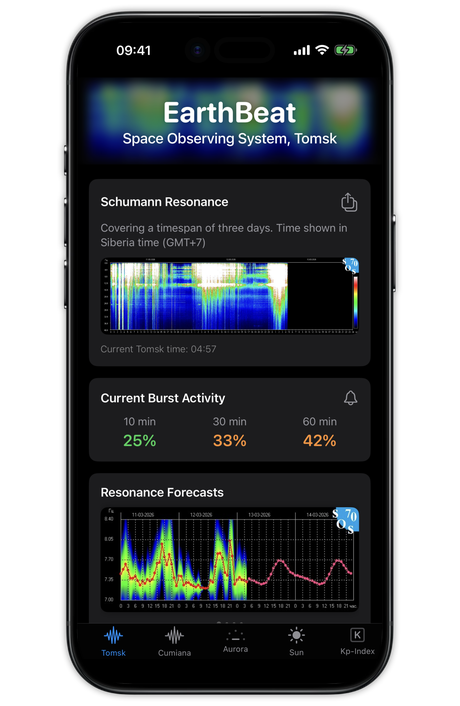
EarthBeat displays the Schumann resonance of Earth, measured at observatories in Tomsk and Cumiana. The planetary physics described on this page does not apply to the app's live data, which represents our own cavity. The value of the comparison is conceptual: the same electromagnetic framework that produces the 7.83 Hz signature you see in EarthBeat also underlies the search for analogous signals across the Solar System. When the Huygens probe recorded 36 Hz at Titan, it did so because the same laws that Schumann wrote down in 1952 for Earth apply there too, with different numbers plugged in.
Summary
- A Schumann resonance requires a conductive surface, a conductive ionosphere, and an excitation source. Few places in the Solar System meet all three conditions cleanly.
- Titan is the only world beyond Earth with an observational detection: the 36 Hz signal recorded by the Huygens probe in 2005, interpreted as a second-mode eigenfrequency driven by Saturn's magnetosphere and implying a subsurface water-ammonia ocean.
- The Titan interpretation remains debated; Dragonfly (launch 2028, arrival 2034) is expected to settle it.
- Mars searches from orbit and from the InSight surface lander have not detected a resonance; the predicted fundamental sits in the 7 to 14 Hz range.
- Venus has strong lightning evidence but no ELF measurement. Predicted fundamental is near 9 Hz.
- Jupiter's predicted fundamental is near 0.76 Hz, too low for most existing instrumentation. Saturn has not been modelled.
- A confirmed planetary SR spectrum would provide remote information about the interior, the ionosphere, and the lightning environment of the host body.