The Physical Chain
An earthquake is a mechanical event in the crust. The Schumann resonance is an electromagnetic phenomenon in a cavity 60 to 90 km above the ground. To get from one to the other, the LAIC model posits a chain of coupling effects that alter the ionosphere in the days before rupture.
Strain in the crust is thought to produce several things: release of radon and other gases, changes in groundwater electrical conductivity, emission of ultra-low-frequency electromagnetic waves from stressed rock, and atmospheric gravity waves triggered by thermal and pressure changes near the surface. Any of these can reach the lower ionosphere and change its ion density over the epicentral region. The net result, in the simplest modeled form, is that the D-region that caps the Earth-ionosphere cavity drops in altitude by up to 20 km over a roughly circular region about 1000 km across.
A Schumann resonance cavity with a local dent in its upper wall no longer responds uniformly. Lightning discharges in the three major global thunderstorm centers (Amazon basin, central Africa, Maritime Continent) continue to inject energy into the cavity, but part of the radiated signal now scatters off the disturbed region. At stations positioned in the scattered wavefield, the resulting interference pattern shows amplitude anomalies at specific frequencies. The theoretical model by Nickolaenko et al. (2006), using the knee profile of vertical conductivity and the Stratton-Chu integral equation to solve the diffraction problem, reproduces the observed 10 to 15 percent intensity change around the fourth mode.
What Gets Measured
The characteristic signature first reported by Hayakawa et al. (2005) at Nakatsugawa in relation to the 1999 Chi-chi earthquake has three components:
- Fourth-mode enhancement. The amplitude of the fourth Schumann resonance harmonic, normally weaker than the lower three, grows unusually strong. In the conventional spectrum, amplitude decreases monotonically with mode number. During the anomaly window the fourth mode becomes comparable to or stronger than the third.
- Peak frequency shift. The peak frequency of the fourth mode shifts by approximately 1 Hz from its usual value.
- Directional signature. The anomaly is strongest in the magnetic field component aligned with the great-circle path between the observing station and the epicenter. At Nakatsugawa for the Chi-chi event this was the east-west component, corresponding to waves arriving along the meridional direction toward Taiwan.
The timing varies. The anomaly is often detected several days to about one week before the main shock, sometimes persisting one day after. A statistical survey by Ohta et al. (2006), covering six years of Nakatsugawa data and 29 earthquakes in and around Taiwan with magnitudes above 5.0, confirmed the pattern with a consistency higher than expected by chance.
Evidence From Individual Events
1999 Chi-chi earthquake, Taiwan (M 7.3). The foundational case. Hayakawa, Ohta, Nickolaenko and Ando (2005) documented fourth-mode enhancement at Nakatsugawa approximately one week before the main shock on 21 September 1999. A second event on 2 November 1999, the Chia-yi earthquake (M > 6), produced a weaker but similar signature.
2004 Mid-Niigata and 2007 Noto Hantou earthquakes, Japan. Ohta, Izutsu and Hayakawa (2009) reported anomalous Schumann resonance excitation and additional line emissions at Nakatsugawa in the days around both events. Both events were within a few hundred kilometers of the station, placing them in a different regime from the Taiwan events and motivating later near-field theoretical work.
2011 Tohoku-Oki earthquake, Japan (M 9.0). Zhou et al. (2013) analysed Schumann resonance records from Chinese stations before the March 2011 event. They found amplitude anomalies above the 2-sigma level in all four modes, rather than just the fourth, on 8 March, three days before the earthquake. The broader-mode pattern differed from the Taiwan signature and supported the emerging distinction between near-field and far-field anomalies.
2013 to 2018 Mexican Pacific coast (12 events, M > 5). Sierra Figueredo et al. (2021) analysed Coeneo station data using a 21-day window around each event. They found statistically significant anomalies in frequency and amplitude. They then tested a null case: comparable windows during quiet solar activity but without significant earthquakes. Statistically significant anomalies appeared there too. Their conclusion: the Mexican station results are not conclusive as a precursor method.
2021 Tohoku offshore earthquakes (both M~7). Hayakawa et al. (2021) reported enhancement of Schumann resonance modes at a station near Nagoya, about 1000 km from the epicenters, before and after each event. The anomaly was interpreted using a near-field theoretical framework based on the 2D Telegraph Equation and seismogenic perturbations of mesospheric conductivity.
2020 to 2025 Greek region. Tritakis et al. (2025) reviewed five years of data from Schumann resonance stations at the northern and southern edges of Greece. They observed quasi-precursor signals (characteristic amplitude bulges in the 20 to 30 Hz range, corresponding to the third and fourth modes) before moderate-magnitude earthquakes in the 4 to 6 range, which are frequent in the region. They also compared against recordings from the Hylaty station in southern Poland, a non-seismic zone. Their explicit conclusion: individual case studies tend to overestimate the strength of the phenomenon, and systematic evaluation across many events gives a more cautious picture than early results suggested.
Near-Field and Far-Field: Two Different Signatures
Most of the early Japanese work covered distant earthquakes, where the station sat several thousand kilometers from the epicenter. In that geometry, scattered ELF waves interfere with the direct global signal and the fourth mode shows the cleanest effect, as predicted by the Nickolaenko et al. (2006) scattering model.
When the epicenter is close to the station (a few hundred kilometers), the physical picture is different. The station sits inside the disturbed zone rather than in its scattered field. Hayakawa et al. (2020, 2021) introduced near-field theoretical models where multiple modes, including the first, respond to the local change in the ionospheric characteristic height. This explains why the 2011 Tohoku event at Chinese stations showed anomalies across all four modes, rather than the far-field fourth-mode-only pattern seen from Japan for Taiwan events.
Limits of the Evidence
The scientific record on Schumann resonance earthquake precursors is substantial but not conclusive. Several recurring issues apply:
Retrospective design. Most case studies begin after a large earthquake has already occurred, then work backward through the SR record looking for anomalies. This design cannot establish how often anomalies of the same shape appear during quiet periods. The Sierra Figueredo et al. (2021) Mexican study is one of the few that tested both conditions explicitly and found anomalies in both.
Modest effect size. The intensity change is around 10 to 15 percent in the fourth mode for the Nickolaenko 2006 model. Daily lightning migration, geomagnetic activity, and local electromagnetic noise can produce comparable variations. Separating seismogenic signals from background requires multi-day windows, good statistics, and often multiple stations.
Station geometry matters. The Japanese results depend heavily on the station-source-lightning geometry. The same event might be visible at one observatory and invisible at another on the same night. This geometric dependence makes the signature harder to standardize across a distributed network.
Mechanism not fully specified. The Lithosphere-Atmosphere-Ionosphere Coupling framework admits several pathways (radon release, acoustic-gravity waves, crustal EM emissions, pre-rupture electrical discharges). Which pathway dominates, and under what conditions, remains an open question as of the most recent reviews (Zhou et al., 2023).
No operational forecast. No institution currently uses Schumann resonance as an earthquake prediction tool in any regulatory or public-warning capacity. The research community generally frames the work as "precursor identification" rather than "earthquake prediction".
Why EarthBeat Does Not Predict Earthquakes
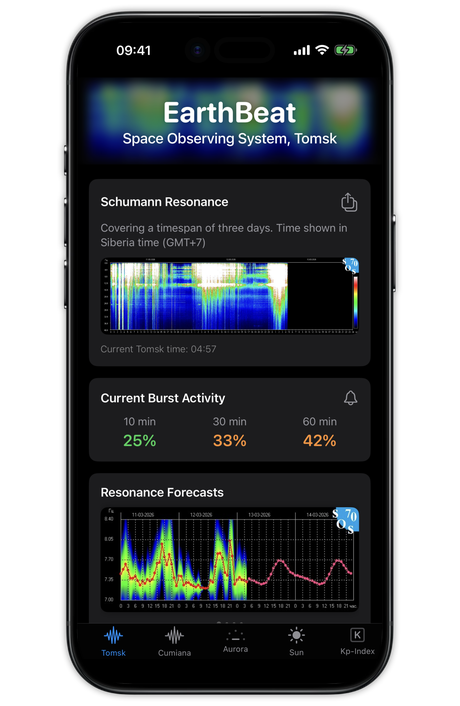
EarthBeat displays the Schumann resonance spectrogram from the Tomsk Space Observing System and the secondary VLF feed from the Cumiana station in Italy. These stations are not part of a seismo-electromagnetic observation network, and even at dedicated stations the published evidence supports retrospective analysis rather than forward prediction.
If you are interested in the science, the most useful exercise with EarthBeat's data is to compare the weekly Schumann resonance overview against a public earthquake catalog such as the USGS or the EMSC feed. Look for fourth-mode enhancements or broader spectral changes in the days surrounding moderate or large events within a few thousand kilometers of Tomsk. This is the same approach used in the peer-reviewed literature and lets you see the phenomenon, or its absence, with your own eyes.
Summary
The Schumann resonance responds measurably to large earthquakes in the days around the event, most clearly in the fourth harmonic for distant earthquakes and across multiple modes for nearby ones. The proposed physical mechanism is a localized drop in the lower ionosphere's effective height over the epicenter, which changes the Earth-ionosphere cavity's response to global lightning. The model reproduces the observed 10 to 15 percent intensity changes. The statistical evidence is consistent across several independent stations but not strong enough to support operational prediction. For a user of EarthBeat, the value is educational and retrospective: the signature is sometimes visible in the weekly overview when compared against earthquake catalogs, and the exercise is a concrete entry into one of the more interesting research frontiers in geophysics.