How the Earth-Ionosphere Cavity Works
Earth is wrapped in a shell of electrically conductive air called the ionosphere. It starts about 60 km above the surface and extends to roughly 1,000 km, though the region that matters most for the Schumann resonance is the D-layer at 60-90 km altitude. Solar ultraviolet radiation strips electrons from gas molecules up there, creating a layer that conducts electricity. Changes in this layer are a key part of space weather.
The ground beneath our feet also conducts electricity. So you end up with two conductive surfaces - Earth's surface and the ionosphere - separated by the atmosphere, which acts as an insulator. In physics, this arrangement is called a waveguide. Electromagnetic waves can propagate within this gap, trapped between the two conductive boundaries.
The cavity isn't perfectly uniform. The ionosphere is higher over the equator and lower near the poles. It's thicker on the sunlit side of Earth and thinner at night. These variations matter because they affect the exact frequencies at which waves resonate. But the basic geometry - a sphere wrapped in a conductive shell - is what produces the Schumann resonance.
The Fundamental Frequency and Harmonics
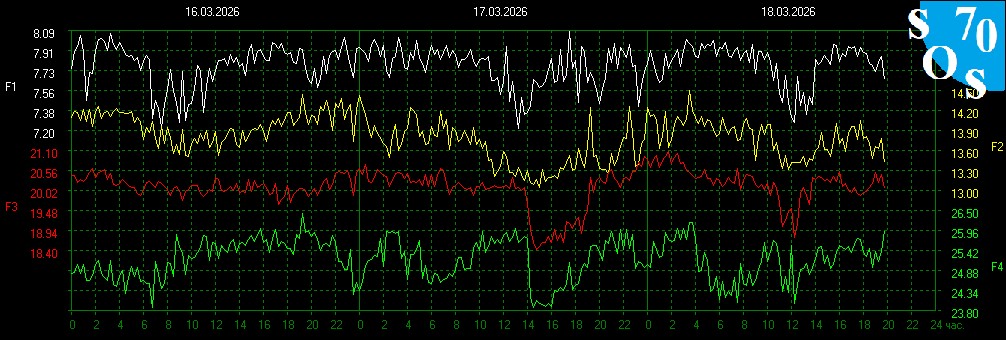
The lowest frequency that can sustain a standing wave in this cavity is about 7.83 Hz. This is the fundamental mode, sometimes called the first Schumann resonance. It corresponds to a wavelength equal to Earth's circumference - roughly 40,000 km.
The math comes from a relationship between the speed of light and the size of the cavity. Electromagnetic waves travel at about 300,000 km/s. Divide that by Earth's circumference (40,075 km), and you get approximately 7.5 Hz. The actual value is slightly higher because of the cavity geometry and the conductivity profile of the ionosphere.
Above the fundamental, higher modes exist at roughly predictable intervals:
| Mode | Typical Frequency | Relationship |
|---|---|---|
| 1st (fundamental) | ~7.83 Hz | Baseline |
| 2nd harmonic | ~14.3 Hz | n=2 |
| 3rd harmonic | ~20.8 Hz | n=3 |
| 4th harmonic | ~27.3 Hz | n=4 |
| 5th harmonic | ~33.8 Hz | n=5 |
The formula for the nth mode is: f(n) = (c / 2piR) * sqrt(n(n+1)), where c is the speed of light and R is Earth's radius. The spacing between harmonics is not perfectly even because of this square-root relationship.
Each mode has its own characteristic pattern of amplitude and quality factor. The fundamental is typically the strongest, with amplitude decreasing at higher modes.
What Drives the Schumann Resonance
Lightning is the engine. About 2,000 thunderstorms are active across the planet at any given moment, producing roughly 50 lightning strikes per second. Each strike is a brief but powerful electromagnetic pulse that radiates energy across a wide frequency spectrum, including the extremely low frequency (ELF) range where the Schumann resonance lives.
Individual strikes are random. But 50 per second, sustained around the clock, creates a continuous excitation of the cavity. The energy from all those strikes adds up, and the cavity selectively amplifies frequencies near its resonant modes. The result is a persistent signal that can be detected anywhere on Earth.
Three major thunderstorm centers dominate the global pattern: the Amazon basin, central Africa, and the Maritime Continent (Indonesia and surrounding regions). Because these centers are concentrated in the tropics and peak at different times of day, the Schumann resonance shows a clear diurnal cycle. Amplitude tends to peak in the afternoon hours, local time, of the most active thunderstorm region.
Data from Tomsk and Cumiana
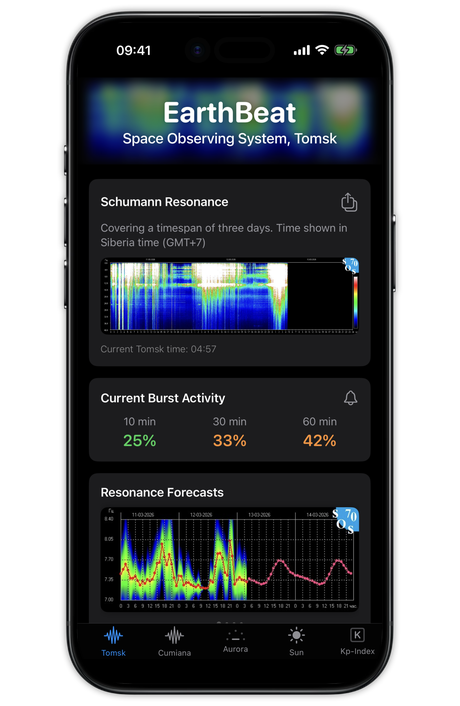
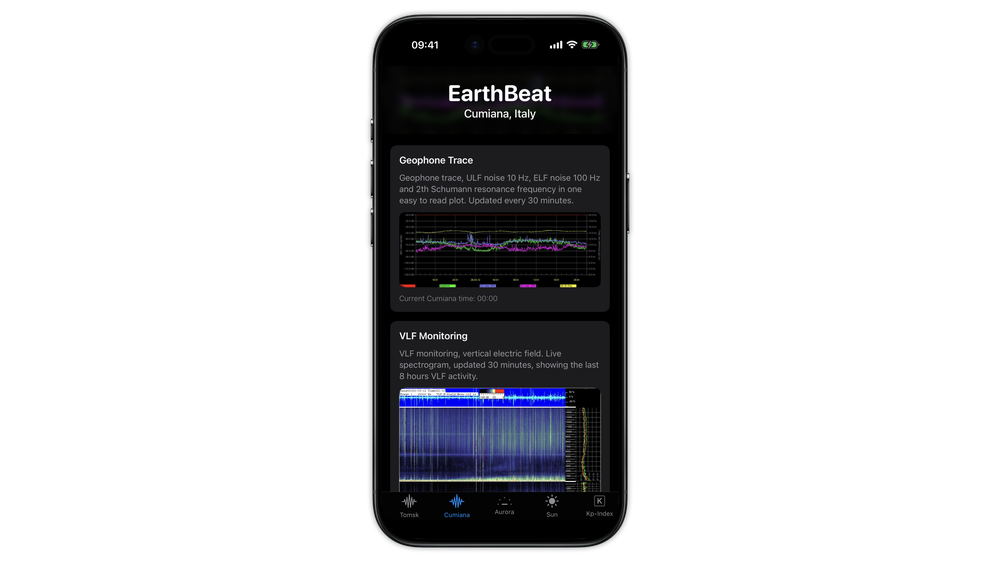
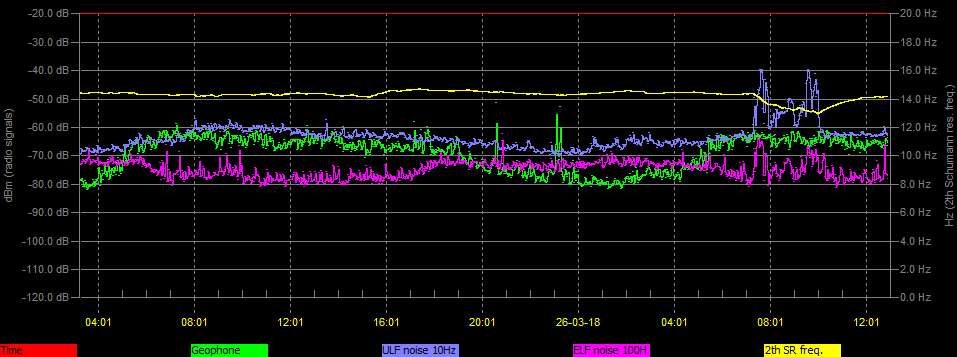
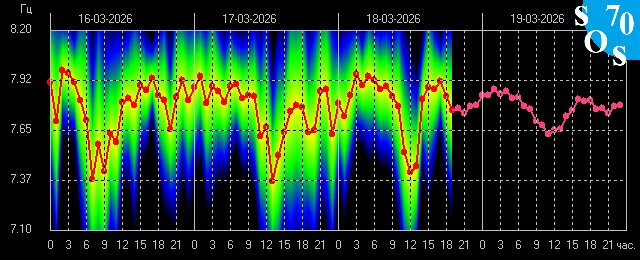
EarthBeat pulls Schumann resonance data from two independent stations. The Tomsk Space Observing System in Russia and the Cumiana VLF station in Italy provide cross-referenced measurements updated every minute.
Why the Frequency Changes
The Schumann resonance frequency is not a fixed constant. It fluctuates, typically by a few tenths of a hertz on any given day. Larger shifts are possible during extreme events. Several factors drive these changes:
Ionospheric height. When the ionosphere moves up or down, the cavity size changes, and so does the resonant frequency. Solar X-ray flares can push the D-layer lower, temporarily raising the frequency. At night, when solar radiation drops, the ionosphere rises and the frequency decreases slightly.
Solar activity. The 11-year solar cycle has a measurable effect. During solar maximum, increased UV and X-ray output makes the ionosphere more conductive and changes its altitude profile. Researchers have documented small but consistent frequency shifts correlated with solar activity levels.
Geomagnetic storms. A strong geomagnetic storm - triggered by a coronal mass ejection hitting Earth's magnetosphere - can disturb the ionosphere significantly. During severe storms, Schumann resonance signals can become distorted, with frequency shifts and amplitude changes that persist for hours.
Seasonal patterns. Because thunderstorm activity follows the seasons (more land heating in the northern hemisphere summer shifts the balance of global lightning), the Schumann resonance shows seasonal variations in both amplitude and frequency.
EarthBeat also monitors the Global Consciousness Project, a separate experiment that tracks statistical anomalies in random number generator networks worldwide.
How It's Measured
Detecting a signal at 7.83 Hz with a magnetic field strength of about one picotesla is not easy. The equipment needs to be extremely sensitive, and the measurement site needs to be far from sources of electromagnetic noise - power lines, roads, cities, railways.
The primary sensor is an induction coil magnetometer. This is essentially a large coil of wire, often with a high-permeability core, that converts changing magnetic fields into voltage. The coils used for Schumann resonance work are optimized for the 3-60 Hz range.
Some of the most important monitoring stations include:
- Tomsk, Russia - The Space Observing System (SOS) at Tomsk State University operates continuous Schumann resonance monitoring with publicly available spectrograms. This is the primary data source for EarthBeat.
- Cumiana, Italy - Run by the Osservatorio Astronomico di Torino, this station has been collecting ELF data for decades.
- Hollister, California - Part of the Quake Finder network, this station contributes to a global dataset.
- Nagycenk, Hungary - One of the longest-running Schumann resonance monitoring sites, operated by the Geodetic and Geophysical Institute.
Modern stations digitize the signal and compute spectrograms - visual representations that show how frequency, amplitude, and quality factor change over time. These spectrograms are what you see in the EarthBeat app.
Summary
The Schumann resonance is a measurable, well-understood electromagnetic phenomenon driven by global lightning activity. Its fundamental frequency near 7.83 Hz and its harmonics provide a continuous record of conditions in the Earth-ionosphere cavity. EarthBeat tracks this signal in real time from two independent observatories.