What Is Space Weather
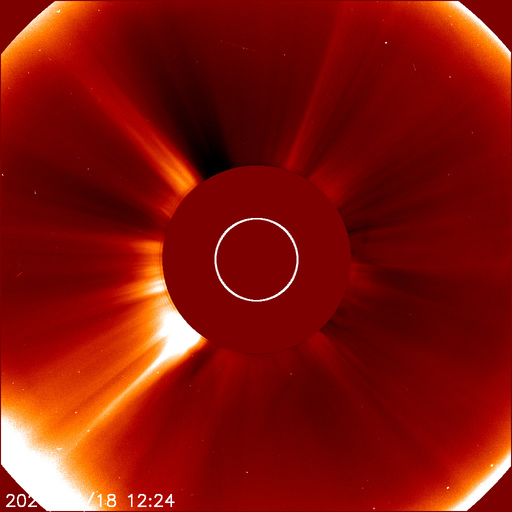
Space weather describes the changing conditions in near-Earth space driven by activity on the Sun. It covers everything from the steady outflow of solar wind to sudden explosive events like solar flares and coronal mass ejections (CMEs).
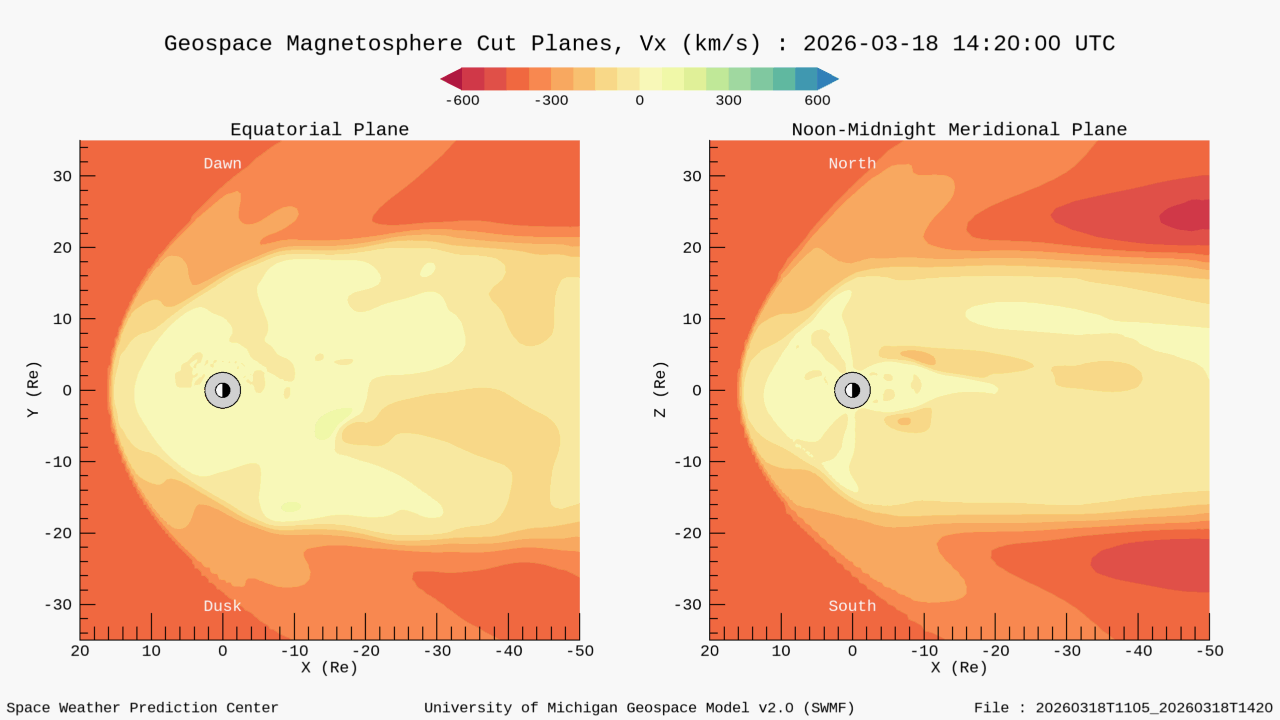
Earth's magnetic field acts as a shield, deflecting most of this incoming material. But the shield is not perfect. During strong solar events, energy and particles can penetrate the magnetosphere, disturb the ionosphere, and induce electric currents on the ground. These effects are measurable, and sometimes damaging.
The field is relatively young as a formal science. NOAA's Space Weather Prediction Center (SWPC) was established in 1965, and serious operational forecasting didn't begin until the 1990s. Today, a fleet of satellites monitors the Sun and the space environment around the clock.
Key Metrics
Several measurements define the state of space weather at any given moment. Each captures a different piece of the puzzle:
Kp Index - The planetary geomagnetic activity index, scaled 0-9. Values of 5 or higher indicate a geomagnetic storm. Derived from magnetometer readings at 13 stations worldwide. This is the single most-watched number in space weather forecasting.
Solar wind speed - The velocity of the plasma stream flowing past Earth. Normal conditions sit around 400 km/s. High-speed streams from coronal holes can push past 700 km/s, and CME-driven shocks can exceed 1,000 km/s.
IMF Bz (Interplanetary Magnetic Field) - The north-south component of the magnetic field carried by the solar wind. When Bz turns southward (negative), it can connect with Earth's magnetic field and transfer energy into the magnetosphere. Southward Bz is the single strongest predictor of geomagnetic storm intensity.
X-ray flux - Measured by GOES satellites in the 0.1-0.8 nm band. Solar flares are classified by their peak X-ray flux: C, M, and X class, each ten times stronger than the previous. Background levels sit in the A or B range.
Proton flux - High-energy protons (above 10 MeV) accelerated by solar flares or CME-driven shocks. Elevated proton flux creates a radiation hazard for astronauts and can degrade satellite electronics. NOAA classifies proton events on the S1-S5 scale.
Why Space Weather Matters
Space weather was a curiosity for most of human history. That changed when we became dependent on technology that operates in space or relies on stable electromagnetic conditions.
Power grids. Geomagnetic storms induce currents in long conductors like power lines and pipelines. On March 13, 1989, a severe storm caused the entire Hydro-Quebec power grid to collapse in 92 seconds (Baker, 1998). Six million people lost electricity for up to nine hours. Transformers in New Jersey and the UK also suffered damage. The storm wasn't even the worst on record.
Satellites. Energetic particles degrade solar panels, corrupt memory chips, and build up surface charges that can trigger phantom commands. During the October-November 2003 "Halloween Storms," Japan's ADEOS-II satellite was permanently disabled, and dozens of other spacecraft reported anomalies. GPS accuracy degraded across the globe.
Aviation. Airlines reroute polar flights during strong solar proton events to reduce radiation exposure for crew and passengers. HF radio communications, still the primary backup for oceanic flights, can be blacked out for hours during X-class flares. The FAA and ICAO now include space weather in their aviation weather advisories.
GPS and navigation. The ionosphere bends GPS signals on their way to receivers on the ground. During geomagnetic storms, the ionosphere becomes turbulent, causing GPS position errors that can reach tens of meters. Precision agriculture, surveying, and autonomous systems all depend on centimeter-level accuracy that storms can temporarily destroy.
Who Monitors Space Weather
Several national and international organizations share the workload:
- NOAA Space Weather Prediction Center (SWPC) - Boulder, Colorado. The primary US forecast office for space weather. Operates 24/7, issues watches, warnings, and alerts. Receives data from GOES and DSCOVR satellites.
- ESA Space Safety Programme - European Space Agency's coordination center for space weather in Europe. Operates the Space Weather Service Network, which aggregates data from European ground stations and spacecraft.
- Bureau of Meteorology (BOM) - Australia's Space Weather Services group has been monitoring since the 1940s, making it one of the longest-running programs. Provides forecasts for the Asia-Pacific region.
- UK Met Office Space Weather Operations Centre - Provides warnings for UK government and critical infrastructure operators.
- ISRO Space Situational Awareness Control Centre - India's monitoring capability for space weather and orbital debris tracking.
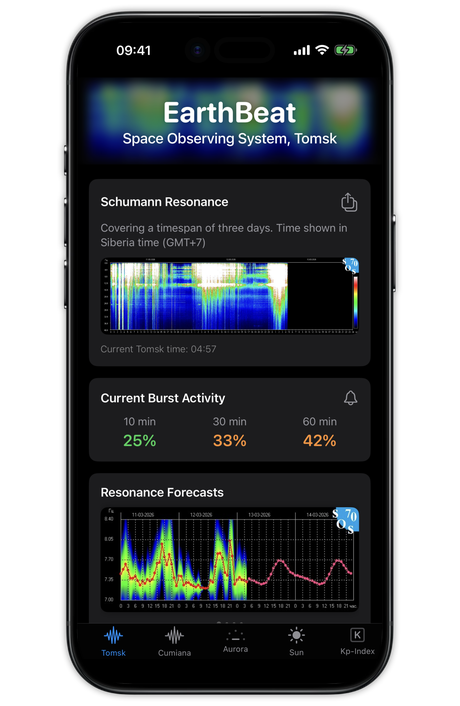
Beyond traditional space weather monitoring, EarthBeat includes data from the Global Consciousness Project, which tracks a different kind of signal entirely.
Summary
Space weather is no longer a niche concern for satellite operators. It affects power grids, aviation, GPS accuracy, and communications systems that modern life depends on. Understanding the key metrics and monitoring them in real time is increasingly important. EarthBeat brings NOAA SWPC data to your phone, updated every five minutes.