What Is Solar Wind
The solar wind is a plasma - a gas so hot that atoms lose their electrons, creating a mix of protons, electrons, and heavier ions. The Sun's corona (its outer atmosphere) is heated to over a million degrees, far hotter than the visible surface at roughly 5,500 degrees. At those temperatures, the corona's thermal pressure exceeds the Sun's gravitational pull, and particles escape outward in all directions.
The existence of the solar wind was predicted by physicist Eugene Parker in 1958 and confirmed by the Soviet Luna missions and NASA's Mariner 2 in 1962. Parker's original paper was initially rejected by reviewers who found the idea implausible. He would later have a spacecraft named after him - NASA's Parker Solar Probe, launched in 2018.
At Earth's orbit, the solar wind has typical properties:
- Speed: 300-800 km/s (roughly 1 million to 3 million km/h)
- Density: 1-20 particles per cubic centimeter (extremely tenuous by terrestrial standards)
- Temperature: about 100,000 K for protons
- Magnetic field strength: a few nanotesla (carried from the Sun as the interplanetary magnetic field)
For comparison, the best laboratory vacuum on Earth contains trillions of particles per cubic centimeter. The solar wind is emptier than any vacuum we can create. But it moves fast enough, and carries enough magnetic energy, to have substantial effects when it encounters a planetary magnetic field.
Fast and Slow Solar Wind
The solar wind comes in two distinct flavors. They originate from different regions on the Sun and have different properties.
Slow solar wind flows at roughly 400 km/s and originates from the streamer belt - the region of closed magnetic field lines near the solar equator. It is denser and more variable than the fast wind. Its exact acceleration mechanism is still an active area of research.
Fast solar wind blows at 600-800 km/s and comes from coronal holes - regions where the Sun's magnetic field opens outward into space, allowing plasma to escape more freely. Coronal holes appear as dark patches in extreme ultraviolet images of the Sun. They can persist for months and rotate with the Sun, producing recurring high-speed streams that sweep past Earth every 27 days (one solar rotation period as seen from Earth).
Where fast wind catches up to slow wind ahead of it, the two streams collide and form a compression region called a corotating interaction region (CIR). CIRs can produce moderate geomagnetic storms without any flare or CME involvement. They are a major source of recurrent geomagnetic activity, visible as elevated Kp index values, especially during the declining phase of the solar cycle when large coronal holes are common.
How We Measure It
You can't measure the solar wind from the ground. Earth's magnetic field and atmosphere block it completely. Measuring it requires a spacecraft positioned upstream in the solar wind, before it reaches the magnetosphere.
The primary monitor is DSCOVR (Deep Space Climate Observatory), a NOAA satellite stationed at the L1 Lagrange point - a gravitational balance point about 1.5 million km from Earth on the line between Earth and the Sun. At L1, a spacecraft orbits the Sun at the same rate as Earth, maintaining its position ahead of us indefinitely.
DSCOVR carries two key instruments for solar wind monitoring:
- Faraday Cup - measures the velocity, density, and temperature of the solar wind plasma by collecting ions and measuring the current they produce
- Magnetometer - measures the strength and direction of the interplanetary magnetic field (IMF), including the critical Bz component
Data from DSCOVR takes about 5 seconds to reach Earth via radio. The solar wind itself takes 15-60 minutes to travel from L1 to Earth, depending on its speed. This gives forecasters a narrow but useful window to issue final warnings before a storm hits.
Before DSCOVR, the ACE (Advanced Composition Explorer) satellite held this role for nearly two decades. ACE launched in 1997 and still operates as a backup. DSCOVR took over as the primary real-time monitor in 2016.
Solar Wind and Earth
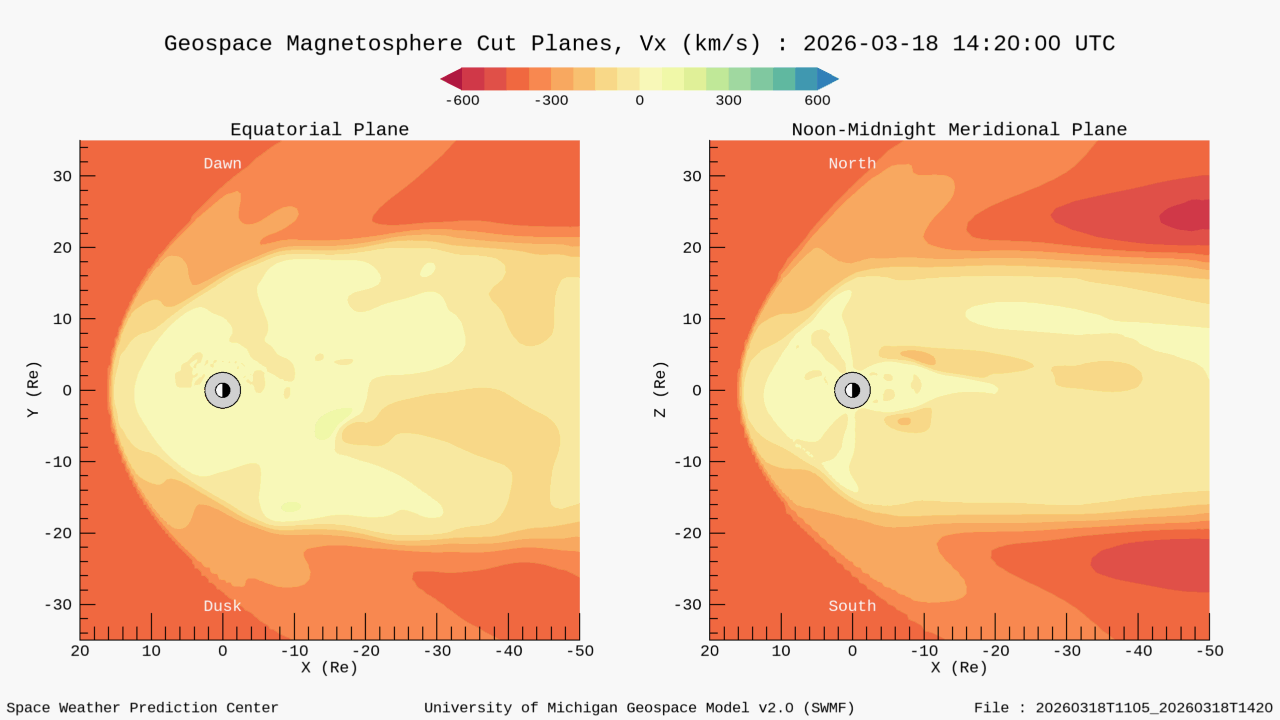
Earth's magnetic field forms a barrier called the magnetosphere that deflects the solar wind around the planet. On the sunward side, the magnetosphere is compressed to about 10 Earth radii. On the night side, it stretches into a long tail hundreds of Earth radii downstream.
The key to understanding solar wind impacts is the interplanetary magnetic field (IMF), specifically its north-south component, called Bz. Earth's magnetic field points northward at the equator. When the IMF carried by the solar wind also points northward (positive Bz), the two fields repel each other and the magnetosphere stays closed. Energy transfer from the solar wind is minimal.
When Bz turns southward (negative), everything changes. The oppositely directed magnetic fields can connect through magnetic reconnection on the dayside magnetopause. This opens a pathway for solar wind energy and particles to flow into the magnetosphere. The energy gets stored in the magnetotail and then released in substorms that accelerate particles down magnetic field lines toward the poles, producing aurora.
The strongest geomagnetic storms require sustained southward Bz. Even a fast, dense solar wind will produce little geomagnetic effect if its magnetic field stays northward. Conversely, a moderate-speed CME with strongly southward Bz can produce a severe storm. Forecasters watch Bz more closely than any other solar wind parameter.
Solar wind speed matters too, but mainly as a multiplier. Higher speed means more energy available if Bz cooperates. And higher density means more mass slamming into the magnetosphere, which compresses it further and can trigger sudden storm commencements - abrupt jumps in the ground-level magnetic field as the magnetosphere is pushed inward.
Summary
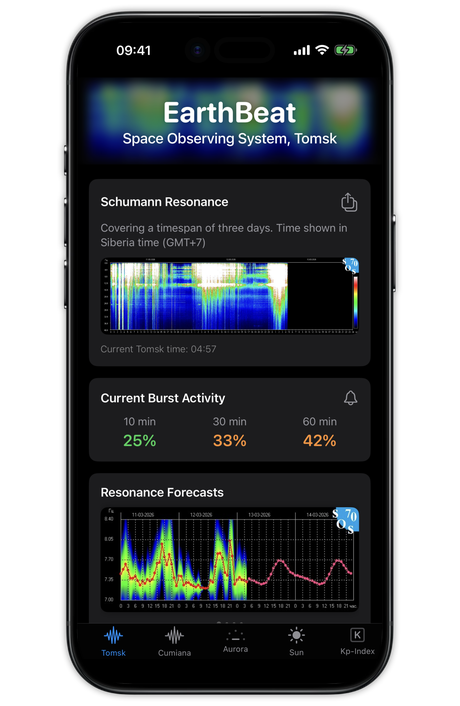
The solar wind is the link between solar activity and its effects at Earth. By monitoring speed, density, and the critical Bz component from the DSCOVR satellite at L1, forecasters can anticipate geomagnetic storms before they arrive. EarthBeat displays these measurements in real time.