Solar Flares
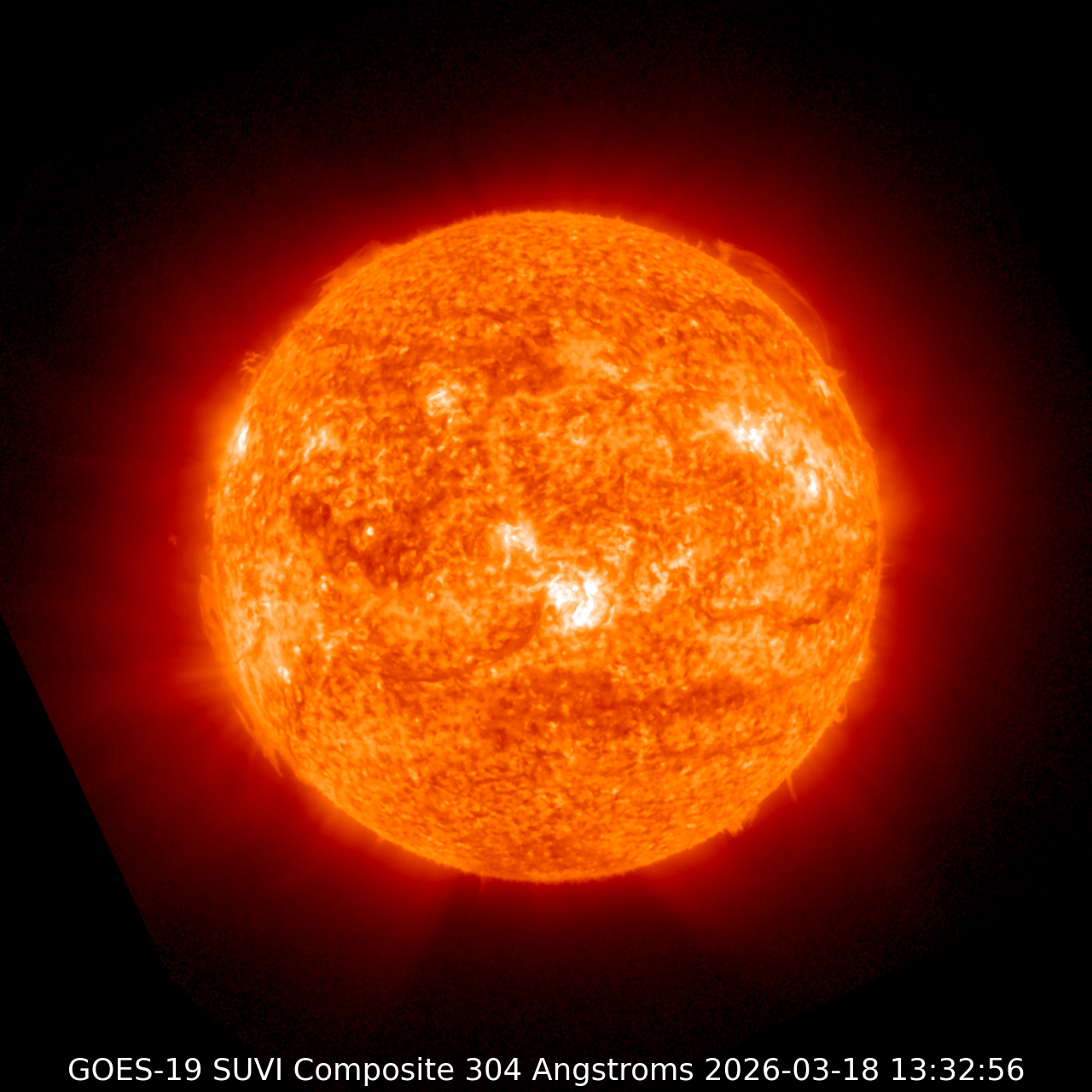
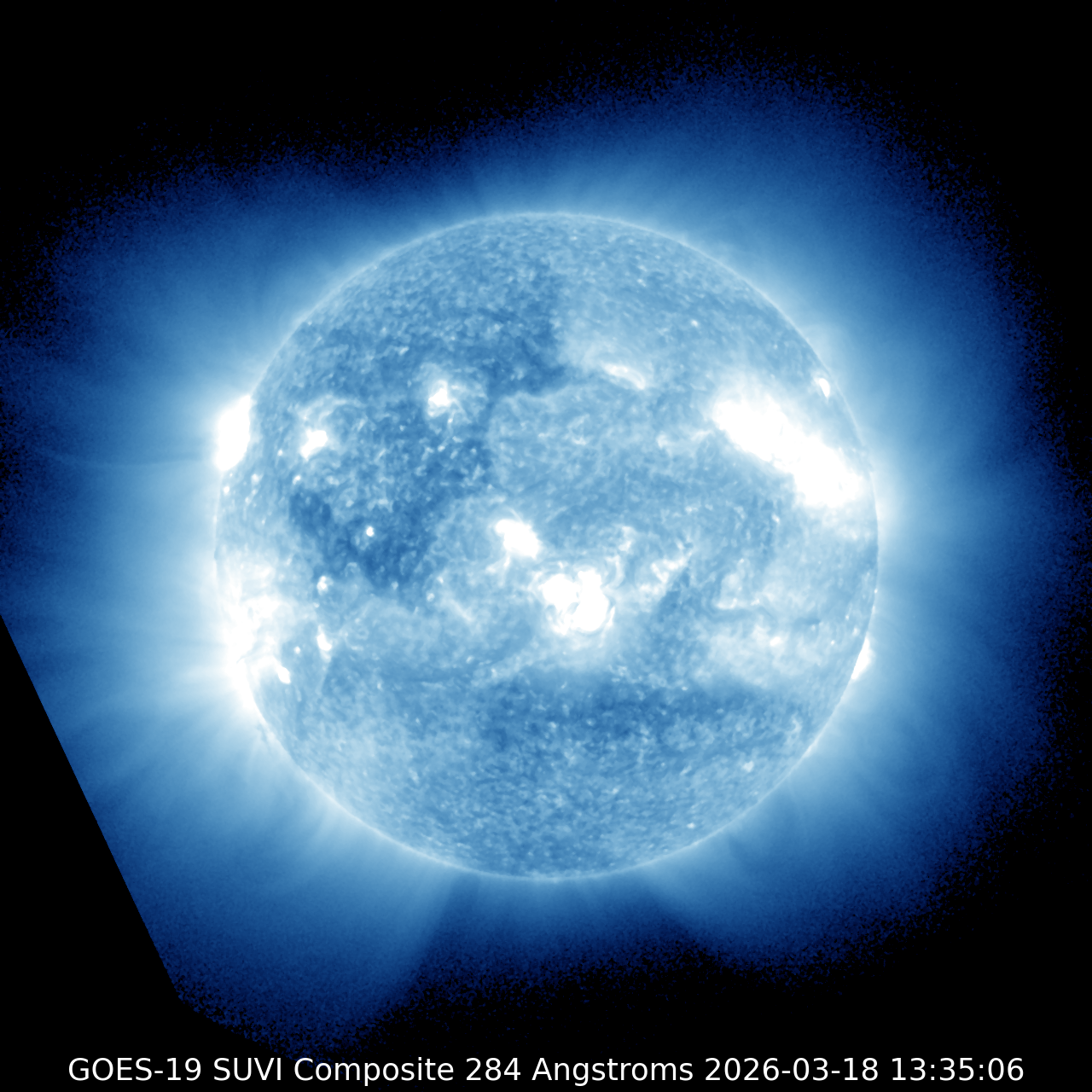
A solar flare is a sudden, intense brightening on the Sun's surface. It happens when magnetic field lines in the corona become twisted to the point of instability, then rapidly reconnect in a process called magnetic reconnection. The energy released in a large flare can equal the explosion of billions of nuclear weapons, all in a matter of minutes.
That energy comes out as radiation across the entire electromagnetic spectrum: radio waves, visible light, ultraviolet, X-rays, and gamma rays. The radiation travels at the speed of light and reaches Earth in about 8 minutes. There is no advance warning for the radiation itself.
Flares are classified by their peak X-ray flux, measured by the GOES satellites in the 0.1-0.8 nm wavelength band:
| Class | Peak Flux (W/m2) | Effect |
|---|---|---|
| A | < 10-7 | Background levels, no impact |
| B | 10-7 to 10-6 | No significant effect |
| C | 10-6 to 10-5 | Minor HF radio degradation on sunlit side |
| M | 10-5 to 10-4 | HF radio blackouts, minor navigation errors |
| X | > 10-4 | Complete HF blackout, GPS degradation, satellite issues |
Each class is ten times stronger than the one before it. An M1 flare produces ten times the X-ray flux of a C1. Within each class, a number from 1.0 to 9.9 gives the precise intensity. The X class has no upper limit. The strongest flare ever recorded was estimated at X45 during the November 2003 Halloween Storms, though the detectors saturated at X28 and the true value had to be reconstructed from other data.
Most flares last between 10 minutes and an hour. Impulsive flares peak quickly and fade fast. Long-duration flares can sustain elevated X-ray output for hours and are more likely to be associated with coronal mass ejections.
Coronal Mass Ejections
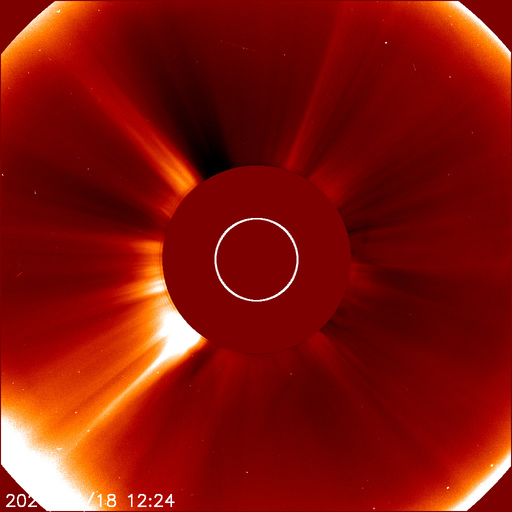
A coronal mass ejection is a different beast entirely. While a flare is a flash of radiation, a CME is a physical eruption. A billion tons or more of magnetized plasma gets launched away from the Sun, carrying its own embedded magnetic field out into the solar system.
CMEs travel slower than light, but faster than the normal solar wind. Speeds range from about 250 km/s for slow events to over 3,000 km/s for the fastest. A typical CME aimed at Earth takes 2-3 days to arrive. The fastest can cover the distance in under 18 hours.
Not every CME hits Earth. The Sun is big and CMEs are directional. A CME launched from the edge of the solar disk will sail harmlessly past us. Only "halo" CMEs, those launched roughly toward (or away from) Earth, show up as an expanding halo around the Sun in coronagraph images.
The reason CMEs matter more than flares for geomagnetic effects is simple: they carry mass and a magnetic field. When a CME's magnetic field is oriented southward (negative Bz), it can connect with Earth's magnetic field through magnetic reconnection and dump enormous energy into the magnetosphere. This is what produces the strongest geomagnetic storms.
The Solar Cycle
The Sun's magnetic field flips polarity roughly every 11 years. This cycle drives the rise and fall of solar activity. At solar minimum, the Sun can go weeks without a sunspot. At solar maximum, large active regions pepper the disk, and M- and X-class flares become common.
We are currently in Solar Cycle 25, which officially began in December 2019. Early predictions suggested it would be a modest cycle, similar to its predecessor. That turned out to be wrong. Activity has consistently run well above the initial forecast, with sunspot numbers and flare counts exceeding predictions by a wide margin.
The cycle count started with Solar Cycle 1 in 1755, based on the systematic sunspot records that began around that time. Numbering is somewhat arbitrary for cycles before modern instrumentation, but the 11-year pattern holds across centuries of data.
Some cycles are stronger than others. Solar Cycle 19, peaking around 1958, was the strongest on record. Solar Cycles 23 and 24 were relatively weak. The current cycle appears to be tracking closer to the stronger end of the historical range.
Solar Energetic Particles
Some solar events accelerate protons and heavier ions to extreme energies. These solar energetic particles (SEPs) can arrive at Earth within minutes to hours after a flare or CME shock, traveling at a significant fraction of the speed of light.
NOAA classifies solar radiation storms on the S1-S5 scale based on the flux of protons with energy above 10 MeV, measured by GOES satellites:
| Scale | Proton Flux (pfu) | Impact |
|---|---|---|
| S1 - Minor | 10 | Minor impact on HF polar radio |
| S2 - Moderate | 100 | Small effects on satellite operations, elevated polar radiation |
| S3 - Strong | 1,000 | Single-event upsets in satellite electronics, radiation hazard for astronauts |
| S4 - Severe | 10,000 | Satellite damage possible, significant radiation risk at aviation altitudes |
| S5 - Extreme | 100,000 | Satellite loss possible, complete HF blackout in polar regions |
The radiation hazard is the most direct threat to humans from space weather. Astronauts outside the magnetosphere, whether on the International Space Station during an EVA or on a future Moon or Mars mission, can receive dangerous doses during strong proton events. Airlines reroute polar flights during S2 or higher events to reduce crew exposure.
One of the largest proton events in the space age occurred in October 1989, when proton flux exceeded 40,000 pfu. More recently, the January 2005 event caused multiple satellite anomalies and triggered aviation reroutes across the polar regions.
Summary
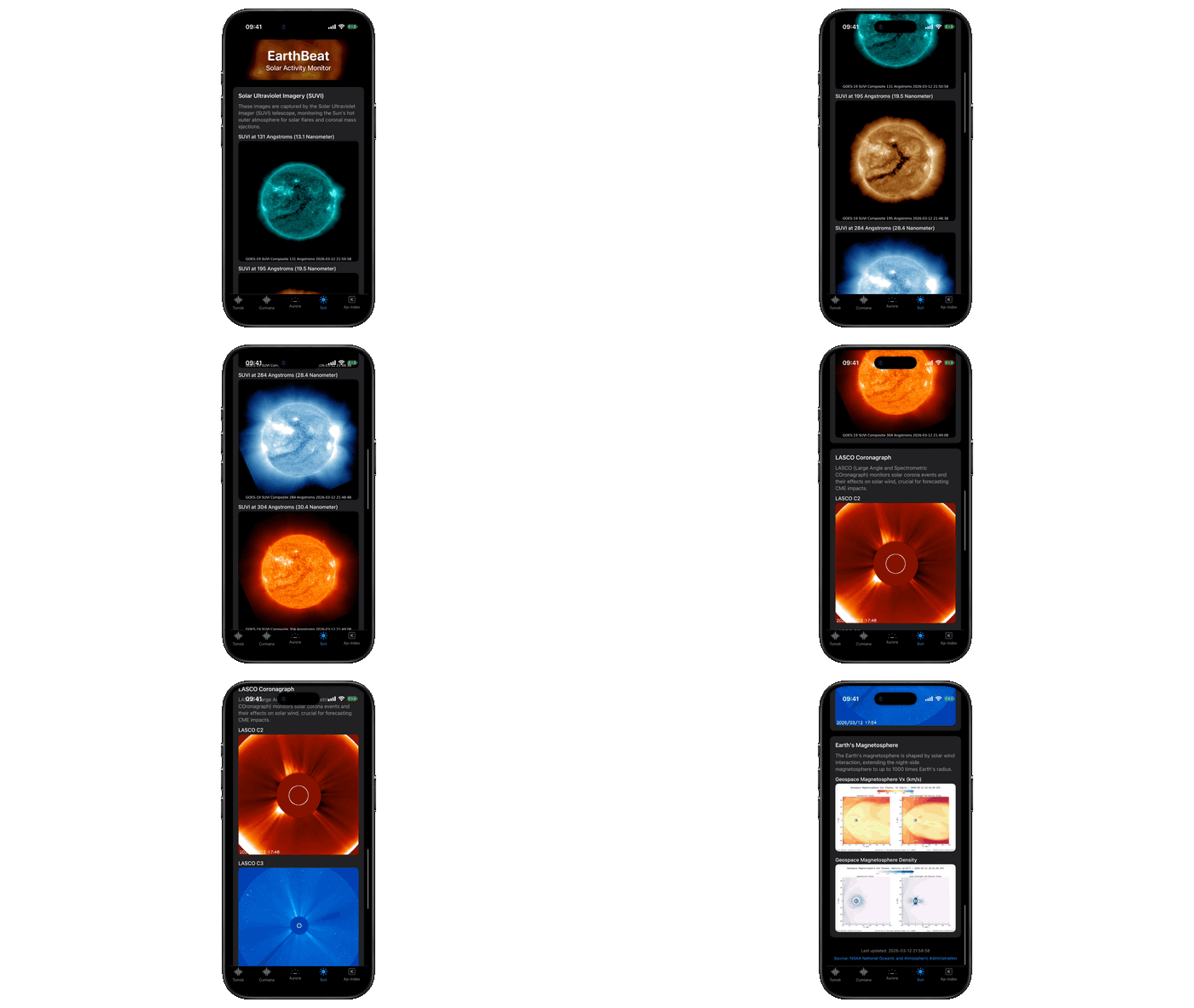
Solar flares, coronal mass ejections, and the solar cycle drive the space weather that affects Earth. Understanding these phenomena helps explain why geomagnetic storms happen and what their effects will be. EarthBeat provides live Sun imagery from NASA SUVI alongside X-ray flux and proton flux measurements.