Winfried Otto Schumann
Winfried Otto Schumann was born on May 20, 1888, in Tubingen, Germany. He studied electrical engineering and physics, eventually becoming a professor at the Technical University of Munich (Technische Universitat Munchen), where he spent most of his career.
Schumann's work covered a broad range of electrical engineering topics - high-voltage technology, wave propagation, and electrical discharges. He was not a geophysicist by training. But his understanding of electromagnetic wave theory gave him the tools to solve a problem that sat at the intersection of physics and Earth science.
By the early 1950s, Schumann was in his sixties and well-established in his field. The question he took on - whether the space between Earth and its ionosphere could support resonant electromagnetic waves - was not entirely new. Others had considered the idea. But Schumann was the first to work through the mathematics rigorously and publish the results.
The 1952 Prediction
Schumann published his key paper in 1952 in Zeitschrift fur Naturforschung (Journal for Natural Research), a German scientific journal. The paper laid out the theoretical framework for electromagnetic resonances in the Earth-ionosphere cavity.
His approach treated Earth as a perfect conductor (a reasonable approximation for ELF waves) and the ionosphere as a concentric conducting shell roughly 60-100 km above the surface. Between these two shells, the atmosphere acts as a dielectric - an insulating gap.
The mathematics predicted that this cavity should support transverse magnetic (TM) modes at specific frequencies. His initial calculation put the fundamental mode around 10 Hz. Later refinements by Schumann and others, accounting for the finite conductivity of both the ground and the ionosphere, brought the predicted value closer to 7.83 Hz.
Herbert L. Konig, one of Schumann's doctoral students, played an important role in this period. Konig worked on both the theoretical refinements and early attempts at experimental detection. He would go on to become a prominent researcher in ELF phenomena in his own right.
First Measurement
Confirming the prediction proved difficult. The signal is extraordinarily weak - roughly one picotesla in magnetic field strength. To put that in context, Earth's static magnetic field is about 50 microtesla, making the Schumann resonance roughly 50 million times weaker than the field a compass needle responds to.
Several groups attempted measurements in the late 1950s, with mixed results. The breakthrough came in 1960, when Martin Balser and Charles Wagner at MIT Lincoln Laboratory published definitive measurements confirming the Schumann resonances. Using highly sensitive receivers and careful signal processing techniques, they identified the fundamental mode and several harmonics.
Their success came down to instrumentation. Balser and Wagner used large induction coil antennas with high-permeability cores, installed in electromagnetically quiet locations. They combined long integration times with spectral analysis to pull the Schumann resonance out of the noise. By 1962, multiple groups had independently confirmed their results.
Evolution of Measurement
The early decades of Schumann resonance research relied on analog equipment. Recordings were made on magnetic tape, and spectral analysis required physical spectrum analyzers or laborious manual computation. Data collection was intermittent - a few hours or days at a time, often limited by equipment availability and site access.
The shift to digital acquisition in the 1980s and 1990s changed everything. Digital systems could record continuously, with higher dynamic range and lower noise floors than analog equipment. Perhaps more importantly, digital data could be processed algorithmically - opening the door to automated, real-time monitoring.
Sensor technology also improved. Modern induction coils are more sensitive and more stable than their predecessors. Some stations use SQUID magnetometers (superconducting quantum interference devices), which can detect magnetic fields orders of magnitude weaker than conventional coils, though these are expensive and require cryogenic cooling.
The development of the internet made another transformation possible: global data sharing. A station in Siberia could now contribute data to a research group in Europe or North America within minutes. This enabled studies of the Schumann resonance as a truly global phenomenon, rather than a local measurement at a single site.
Modern Monitoring
Today, several stations around the world maintain continuous Schumann resonance monitoring. The data they produce is orders of magnitude richer than what Balser and Wagner captured in 1960.
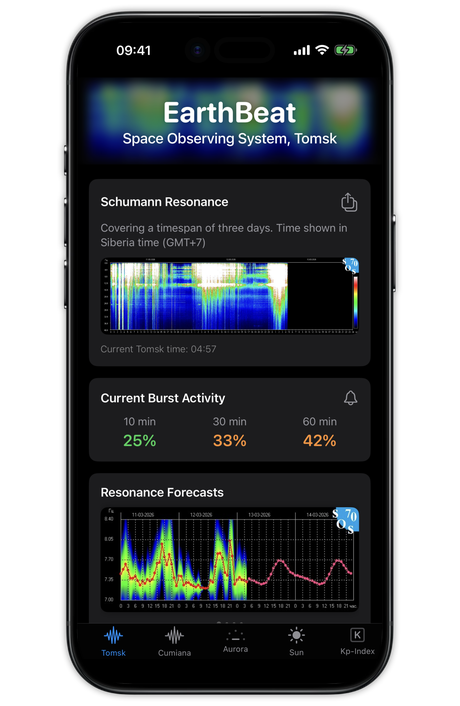
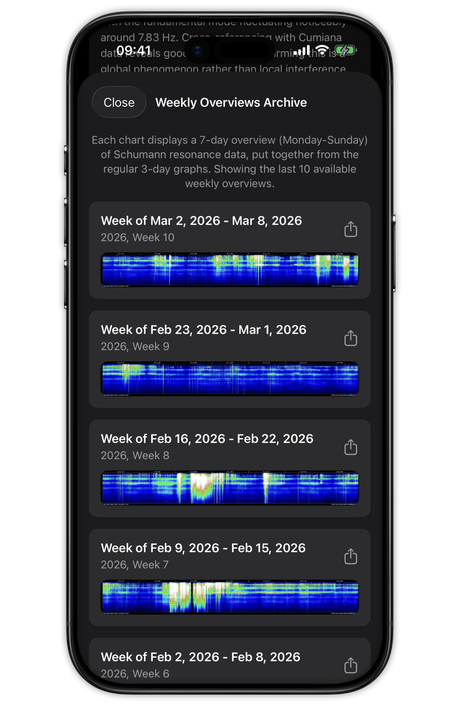
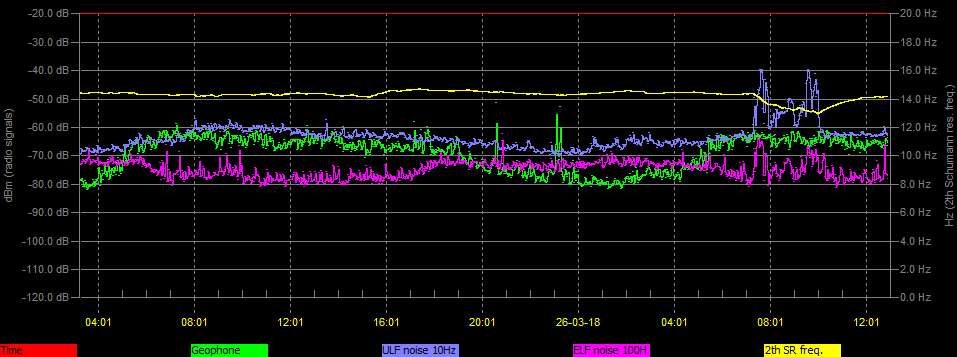
The Tomsk Space Observing System (SOS) at Tomsk State University in Russia is one of the most widely referenced sources. It produces real-time spectrograms covering frequency, amplitude, quality factor, and electromagnetic background. These spectrograms update continuously and are publicly accessible - they are the primary data source for the EarthBeat app.
The Nagycenk Observatory in Hungary has one of the longest continuous Schumann resonance datasets in existence. Operated by the Geodetic and Geophysical Institute of the Hungarian Academy of Sciences, its records extend back decades and have been used in numerous studies of long-term trends.
Other active monitoring stations include facilities in Israel (Tel Aviv University), Japan (Moshiri and Onagawa), India (Agra), and the United States (various university and private installations). Together, these stations provide near-global coverage.
Modern spectrograms display three parameters for each harmonic mode:
- Frequency - the center frequency of the resonance peak, typically within a few tenths of a hertz of the nominal values
- Amplitude - the strength of the signal at that mode, measured in picotesla
- Quality factor (Q) - a measure of how sharp the resonance peak is, which reflects the cavity's energy loss characteristics
These three parameters together tell a complete story about the state of the Earth-ionosphere cavity at any given moment. Changes in any of them carry information about lightning activity, ionospheric conditions, and solar influences.
Summary
From Schumann's theoretical prediction in 1952 to today's global digital monitoring networks, the study of Earth-ionosphere cavity resonances has grown from a mathematical curiosity into a window on global electromagnetic activity. EarthBeat continues this tradition by making the data accessible to everyone.