Why People Watch the GCP
The appeal is philosophical as much as scientific. Does collective attention leave a trace? Can the focused awareness of millions of people nudge physical reality in a measurable way? These are old questions dressed in new technology.
For many, the GCP dot is a daily ritual. A glance at the screen before meditation. A check during a major news event. A quiet curiosity about whether tonight's mass prayer or tomorrow's global celebration will register on a network of machines that are supposed to produce nothing but noise.
The dot does not give you answers. It gives you a data point. What you make of it depends on what you bring to it.
Some people track it for years and find patterns that feel meaningful. Others track it and find randomness. Both responses are honest. The GCP has always been more about the question than the answer.
Group Meditation and the GCP
Meditation communities around the world have developed a practice of tracking GCP data during collective sessions. The idea is simple: if focused group intention can influence random processes, then a synchronized meditation involving thousands of participants might produce a visible shift.
Some organized meditation events have coincided with notable deviations in GCP data. The Global Peace Meditation events and the annual Unify Global gatherings are examples that practitioners frequently cite. Not every session produces a visible effect. Some show nothing unusual at all.
These observations are anecdotal from a scientific standpoint. The GCP team has analyzed some large meditation events formally, with pre-registered hypotheses, and the results are mixed. But for practitioners, the experience of meditating while watching the dot shift carries its own weight, regardless of what a formal analysis concludes.
There is something worth saying here about expectation. If you sit down to meditate hoping to move a dot on a screen, that is a different practice from sitting down to meditate. Most experienced teachers would point out the difference. The GCP is best treated as a companion to practice, not a scorecard for it.
The Question Is the Point
For the awareness community, the GCP's value does not depend on a definitive scientific verdict. The project asks a question that matters to people who take consciousness seriously: are we connected in ways that go beyond the obvious?
That question predates the GCP by millennia. Contemplative traditions across cultures have described something like a shared field of awareness. The GCP does not prove those traditions right. But it provides a modern frame for an ancient intuition, one that uses data instead of doctrine.
Holding space for unanswered questions is itself a practice. The willingness to sit with uncertainty, to observe without forcing conclusions, to stay curious - these are skills that both meditation and science share, even when they disagree about what counts as evidence.
The GCP dot is, in the end, a mirror. It shows you randomness, or it shows you something more. Your relationship with that ambiguity says as much about you as it does about the data.
Using EarthBeat to Follow the GCP
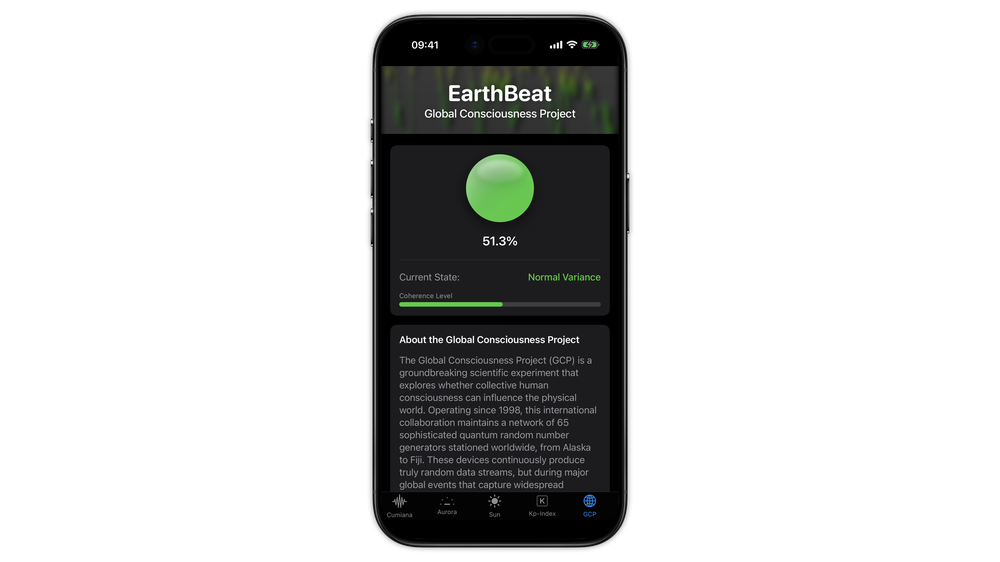
The 3D GCP dot in EarthBeat updates in real time. It pulls data from the global network and renders it as a color-shifting sphere that responds to changes in network variance.
Green means the generators are producing output close to what pure chance would predict. Yellow means moderate deviation. Red means the network has moved significantly away from expected randomness.
You can track it during meditation. You can check it during major world events. You can glance at it first thing in the morning as part of your daily awareness practice. Some users keep a journal of what they observe and how it correlates with their inner state or with events in the world.
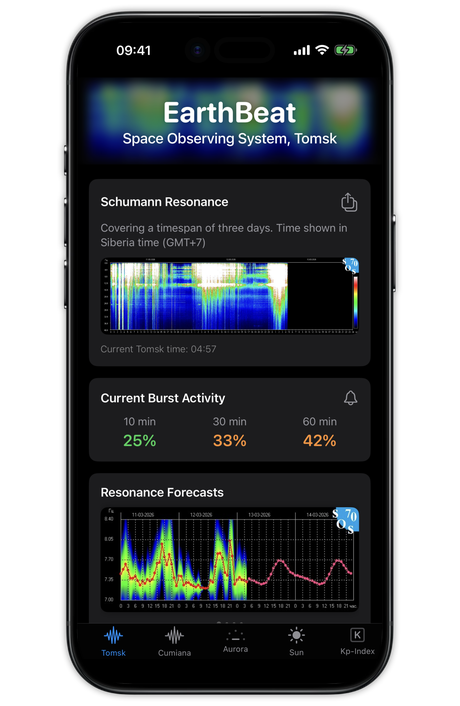
EarthBeat places the GCP dot alongside the Schumann resonance spectrogram and space weather data. Together, these signals give you a picture of Earth's activity from multiple angles: electromagnetic, geomagnetic, and statistical.