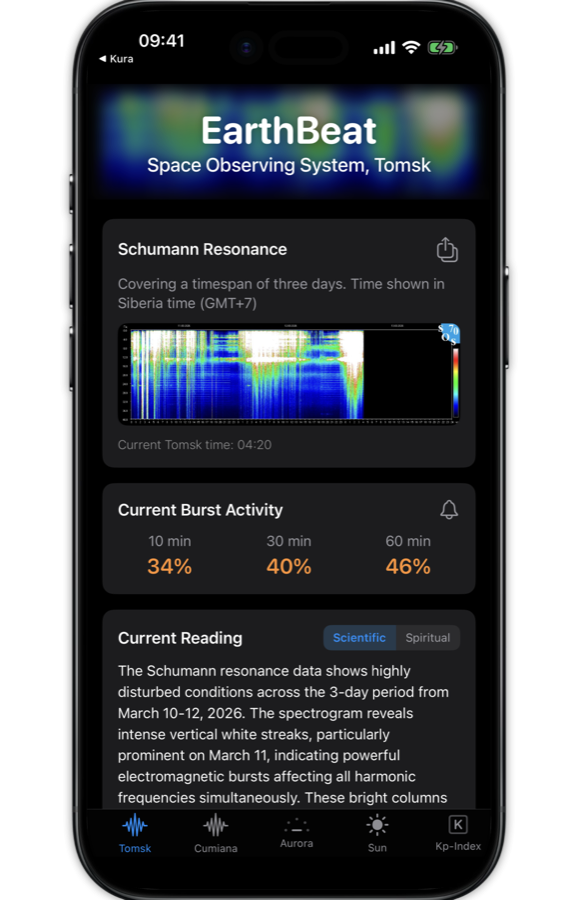
Live Spectrogram
Current Schumann Resonance from Tomsk Observatory
The spectrogram below shows the last three days of Schumann resonance activity as measured by the Tomsk Space Observing System (sos70.ru) in Russia. Bright areas indicate higher electromagnetic energy at specific frequencies.
Tomsk Space Observing System — updates every 5 minutes • Last reading: 2026-03-15 16:00 UTC
Understanding
What Is the Schumann Resonance?
The Schumann resonance is a set of peaks in the extremely low frequency (ELF) portion of Earth's electromagnetic spectrum. These resonances are generated by approximately 2,000 thunderstorms active around the planet at any given moment, producing roughly 50 lightning strikes per second. The electromagnetic waves created by these discharges travel around the Earth in the cavity between the surface and the ionosphere.
Named after German physicist Winfried Otto Schumann, who predicted them mathematically in 1952, these resonances were first measured in 1954. The fundamental frequency of approximately 7.83 Hz is often referred to as "Earth's heartbeat" or "Earth's electromagnetic pulse."
The Schumann Resonance Harmonics
The Schumann resonance doesn't exist at just one frequency. Like musical overtones, it produces a series of harmonics, each with its own characteristic frequency, amplitude, and quality factor:
| Harmonic | Frequency | Description |
|---|---|---|
| 1st (Fundamental) | ~7.83 Hz | The primary Schumann resonance, "Earth's heartbeat" |
| 2nd Harmonic | ~14.3 Hz | Falls within the beta brainwave range |
| 3rd Harmonic | ~20.8 Hz | Upper beta brainwave range |
| 4th Harmonic | ~27.3 Hz | Gamma brainwave range |
| 5th Harmonic | ~33.8 Hz | Higher gamma brainwave range |
Why Does the Frequency Change?
The 7.83 Hz figure is an average. In reality, the fundamental frequency fluctuates between approximately 7.5 Hz and 8.1 Hz throughout the day. These variations are driven by changes in the ionosphere's height and conductivity, which are influenced by:
Solar activity — Solar flares and coronal mass ejections (CMEs) compress the ionosphere, altering the cavity size and resonance characteristics. Global lightning distribution — As the Earth rotates, different thunderstorm centers (Africa, South America, Southeast Asia) dominate, shifting the resonance pattern. Seasonal changes — Ionospheric conditions vary with seasons, creating subtle long-term frequency shifts.
Schumann Resonance and Human Consciousness
Many observers note connections between Schumann resonance activity and collective human consciousness. The fundamental frequency at 7.83 Hz sits at the boundary between the theta (4-8 Hz) and alpha (8-12 Hz) brainwave ranges — states associated with deep relaxation, meditation, and heightened awareness.
While scientific research into these correlations continues, some studies have explored links between geomagnetic activity and human behavior, sleep quality, and cardiovascular health. The Global Consciousness Project (GCP), which EarthBeat also tracks, examines potential relationships between global events and patterns in random number generators worldwide.
View the combined Earth Pulse dashboard → - see the live status card combining Schumann resonance, Kp index, solar wind, and GCP data in a single visualization.
The App
Monitor Everything with EarthBeat
One app for Schumann resonance, space weather, aurora forecasts, and global consciousness data. Available for iOS, with Android in beta.
Live Schumann Resonance
Real-time data from Tomsk and Cumiana observatories. Spectrogram, frequency, amplitude, quality factor, and electromagnetic background. Tap any graph for full-screen with pinch-to-zoom.
Space Weather Dashboard
Kp-index monitoring with forecasts, solar wind speed, IMF/Bz data, X-ray flux from GOES satellites, and proton flux levels. All the key space weather indices in one view.
Aurora Forecast & Map
Real-time aurora prediction with full map view. Track northern and southern lights visibility based on Kp-index and geomagnetic conditions. Never miss an aurora event.
Customizable Widgets
Home Screen, Lock Screen, and Control Center widgets in multiple sizes. Tomsk data, aurora forecast, live Sun images from NASA, and GCP consciousness indicator.
AI Current Reading Pro
Scientific and spiritual analysis of current Schumann resonance activity, updated every 3 hours. 100-250 word insights in your preferred language.
Burst Notifications Pro
Advanced Tomsk burst analysis (10/30/60 minutes). Get notified when Schumann resonance activity spikes. Custom thresholds and notification preferences.
Global Consciousness Project
Real-time GCP data displayed as a 3D colored indicator reflecting worldwide consciousness patterns from the Princeton-based research network.
Share Cards
Share beautiful social cards of the current EarthBeat status in dark or light theme. Pro subscribers can generate cards in all 9 supported languages.
Weekly Overview Pro
Weekly Schumann resonance overview with sharing capability and 10-week archive. Track patterns over time and identify recurring trends.
Available in English, German, Portuguese, Spanish, French, Italian, Simplified Chinese, Japanese, and Russian.
Android version Beta coming soon.
See It in Action
Beautiful Widgets, Aurora Maps, and Space Weather
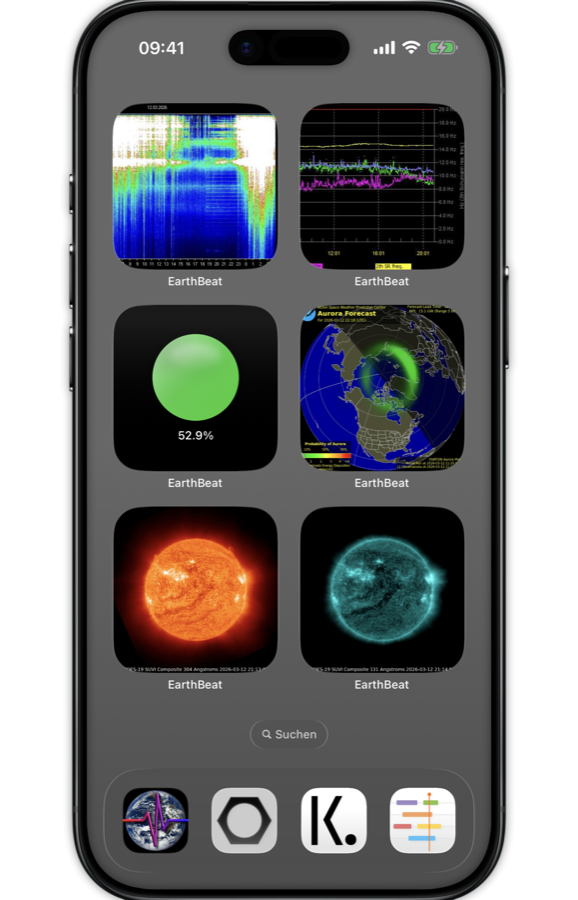
Home Screen Widgets
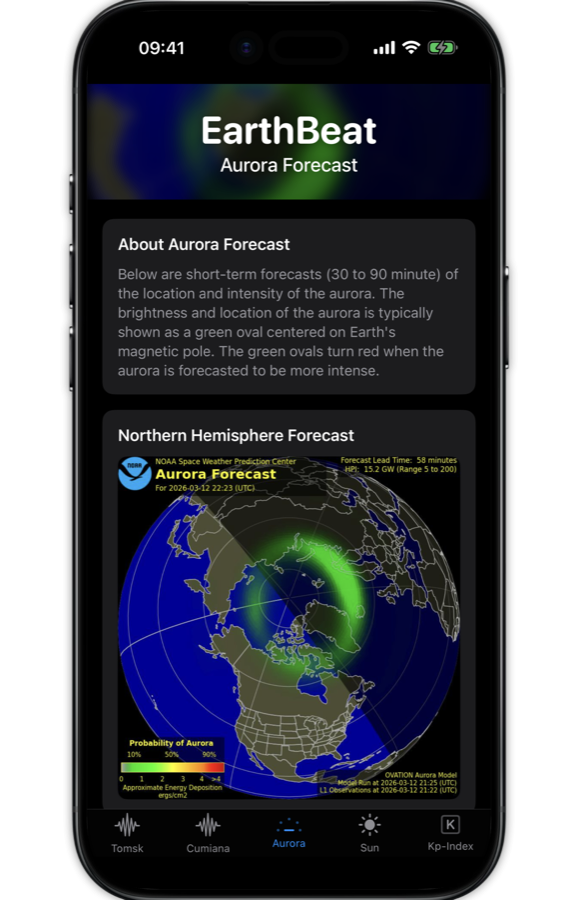
Aurora Forecast Map
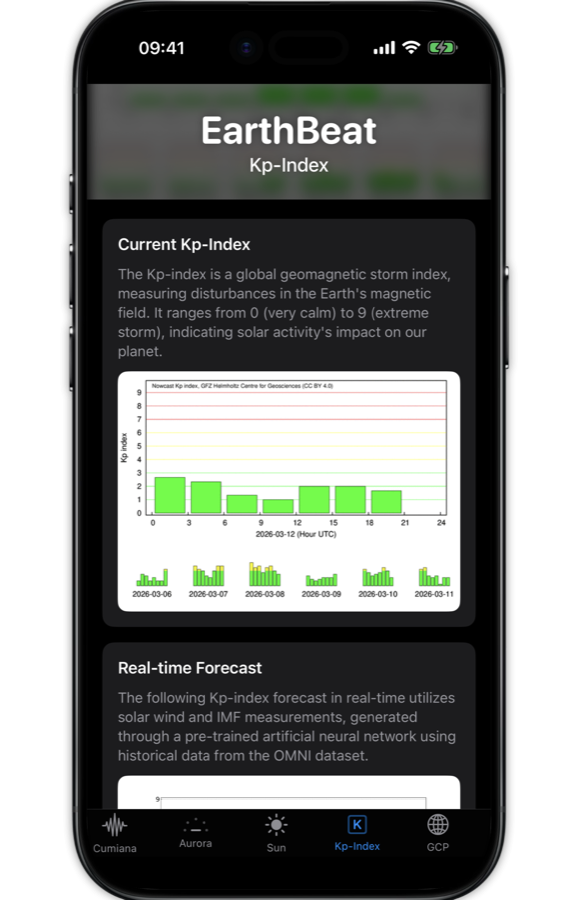
Kp-Index & Space Weather
Frequently Asked Questions
What is the Schumann resonance?
The Schumann resonance is a set of electromagnetic frequencies generated by lightning discharges in the cavity between Earth's surface and the ionosphere. The fundamental frequency is approximately 7.83 Hz, often called Earth's electromagnetic heartbeat. It was first predicted by physicist Winfried Otto Schumann in 1952 and confirmed experimentally in 1954.
What is the normal Schumann resonance frequency?
The fundamental Schumann resonance frequency is approximately 7.83 Hz, but it naturally fluctuates between about 7.5 Hz and 8.1 Hz throughout the day. Higher harmonics occur at approximately 14.3, 20.8, 27.3, and 33.8 Hz. These variations are influenced by solar activity, ionospheric conditions, and global lightning patterns.
What causes Schumann resonance spikes?
Schumann resonance spikes (also called bursts) are caused by intense lightning activity, solar flares, coronal mass ejections, and geomagnetic storms. Approximately 2,000 thunderstorms are active around Earth at any time, producing about 50 lightning strikes per second. When this activity intensifies or when solar events disturb the ionosphere, the Schumann resonance amplitude increases.
How can I monitor the Schumann resonance?
You can monitor the Schumann resonance using the EarthBeat app for iOS, which provides real-time data from the Tomsk and Cumiana observatories. The app includes a live spectrogram, frequency charts, amplitude readings, and customizable widgets for your Home Screen and Lock Screen. An Android version is currently in beta testing.
Does the Schumann resonance affect humans?
Research into the relationship between Schumann resonance and human health is ongoing. The 7.83 Hz fundamental frequency falls within the alpha brainwave range (8-12 Hz), which is associated with relaxation and meditation. Some researchers report correlations between Schumann resonance activity and changes in sleep patterns, mood, and cognitive function, though scientific consensus on direct effects has not been established.
What is the Kp-index and how does it relate to the Schumann resonance?
The Kp-index measures geomagnetic activity on a scale of 0-9. Higher Kp values indicate stronger geomagnetic storms, which can influence the Schumann resonance by altering ionospheric conditions. A Kp of 5 or higher indicates a geomagnetic storm and often correlates with visible aurora activity. EarthBeat tracks both the Kp-index and Schumann resonance simultaneously.
Start Monitoring Earth's Heartbeat
Download EarthBeat on the App Store. Track Schumann resonance, space weather, and aurora forecasts from your pocket.

Or get a free daily snapshot on Telegram:
Open Schumann Resonance Bot