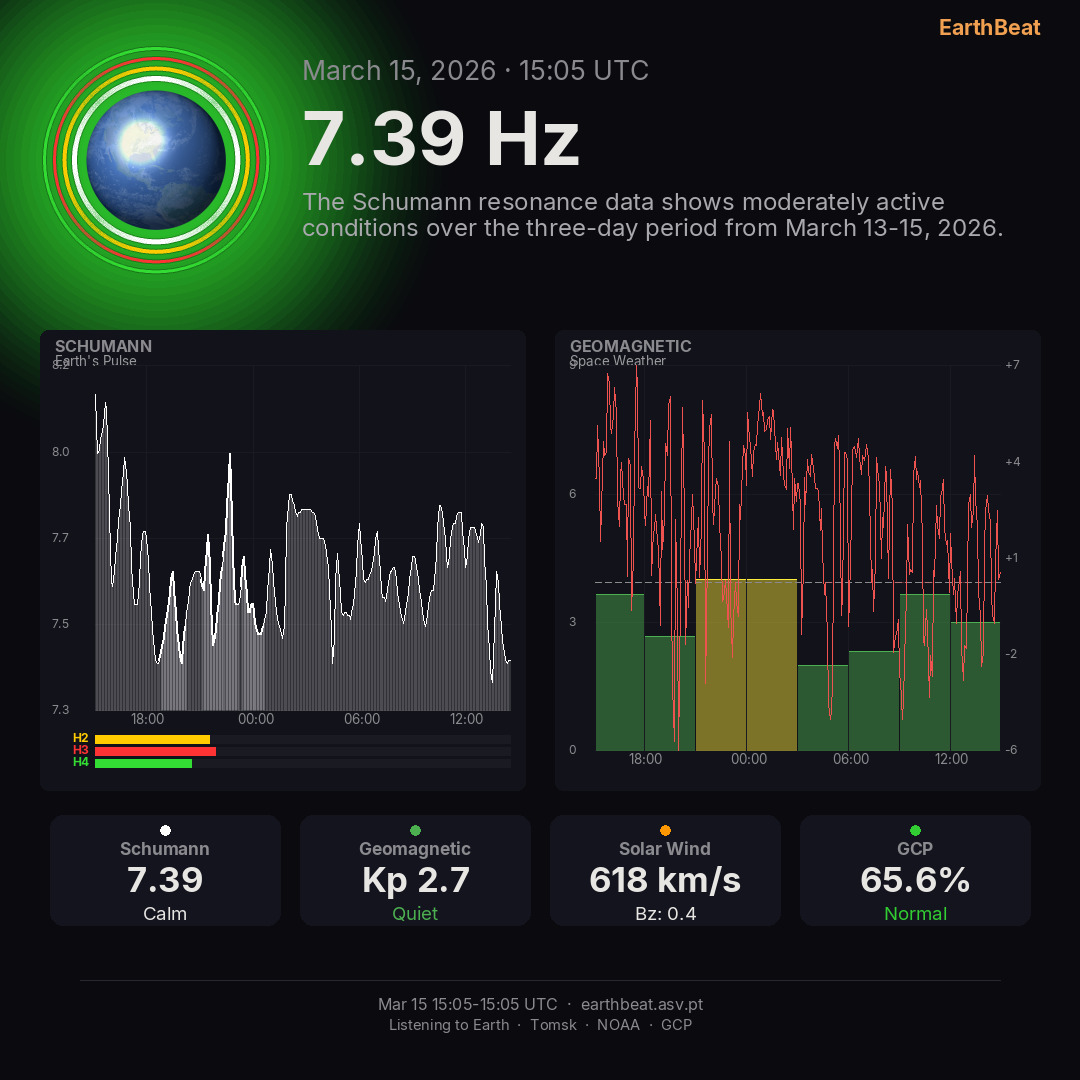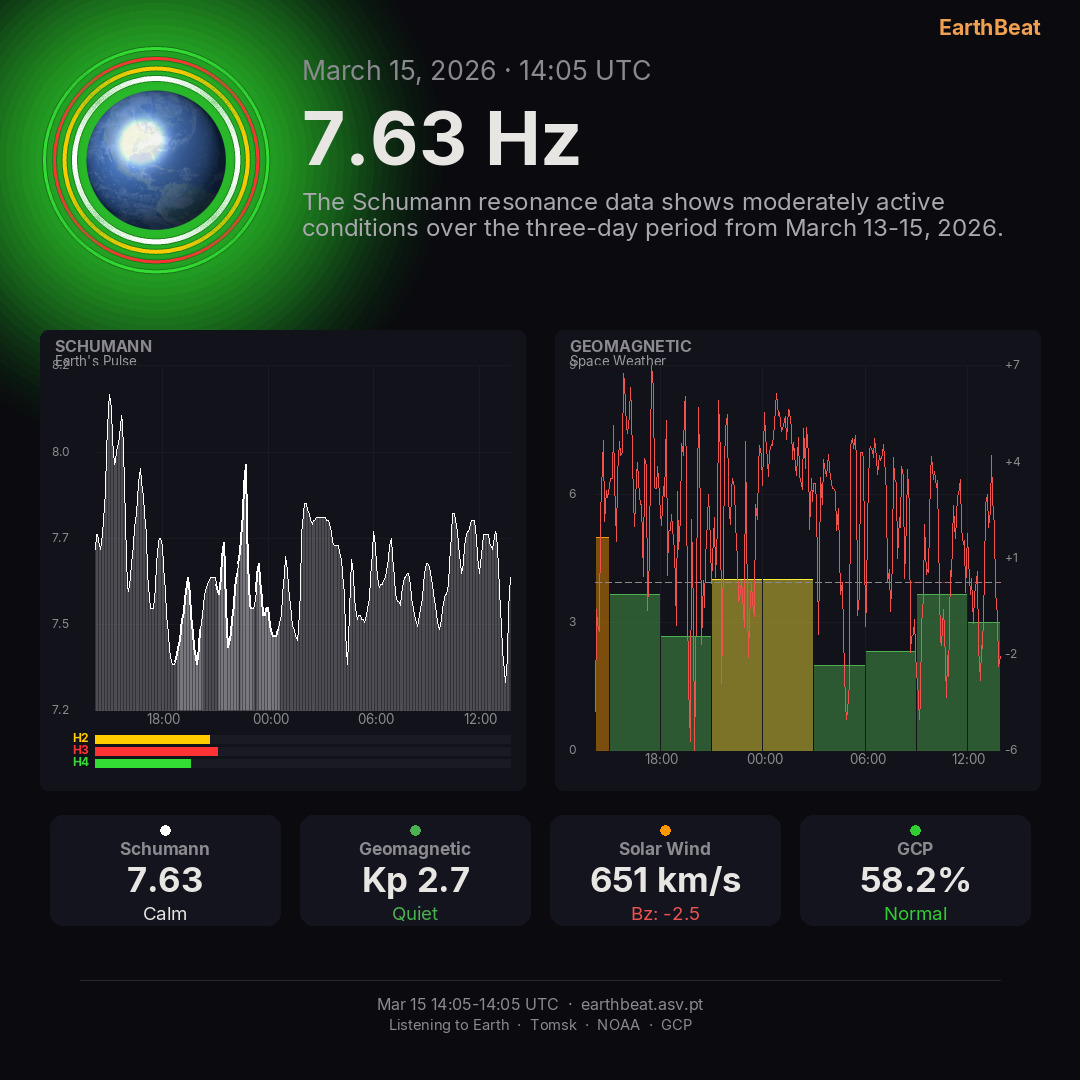
Last updated: 14:00 UTC · Latest reading: 2026-03-15 14:15 UTC
A real-time snapshot of our planet's electromagnetic and geomagnetic state, updated every hour.
Understanding
The EarthBeat status card packs a full picture of Earth's electromagnetic and geomagnetic state into a single image. Here's what each element means.
The central orb is a visual summary of current conditions. Its base color reflects the Kp geomagnetic index: green for quiet (Kp 0-3), yellow for unsettled (Kp 4), orange for minor storm (Kp 5-6), and red for severe storm (Kp 7+).
The glow around the orb comes from the Global Consciousness Project status - a network of random number generators that tracks patterns in collective human attention. The harmonic rings around the orb vary in thickness based on the current Schumann resonance harmonic amplitudes.
Below the orb, the current fundamental Schumann frequency (H1) is displayed prominently. The typical value is around 7.83 Hz - deviations above or below can indicate unusual ionospheric activity. The AI summary provides a brief interpretation of current conditions, generated every 3 hours by analyzing the combined data.
The top chart shows the fundamental frequency (F1) over the past 24 hours as a line whose thickness varies with amplitude - thicker segments indicate stronger resonance activity. Below the main line, colored bars show the H2, H3, and H4 harmonics, giving you a quick visual of activity across all tracked frequency bands. Want to see the raw spectrogram? View the live Tomsk spectrogram.
The bottom chart shows Kp index bars (3-hourly, color-coded from green to red) alongside a Bz line showing the north-south component of the Interplanetary Magnetic Field. A dashed zero line helps you see when Bz turns negative - which is when Earth's magnetic field becomes more vulnerable to solar wind energy transfer.
Four indicator pills at the bottom show the current state at a glance:
Each pill has a colored dot: green for normal/quiet, yellow for elevated, orange for active, and red for extreme conditions.
The card footer shows the time range covered (24 hours ending at the generation time) and credits the data sources: Tomsk Observatory for Schumann resonance, NOAA SWPC for space weather, and the Global Consciousness Project.
Wellness
The Schumann resonance's fundamental frequency of 7.83 Hz sits at the boundary between alpha and theta brainwave states. Alpha waves (8-12 Hz) are associated with calm, relaxed awareness, while theta waves (4-8 Hz) are linked to deep meditation, creativity, and the transition between waking and sleep. This overlap has led many researchers and wellness practitioners to explore whether Earth's electromagnetic heartbeat may influence human consciousness.
During periods of elevated Schumann resonance activity - often triggered by intense lightning, solar flares, or geomagnetic storms - many people report experiencing:
These experiences are widely reported in the Schumann resonance community, and some scientific studies have found correlations between geomagnetic activity and human physiology. However, direct causal mechanisms are not yet established. Research is ongoing, and individual experiences vary significantly.
The Global Consciousness Project (GCP), originally based at Princeton University, operates a network of random number generators (RNGs) placed around the world. The hypothesis is that during events of shared human attention - such as natural disasters, celebrations, or moments of collective focus - these normally random outputs may show subtle but statistically significant deviations from randomness.
The dot on the EarthBeat status card reflects the current GCP network variance. While the interpretation of GCP data remains a subject of scientific debate, the project provides a unique and thought-provoking data stream that complements the more established geophysical measurements.
Some wellness practitioners advocate for earthing or grounding - direct physical contact with the Earth's surface - as a way to connect with Earth's natural electromagnetic field. While the scientific evidence for specific health claims is limited, spending time outdoors and being mindful of natural rhythms is generally recognized as beneficial for mental health and wellbeing.
Whether you track the Schumann resonance from scientific curiosity, personal wellness awareness, or spiritual practice, the EarthBeat status card gives you a window into the invisible electromagnetic environment we all share.
Sources
The EarthBeat status card draws from three independent scientific data streams, each tracking a different aspect of Earth's electromagnetic environment.
The Space Observing System (sos70.ru) in Tomsk, Russia monitors the Schumann resonance with specialized ELF receivers. Data is captured in 5-minute intervals, measuring frequency, amplitude, and quality factor across four harmonics.
The Space Weather Prediction Center provides real-time Kp geomagnetic index, solar wind speed and density, IMF Bz, X-ray flux from GOES satellites, and proton flux measurements. The DSCOVR satellite at the L1 point provides upstream solar wind data.
A network of random number generators distributed worldwide at global-mind.org. The project continuously monitors for patterns in randomness that may correlate with events of shared human attention and awareness.



Get a free daily snapshot of the Schumann resonance spectrogram delivered straight to your Telegram. No app needed.
Open Schumann Resonance BotThe Earth Pulse card combines four data sources into a single visualization: the Schumann resonance frequency and amplitude from Tomsk Observatory, the Kp geomagnetic index and solar wind data from NOAA, and Global Consciousness Project status. The central orb changes color based on geomagnetic activity, while charts show 24-hour trends.
The EarthBeat status card is regenerated every hour with the latest data. The Schumann resonance data updates every 5 minutes from the Tomsk Observatory, while space weather data from NOAA updates every 1-5 minutes. The card captures a snapshot of all current values at generation time.
The orb's base color reflects the Kp geomagnetic index: green for quiet conditions (Kp 0-3), yellow for unsettled (Kp 4), orange for minor storm (Kp 5-6), and red for severe storm (Kp 7+). The glow around the orb reflects the Global Consciousness Project status, and the ring thickness corresponds to Schumann resonance harmonic amplitudes.
Many people report experiencing changes during periods of elevated Schumann resonance activity, including disrupted sleep, vivid dreams, fatigue, mood shifts, and headaches. The fundamental frequency of 7.83 Hz sits at the alpha-theta brainwave boundary. While scientific research into direct causal effects is ongoing, several studies have explored correlations between geomagnetic activity and human physiology.
Bz is the north-south component of the Interplanetary Magnetic Field (IMF) measured by the DSCOVR satellite. When Bz turns negative (southward), it can connect with Earth's magnetic field and transfer energy into our magnetosphere, potentially triggering geomagnetic storms and aurora. Sustained negative Bz below -10 nT often leads to visible aurora at mid-latitudes.
The Global Consciousness Project (GCP) operates a network of random number generators worldwide. The hypothesis is that collective human attention during major events correlates with non-random patterns in the data. The dot on the card shows the current GCP network variance: blue indicates increased coherence, green is normal, and yellow or red suggest heightened network activity.
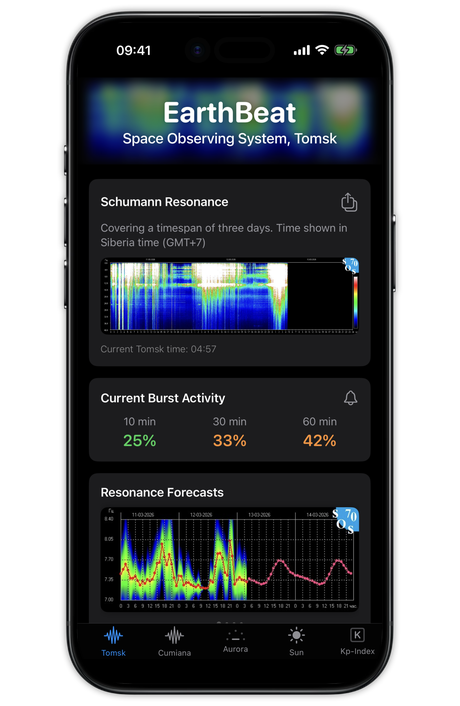
Yes - EarthBeat is a comprehensive iOS app that monitors the Schumann resonance in real-time from two observatories (Tomsk and Cumiana), along with space weather data, aurora forecasts, and Global Consciousness Project status. It includes Home Screen and Lock Screen widgets, AI-powered daily insights, and push notifications for burst activity. Download it from the App Store.